



Designing and implementing a new model for procurement requires sophisticated project management, substantive changes to policies and processes, new designs for organizational structure, robust change management, enabling technologies, and more. Coordinating all of these activities can quickly become messy and overwhelming if it is not carefully planned and orchestrated.
This article draws on insights from ScottMadden (a management consulting firm with expertise in shared services and P2P) to provide an overview and leading practices for structuring procurement transformation.
A Framework for Transforming Procurement
Adopting a new service delivery model for procurement is a significant transformation that typically includes five broad stages:
- Assessment of the current state process
- Design of an ideal future state process
- Implementation
- Stabilization
- Continuous Improvement
It’s important not to ignore later stages of the transformation. As ScottMadden Partner and Supply Chain Co-Lead Trey Robinson points out, “stabilization is often overlooked, but you should expect to take some time after implementation for the processes and technologies to stabilize.” Continuous improvement is also vital for cementing progress and staying responsive to changes in technology or the business environment.
Organizations typically move through these transformation stages in two main phases:
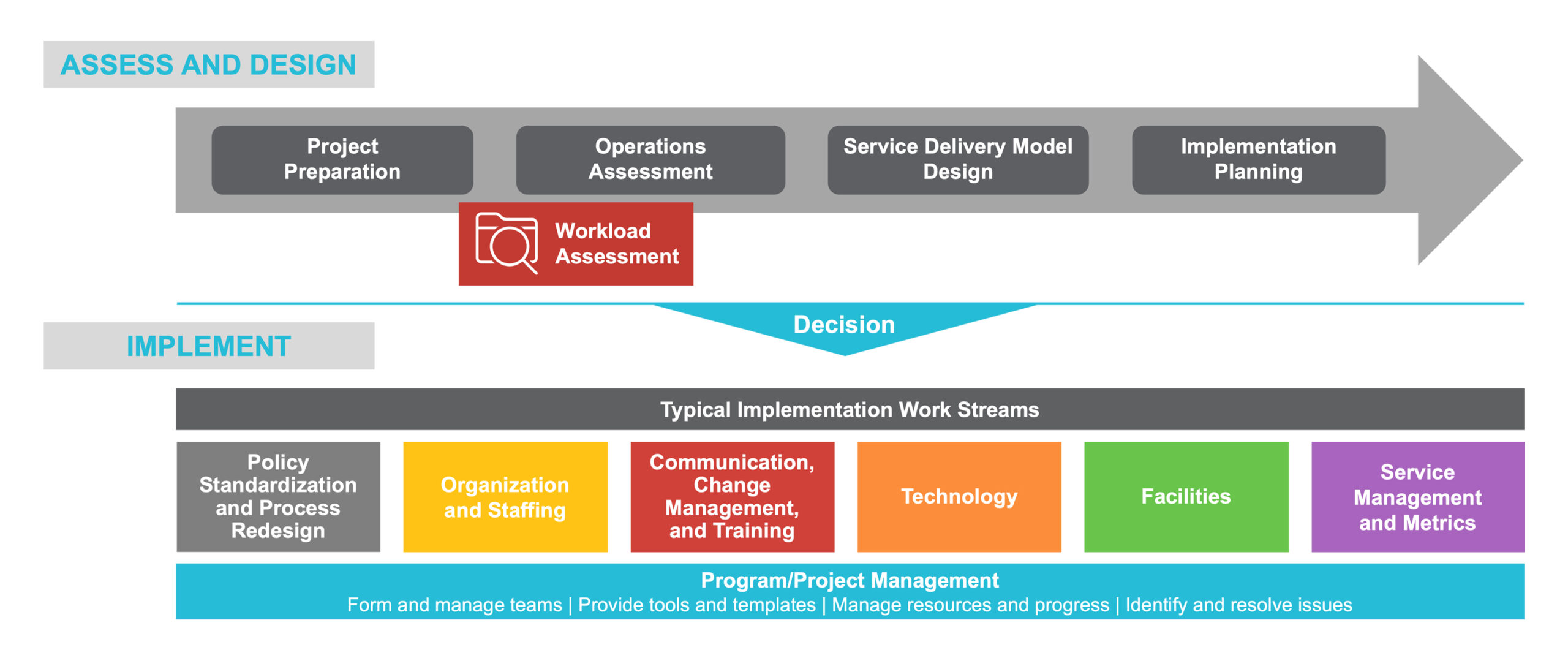
- Assessment and design: A period of preparation, benchmarking, and development
- Implementation brings the design to life. At this stage, organizations select and configure technology, expand or establish shared service centers, train staff, and pilot changes before rolling the transformation out more broadly.
Figure 1 shows the typical approach at a high level.
Typical Approach for Procurement Service Delivery Implementation
Transformation Workstreams
The work of implementing a shared services model typically unfolds across six common workstreams:
- Planning and project management includes the formation of an implementation team, the development of project tools and templates, tracking and reporting on the status of the implementation, and identifying and resolving challenges and risks.
- The policies, procedures, and processes workstream develops an inventory of procurement policies, processes, categories, and taxonomies; documents the current state of procurement; defines requirements for future state processes; and designs the future state.
- Organization and staffing focuses on defining procurement jobs, creating job descriptions, planning selection methods, posting jobs, evaluating candidates, and managing transitions in and out of the workforce.
- Communication, change management, and training works to assess the impact of change on stakeholders, build awareness of change through a communication plan, assess training and education needs, and deliver training and education.
- The technologies workstream evaluates the existing service delivery model and procurement technologies, develops future state requirements, and selects and implements technology.
- If an organization wants to co-locate procurement employees in a new facility, a facilities workstream helps to organize the work of determining requirements for the service center, construction or renovation of facilities, ordering and installing equipment, and developing a business continuity plan.
These workstreams are distinct but closely integrated and often include overlapping team members. For example, people who design the new process are also a good fit to help build training because they understand the underlying activities best.
Transformation Timeline
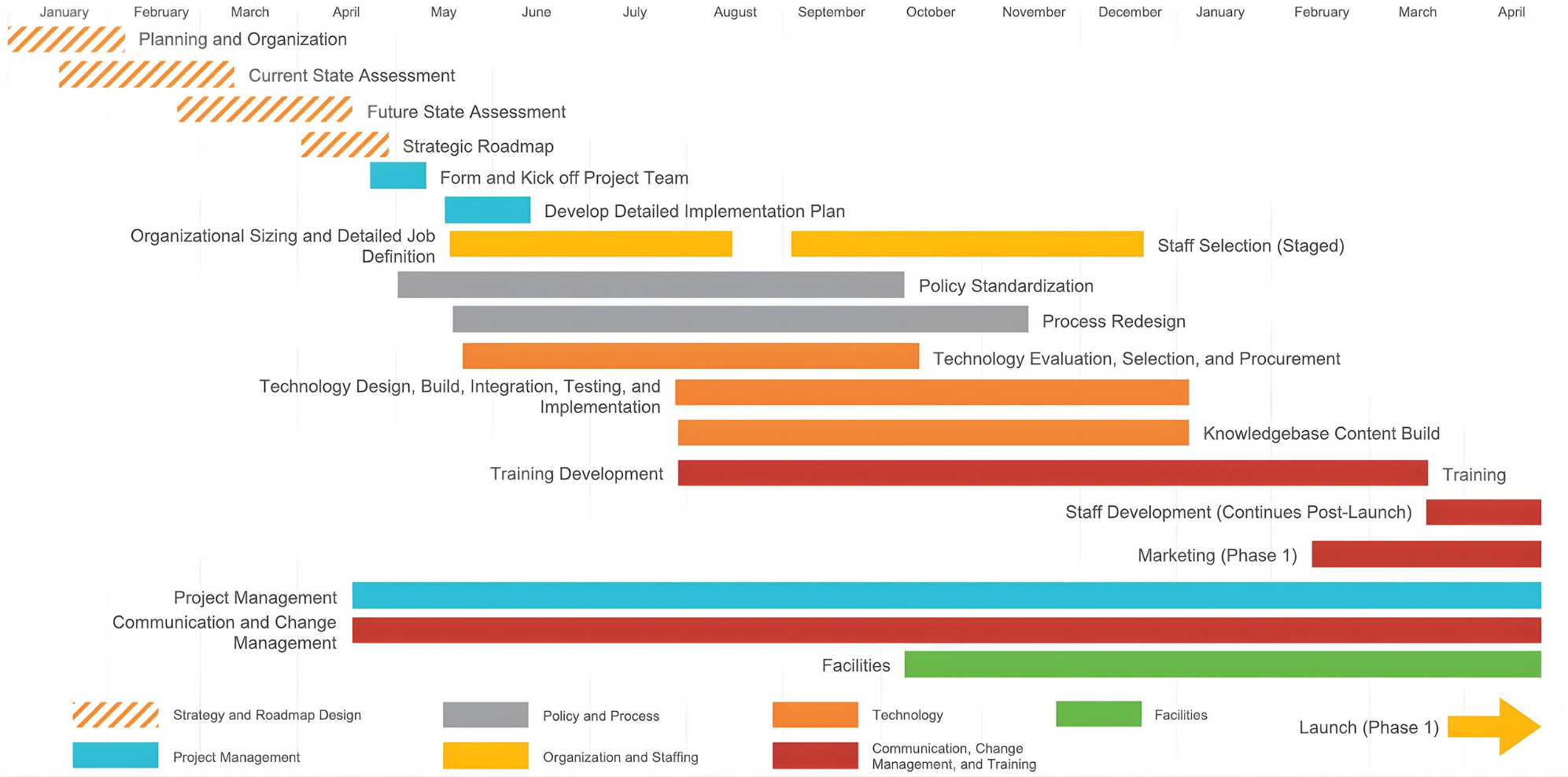
The time it takes to implement a new service delivery model for procurement depends on the size and complexity of the organization. While a typical implementation takes between 12 and 18 months, it could be as short as 9 to 12 months or as long as three or four years.
Figure 2 shows an example of an implementation road map for a large and complex organization. While workstreams like training may carry out work in phases or during specific parts of the transformation, some workstreams like change management should be ongoing throughout the transformation. Robinson shared, “Project management should always be there, and communication and change management never disappear.”
Typical Procurement Service Delivery Model Implementation Timeline
Six Leading Practices for Implementation
The following practices are critical success factors for successful shared services implementation in procurement:
- Involve stakeholders early and often. Identify all stakeholder groups and create detailed plans for each group to ensure adequate communication throughout the transition.
- Make detailed accountabilities clear, by group and role. Define procurement responsibilities by group as part of the creation of a tiered service delivery model. Assign and document individual responsibilities and performance measures at the role level.
- Leverage analytics before, during, and after the transition. Ensure that your assessment fully describes current state procurement metrics and costs to establish a baseline. Provide dashboard reporting for stakeholders to focus their attention on measures of success and other important KPIs after the transition.
- If you are moving to a tiered model, implement and test well-defined tier-escalation criteria. Define use cases for all types of purchases (e.g., PO and non-PO) and document and test procurement handling processes for all use cases at all tiers.
- Aggressively simplify and streamline policies and processes. Review and streamline all procurement-related policies as part of planning for implementation. Organizations should also revise process documents from the user’s perspective and reduce process steps or handoffs wherever possible.
- Treat technology as an enabler—not a silver bullet. Revised processes should leverage technology to simplify work rather than complicate it. Focus on technology dependencies including category taxonomy, inventory data quality, process simplification, training, and knowledge base creation.
Implementing a new service delivery model for procurement is a significant transformation. Leading organizations begin with a robust assessment of procurement’s current state, which provides substantive inputs for the design of an ideal future state. Splitting the work of transformation into distinct but interconnected workstreams helps ensure that implementation proceeds smoothly and addresses stakeholder concerns through effective communications and change management.
About ScottMadden
ScottMadden has been a pioneer in corporate and shared services and has been helping supply chain organizations move beyond their conventional “order taker” role for over two decades. Through deep expertise and practical know-how, ScottMadden assists clients across the full range of supply chain processes and has the unique ability to create alignment between the supply chain function and its internal customers and stakeholders. ScottMadden has developed a supply chain maturity model to differentiate the phases that companies pass through on their journey to world class. Our solutions provide lasting improvements and allow our clients’ supply chain organizations to better serve their internal customers. Our clients span a variety of industries from energy to healthcare to higher education to retail. To learn more, visit https://www.scottmadden.com/topic/procure-to-pay/.
About APQC
APQC (American Productivity & Quality Center) is the world’s foremost authority in benchmarking, best practices, process and performance improvement, and knowledge management (KM). With more than 1,000 member organizations worldwide, APQC provides the information, data, and insights organizations need to support decision-making and develop internal skills. Learn more.
This content includes median values sourced from APQC’s Open Standards Benchmarking database. If you’re interested in having access to the 25th and 75th percentiles or additional metrics, including various peer group cuts, they are either available through a benchmark license or the Benchmarks on Demand tool depending on your organization’s membership type.
APQC’s Resource Library content leverages data from multiple sources. The Open Standards Benchmark repository is updated on a nightly cadence, whereas other data sources have differing schedules. To provide as much transparency as possible, APQC will always attempt to provide context for the data included in our content and leverage the most up-to-date data available at the time of publication.