


RPA Experience & Innovative Solutions
Robotic Process Automation (RPA) is being used by many organizations as an innovative way to improve business performance and gain process efficiency. RPA is a technology solution that allows you to automate repetitive, rules-based processes through use of computer software. In our previous white paper, “RPA: Innovative Transformation Tool for Shared Services,” we describe how RPA is “a transformational tool that has the ability to lower operating costs while simultaneously increasing efficiency, scalability, consistency, reliability, security, and transparency.” These benefits make RPA an attractive addition to your process improvement toolbox and allow you to take your shared services organization to the next level.
RPA for HR
The application of RPA as an approach for improving HR processes is gaining interest. To give you a better feel for the benefits of RPA to HR and to your employees, consider a process with frequent challenges and headaches—onboarding. Having a smooth onboarding process is critical to making a positive first impression on new hires, which yields long-term gains for a company. Multiple studies demonstrate that companies with effective onboarding programs have increased employee engagement, higher retention levels, and even profit growth.
RPA and Human Resources Onboarding
The onboarding process can be labor intensive and prone to human errors, making it an ideal candidate for RPA. Let’s explore how RPA can help improve the employee experience. When a company hires a new employee, there are many steps involved—receiving new hire documentation, setting up employees in the HR Information Systems (HRIS), and triggering downstream processes to provision badging, email addresses, technology access, and similar items.
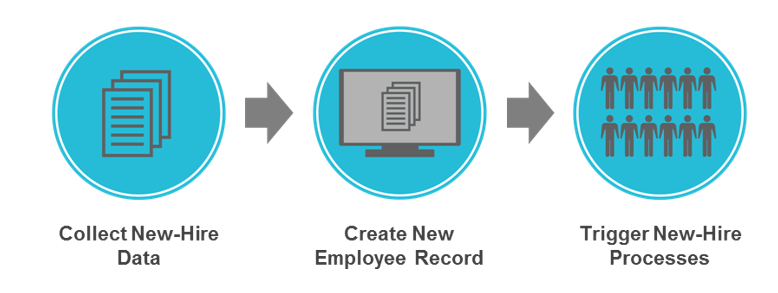
Often, different methods are used to collect and record the new hire’s information. Documentation can be received through email, employee portal, or perhaps via candidate data entered into an Applicant Tracking Systems (ATS). At this step, it is important to ensure the new hire has been provided all necessary information, which often triggers follow-up to collect missing data.
Ideally, the ATS is integrated with the HRIS, and this is a seamless process; however, this step often requires manual intervention to enter the data into the HRIS. If standard procedures are not in place or incorrectly followed, gaps in this process can lead to missteps downstream. Important employee processes may not be triggered, such as provisioning for system access and badging or uploading information for payroll processing. The often manual and complex nature of this process, combined with the importance to the new employee, make onboarding a perfect process candidate for automation.
An optimal RPA experience streamlines the data collection and entry tasks, ensuring that standard processes are followed consistently, with no errors or missed steps. One of the key features of RPA is that the digital workers —or “bots”— can be programmed to read emails and recognize predefined information. For those using an email-based process, recruiters and employees can email documentation to a unique address. The bots will open emails, download files, scan through them, and identify and collect necessary data.
With proper configuration, the bots can not only “read” messages and extract data but can also respond to the sender. For example, the bots can successfully address situations where, for example, information is missing, close specific gaps and continue to follow up with the submitter until completion. The bots eliminate the need for HR to fetch data from multiple sources or for the employee to manually complete new-hire forms.
Another excellent feature of RPA is its ability to securely store credentials while allowing bots to log into multiple systems. After receiving required data, the bots can enter the data on a spreadsheet and cross-check multiple systems internally and externally (e.g., background check website) to ensure the information is consistent and accurate. Once completed, the bots can access the HRIS to finish the new-hire setup in the system. Workflow can also be designed to direct the bots to email security for badge issuance and IT for phone and desktop setup. If desired, the bots can even interact with the payroll system and create the employee record to execute payroll.
By leveraging RPA, companies can perform onboarding from start to finish in a flash with minimal human involvement. HR employees can be released from repetitive and routine tasks to focus more on strategic and improvement activities. And most importantly, new employees will begin their career journey with a positive, lasting experience.
How ScottMadden Can Help
ScottMadden can assist you design and implement the process for an optimal RPA experience. From planning and executing your digital strategy to executing a RPA pilot, our consultants have the knowledge and expertise to help! For more information on RPA at ScottMadden, please see these additional articles of interest:
Additional Contributing Author: Yao Wu