



End-to-end processes like procure-to-pay (P2P) transcend business silos and functional boundaries. To coordinate the work of separate functions across the entire value chain, leading organizations centralize governance of the end-to-end process in a single process owner. This governance structure helps ensure that activities like measurement, process standardization, and process improvements all work in service of the larger end-to-end process.
This article draws on insights from ScottMadden (a management consulting firm with expertise in shared services and P2P) to discuss the importance of global process ownership for P2P. Centralization and global process ownership help ensure that organizations take a balanced approach to developing key procurement capabilities like responsive customer service and impactful sourcing strategies.
Leading Practices in Governance for P2P
Beginning in the mid- to late-2000s, the emphasis in procurement shifted in many organizations from administrative and transactional activities to strategic activities. ScottMadden Partner and Supply Chain Co-Lead John Francis explained that as part of this shift, procurement groups “have started to understand their impacts on accounts payable (AP),” which has led both procurement and AP to move toward an end-to-end P2P process.
To coordinate process improvement activities like standardization and gain visibility over the entire value chain, leading organizations centralize the governance of P2P by identifying a single process owner. The ideal process owner should have strong interpersonal skills, including the ability to bring people together across the enterprise to optimize and improve the end-to-end process. Coordination through a single owner “drives a stronger mandate toward standardization of policies and processes while still retaining a separate organization to execute the day-to-day operations,” Francis explained.
Opportunities for Centralization in Procurement
One important benefit of centralization is that it enables organizations to strike a good balance between strategic and operational facets of procurement. Leading procurement organizations seek a balanced approach across three key procurement capabilities:
- Responsive customer service is important for processing purchase orders in a timely way, responding to operational inquiries, and ensuring that administrative requirements are met.
- Procurement teams that provide impactful sourcing strategies to the business drive greater buy-in and support for procurement goals.
- End-to-end ownership of spend categories drives more effective category management that drives better value over the duration of a contract.
Many organizations focus heavily on advancing their skills to adopt category management, while neglecting operational procurement’s impact on customer service and strategic procurement’s impact on finding value. Centralization through a single process owner is the best governance structure for breaking down silos and achieving a healthy balance of focus among these three areas.
Reporting Relationships
Beyond centralization, it is also important to structure the relationship between finance (the typical parent organization of AP) and supply chain (the typical parent organization of procurement) from a reporting perspective. In organizations where procurement and AP operate as separate teams, there is often a common global process owner across P2P, even if the functions report to separate executives.
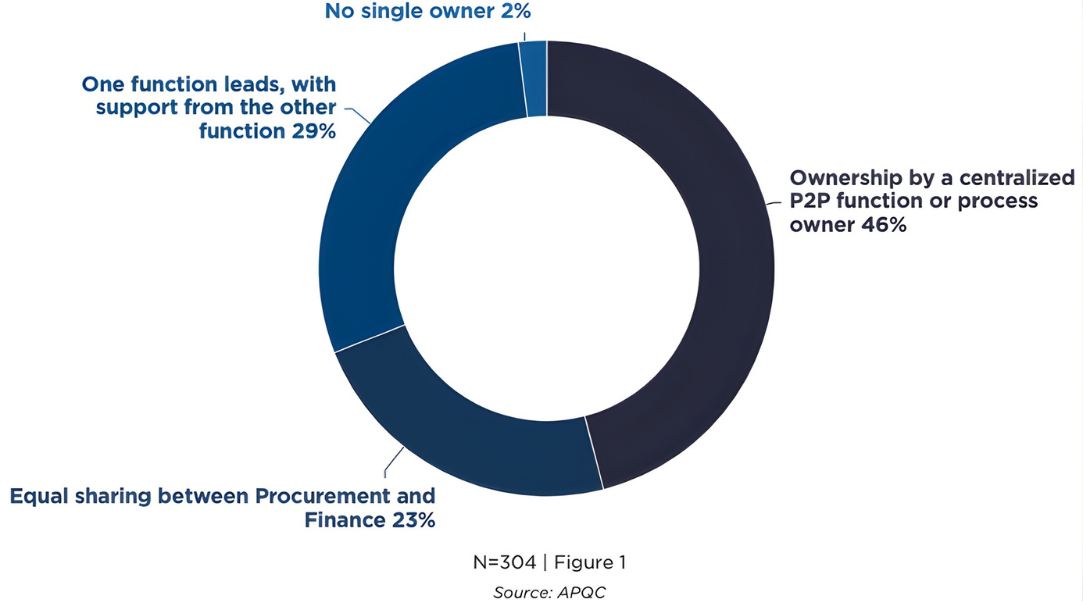
Nearly half of respondents to APQC’s Procure-to-Pay: Cross-Industry Report research (46%) said that the P2P process is owned by a centralized P2P function or a process owner. About a quarter (23%) reported equal sharing between procurement and finance, while 29% said that one function leads, with support from the other function. Very few respondents (two percent) have no end-to-end process ownership for P2P.
P2P End-to-End Process Ownership
It is also important to choose the right reporting relationships and structures for end-to-end process owners. In many leading organizations, the end-to-end process owner is responsible for process design, metrics, process improvement, and continuous improvement. This process owner does not report to the person responsible for the execution of the process. Instead, they typically report to a head of shared services (in a shared services organization) or a governance board that oversees the model.
Learn More
End-to-end processes like P2P transcend organizational silos. Getting the right governance and reporting structures in place is critical for coordinating process management activities across functions, balancing investments in strategic procurement capabilities like category management, and ensuring that process improvements do not damage upstream or downstream processes. More broadly, these governance structures provide a strong foundation upon which organizations can build new and more effective models for procurement service delivery.
About ScottMadden
ScottMadden has been a pioneer in corporate and shared services and has been helping supply chain organizations move beyond their conventional “order taker” role for over two decades. Through deep expertise and practical know-how, ScottMadden assists clients across the full range of supply chain processes and has the unique ability to create alignment between the supply chain function and its internal customers and stakeholders. ScottMadden has developed a supply chain maturity model to differentiate the phases that companies pass through on their journey to world class. Our solutions provide lasting improvements and allow our clients’ supply chain organizations to better serve their internal customers. Our clients span a variety of industries from energy to healthcare to higher education to retail. To learn more, visit https://www.scottmadden.com/topic/procure-to-pay/.
About APQC
APQC (American Productivity & Quality Center) is the world’s foremost authority in benchmarking, best practices, process and performance improvement, and knowledge management (KM). With more than 1,000 member organizations worldwide, APQC provides the information, data, and insights organizations need to support decision-making and develop internal skills. Learn more.
This content includes median values sourced from APQC’s Open Standards Benchmarking database. If you’re interested in having access to the 25th and 75th percentiles or additional metrics, including various peer group cuts, they are either available through a benchmark license or the Benchmarks on Demand tool depending on your organization’s membership type.
APQC’s Resource Library content leverages data from multiple sources. The Open Standards Benchmark repository is updated on a nightly cadence, whereas other data sources have differing schedules. To provide as much transparency as possible, APQC will always attempt to provide context for the data included in our content and leverage the most up-to-date data available at the time of publication.