



Procure-to-pay (P2P) is a value chain with many moving parts that span procurement as well as finance—which means that there are plenty of challenges that can occur as the process is executed. Oftentimes, challenges related to P2P come from a lack of clarity about roles and responsibilities for parts of the process, confusion from customers who feel the process is too complex, or an inability to focus on strategic and value-added work in the midst of daily transaction processing.
This article draws on insights from ScottMadden (a management consulting firm with expertise in shared services and P2P) to provide an overview of common P2P challenges and highlight a tiered service delivery model that enables organizations to get the most value from their procurement technology.
Symptoms of P2P Problems
There are three broad symptoms that point to the need for P2P improvement and redesign:
- Unclear roles: Roles are not clearly defined. Strategic roles are completing transactional tasks with little or no time for anything else.
- Activity without achievement: Business unit partners and vendors see procurement as nothing more than a set of steps that take time and get in the way of what they actually need to accomplish.
- Uncertain service access: Procurement has centralized activities and staff, leading to business unit partners feeling abandoned and uncertain about how to access procurement services. In some cases, the business unit attempts to do the work locally rather than engage with the centralized procurement team.
When procurement gets centralized, does the business know how to access service? Oftentimes people will ‘phone a friend’ and call their favorite person when there might be more efficient and direct ways to access service.
– John Francis / ScottMadden
These broader symptoms can lead to a wide range of different pain points in the business:
- The work of putting out day-to-day fires always wins against strategic work when priorities compete.
- Operational procurement is overlooked as a contributor to customer service and business satisfaction. For example, category management takes priority over answering emails and phone calls from business unit customers and vendors.
- The focus on cost reduction diminishes over time, leaving uncertain direction to add value.
- Savings achievement is negotiated but not subsequently achieved after contract awards.
These issues often stem from the design of the end-to-end process model or the structures that support the process.
Transforming Procure to Pay with a Tiered Service Delivery Model
When people, process, and technology align in the right ways, procurement can become a strategic advantage for organizations. Using shared services and a tiered delivery model for procurement helps organizations avoid challenges like the ones above and get the most value from emerging technologies like AI.
Tiered Procurement Service Delivery Model
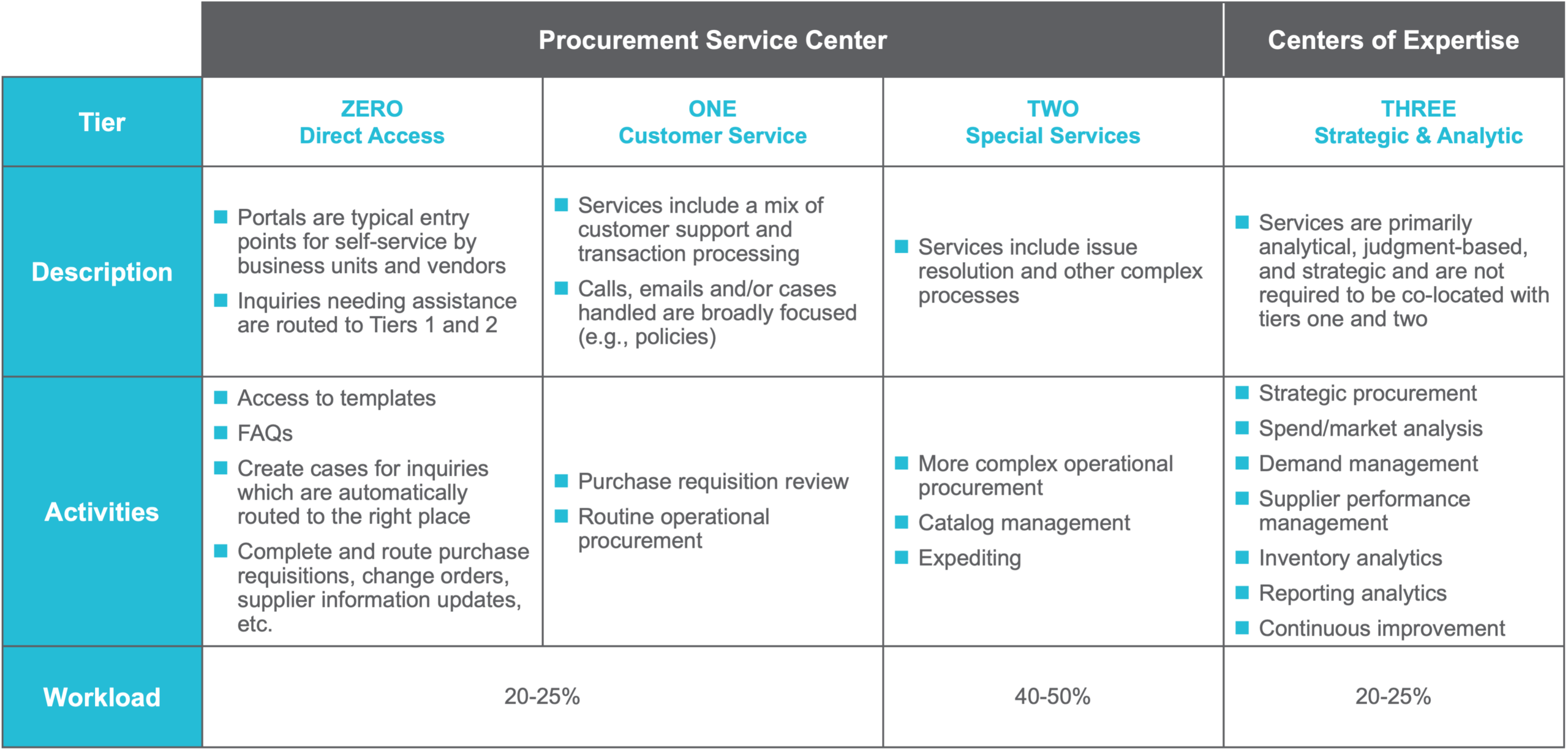
ScottMadden’s procurement service delivery model is divided into four tiers based on the customer’s need and the level of expertise required to meet that need.
- Tier Zero: Direct Access
The direct access tier of the model typically provides a common portal or a landing page for business unit and vendor self-service. Customers have ready access to tools like templates and FAQs and can complete and route purchase requisitions and other procurement requests directly from the portal.Advances in AI and automation mean that organizations can move more work than ever into this tier, leaving human agents free to carry out more complex procurement work.
- Tier One: Customer Service
Services at this tier include a mix of customer support and transaction processing. At this tier, calls, emails, and/or other cases handled are broadly focused (e.g., policy application). This tier also carries out purchase requisition reviews and routine operational procurement activities. - Tier Two: Special Services
In addition to resolving issues escalated from tier one, tier two carries out more complex operational procurement activities like catalog management and expediting. - Tier Three: Strategic Support
While tiers 0-2 sit within shared services, tier three is typically a center of expertise. Services at this tier are primarily analytical, judgement-based, and strategic and are not required to be co-located with tiers one and two. Activities include strategic procurement, spend/market analysis, demand management, supplier performance management, inventory and reporting analytics, and continuous improvement.
Figure 1 provides an illustration of how the tiered service delivery model can work. Roles and processes in this model are structured to avoid co-mingling of operational and strategic work. They are also designed to align the type of work (e.g., transactional, advisory) to the optimal delivery channel and to separate transaction processing from problem resolution. Customers contact the service center by phone or online and either escalate through the first three tiers if needed or skip directly to the fourth tier if their needs are strategic or advisory in nature.
Tiered Procurement Service Delivery Model
Drive Role Clarity and Align Technology with a Tiered Service Delivery Model
The tiered procurement service delivery model addresses many of the challenges that organizations routinely face in the P2P process. Roles are clear because procurement activities are defined, measured, and deliberately placed into specific tiers. In contrast to the uncertainty that plagues other models, business unit customers and vendors know exactly where to go for help and how to get it.
Service management technologies enable the model and drive value across every tier. However, technologies like AI won’t automatically fix bad handoffs, low quality data, or process inefficiencies.
About ScottMadden
ScottMadden has been a pioneer in corporate and shared services and has been helping supply chain organizations move beyond their conventional “order taker” role for over two decades. Through deep expertise and practical know-how, ScottMadden assists clients across the full range of supply chain processes and has the unique ability to create alignment between the supply chain function and its internal customers and stakeholders. ScottMadden has developed a supply chain maturity model to differentiate the phases that companies pass through on their journey to world class. Our solutions provide lasting improvements and allow our clients’ supply chain organizations to better serve their internal customers. Our clients span a variety of industries from energy to healthcare to higher education to retail. To learn more, visit https://www.scottmadden.com/topic/procure-to-pay/.
About APQC
APQC (American Productivity & Quality Center) is the world’s foremost authority in benchmarking, best practices, process and performance improvement, and knowledge management (KM). With more than 1,000 member organizations worldwide, APQC provides the information, data, and insights organizations need to support decision-making and develop internal skills. Learn more.
This content includes median values sourced from APQC’s Open Standards Benchmarking database. If you’re interested in having access to the 25th and 75th percentiles or additional metrics, including various peer group cuts, they are either available through a benchmark license or the Benchmarks on Demand tool depending on your organization’s membership type.
APQC’s Resource Library content leverages data from multiple sources. The Open Standards Benchmark repository is updated on a nightly cadence, whereas other data sources have differing schedules. To provide as much transparency as possible, APQC will always attempt to provide context for the data included in our content and leverage the most up-to-date data available at the time of publication.