



As decarbonization efforts continue to proliferate, electric vehicles (EVs) are widely seen as essential to meeting state and local clean energy goals. However, to meet the charging needs of EVs, a significant charging infrastructure still needs to be developed. As states and regulators consider how to foster EV adoption, make-ready programs have emerged as an increasingly popular option.
Make-Ready Programs Support The EV Charging Infrastructure Development
These programs are gaining popularity among states and regulators and are designed to reduce the financial barriers associated with developing EV-charging infrastructure needs. By providing Utilities support for the upfront infrastructure costs of electrical upgrades and charging equipment, make-ready programs incentivize the accelerated deployment of charging stations.
Policy setting provides an incentive structure to support the growing EV market’s increasing demand for infrastructure development (charging needs). Policy setting, incentive structures, development targets, and compliance requirements play a strategic role in enabling states to reach their clean energy goals through EV adoption and transition towards decarbonization and a cleaner, electrified transportation future.
By March 2021, 15 utilities across the United States announced make-ready programs with a collective budget of more than $1 billion.
Utilities are key in building the nation’s EV-charging infrastructure. As with all customers, utilities need to plan infrastructure costs, stakeholder needs, program participation, market segments, and incentives to construct the new infrastructure. However, there are various approaches to paying for new electric infrastructure. Utilities cover some of these costs for traditional projects, and the customer pays the remainder. The customer’s share of these costs is often referred to as a contribution in aid of construction (CIAC).
A make-ready program differs from the approach used for traditional projects by reducing the cost of EV-charging infrastructure for customers or developers.[1] Under make-ready programs, some of the infrastructure costs that the developer would pay are paid for by the utility. Utilities can typically recover the cost by adding the infrastructure to the rate base or through another recovery mechanism. As such, make-ready programs help address cost recovery, successfully tackle some of the financial barriers associated with expanding EV-charging infrastructure needs, and align the interests of developers, utilities, and customers.
However, there is no one-size-fits-all solution. Programs vary in the types of eligible projects (public vs. private), the equipment covered (in-front-of and/or behind-the-meter), whether utilities can earn a return on make-ready investments, and ownership models (utility vs. third party). Make-ready programs offer the opportunity to expand charging infrastructure to benefit all stakeholders. However, utilities must consider the opportunities unique to their service territories, what is possible in their regulatory environment, and how best to respond to customers’ needs.
Consequently, make-ready program planning and implementation are challenging. Factors, such as varying developer costs, uncertain EV-adoption rates, and the ability of the grid to accommodate charging loads, present challenges that utilities must prepare to overcome. Through our experience developing these programs, we have identified several actions utilities can take to create successful EV make-ready programs.
 | Determine Strategic Scope and ObjectivesAs utilities design their make-ready programs, they must align program objectives with the greatest opportunities to increase adoption by addressing stakeholders’ needs. Stakeholders’ priorities may differ, requiring utilities to design make-ready programs that meet the needs and demands of site owners, developers, customers, fleet owners, and third-party contractors within their service territories. In many cases, policy setting and compliance requirements may establish criteria for utilities to align their program objectives. For example, state-led programs may set development targets for specific communities and market segments, or offer incentives to those installing EV-charging infrastructure. Utilities must orient their programs to pursue mandated targets and aggressively ensure full access to incentives. Establishing the strategic scope and objectives early on enables managers to develop a proactive and cost-effective program. | |
 | Organize and Communicate EarlyMake-ready programs will require extensive coordination among a utility’s internal organizations to implement, potentially more so than large traditional new customer processes. Specific EV make-ready roles and program design should be established early across the groups that will have roles in carrying out the program. In addition, the needs of a make-ready program (e.g., customer service, accounting, legal, etc.) must be communicated to internal organizations with sufficient time to allow managers to alter processes or absorb additional workflow. Such coordination and the corresponding change management are time-intensive and can be challenging to implement in an effective make-ready program. The emerging best practice is for utilities to establish a dedicated EV team to manage the implementation and coordination of EV programs, including make-ready. EV team responsibilities can vary in scope, but they should, at a minimum, serve as the point of contact within the utility and externally for EV programs. Dedicated teams ensure a disciplined approach to an established strategy, coordinate between internal organizations, administer EV make-ready programs, and support compliance with regulatory requirements. EV teams can also drive implementation, develop processes, manage information, and facilitate change management across the utility. | |
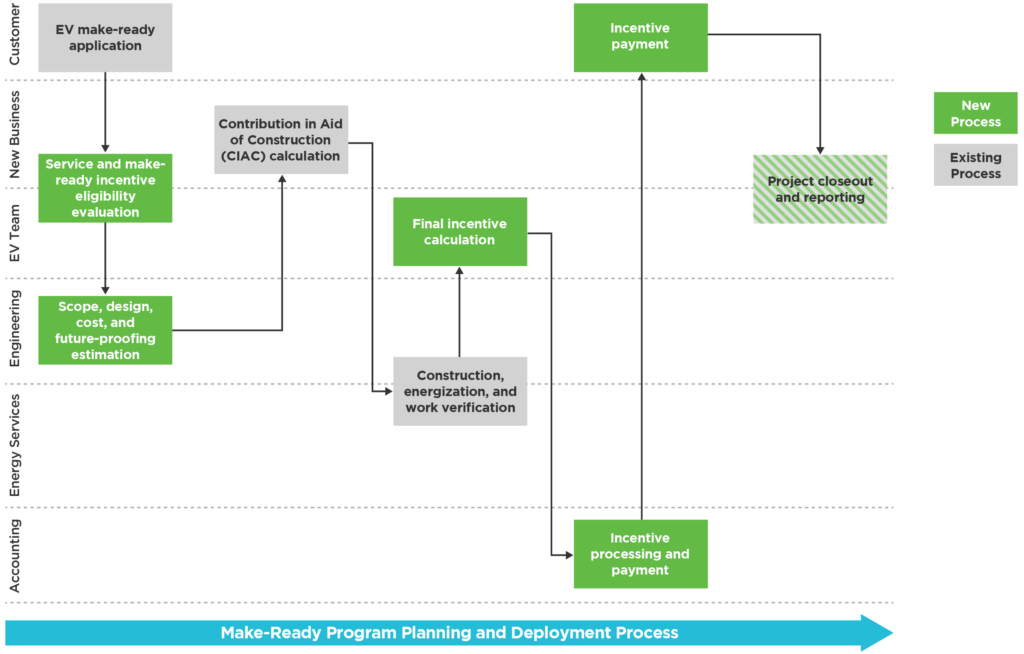
 | Process Design and RefinementAdministering EV make-ready programs may appear similar to establishing typical new business accounts, but there are unique planning considerations that go into make-ready projects. The number of charging stations and plugs, specific location at the site, circuit capacity, anticipated demand, variability in load, and supporting infrastructure all significantly impact the cost and effort required to plan and complete the EV-charging infrastructure installation properly. Existing processes may need to be augmented with additional procedures, such as an application specific to EV supply equipment, utility and developer-side cost calculations, service agreements, and considerations, such as incorporating distributed energy resources. Example process updates are shown in Figure 1. EV-charging infrastructure and associated engineering demands require input from myriad organizations, including distribution engineering, rate design, new business, customer service, and finance and accounting. An iterative process design, improvement, and implementation approach allows for effective change management with internal and external feedback loops. As utilities and stakeholders become more familiar with EV-infrastructure projects, decisions regarding formal processes and policies become more informed. An iterative approach enables utilities to account for unforeseen trends and requirements that impact internal operations, software procurement, staffing, and outreach and education efforts. |
Figure 1: Make-ready programs introduce new steps to the traditional process, requiring coordination across multiple stakeholders.
 | Customer Outreach and EducationOutreach efforts are necessary to identify potential program participants and help them navigate the available incentives. Obtaining knowledge of market segments, customer preferences, developer approaches, and planned projects within a service territory will enable utilities to anticipate upcoming requirements better, prioritize internal efforts, leverage external resources, and identify stakeholders (e.g., developers, commercial and industrial customers’ points of contact, fleets, municipal agencies, etc.). This knowledge enables utilities to address all stakeholders’ interests and right-size their make-ready programs. As utilities develop relationships with stakeholders, it may be necessary to consider focused outreach efforts in areas that can support increased load requirements without significant distribution infrastructure investment. Utilities may need to develop educational materials to support decision-making internally and externally. It will be necessary to train customer service representatives and field personnel in program specifics to meet customers’ needs and drive program participation. Customer education should highlight the programs available to stakeholders, best practices, opportunities for sharing EV-infrastructure costs, and other benefits that mitigate switching costs, installation costs, and customer bill impact. |
Conclusion
Make-ready programs allow utilities to prepare for the rapid expansion of EVs, encourage EV adoption, and rate base new infrastructure. Programs that adopt a multi-stakeholder approach will benefit from a shared learning process, reduced burden of risk, and the experience to expand EV infrastructure in a cost-efficient manner to meet developer, owner, and operator needs.
Make-ready programs are emerging as the preferred method for utilities to support increased access to public EV charging. This trend is accelerating, driven by emissions-reduction targets, state and federal policies, corporate environmental, social, and governance commitments, technological breakthroughs, and shifts in the overall market (preferences of automakers and customers). Make-ready programs can benefit utilities by encouraging capital investment in infrastructure to prepare for future load requirements and adapt to a changing transportation landscape.
How ScottMadden Can Help
ScottMadden works with utilities to plan for the integration of EVs into their business and operations, including the development of EV-charging programs, EV organizations, distribution planning and new business processes, outreach programs, and incentives, including make-ready programs. Our consultants support utilities as they plan for and launch EV-make-ready programs. Our activities include reviewing key program criteria and design considerations to help encourage thoughtful planning and program design. To learn how to accelerate your company’s ability to anticipate and adapt to changes in the market or to get started on your make-ready program, contact us today.
Additional Contributing Authors: Adam Bolton, Sarah Vondracek
[1] Because charging station developers are typically involved in public-charging infrastructure build-out, we use the term “developer” for simplicity. However, charging infrastructure developers and owners can also take the form of utility customers, site hosts, charging station developers, etc.