



Why Governance Is the Scaling Constraint and Enabler
AI pilots rarely fail because the technology cannot perform the task. They fail to scale because leaders cannot yet prove that digital labor is accurate, explainable, compliant, and accountable. For shared services organizations, governance is no longer a back-office control function; it is the operating model capability that determines whether AI can move safely from pilots to production.
AI introduces a different risk profile than traditional automation. Unlike traditional automation, which executes predefined rules, digital labor interprets data and context, which introduces variability in outputs. Decisions can be made at scale with limited human intervention. And in many cases, the logic behind those decisions is not immediately visible. Without a governance model that addresses these realities, organizations either slow adoption out of caution or move forward with exposure.
The organizations that scale AI successfully take a different approach. They treat governance as a critical part of the operating model itself. As AI takes on a role as digital labor, governance must evolve from overseeing systems to governing how work is executed by digital labor. In practice, leading organizations operationalize this model through a centralized “digital control tower.” This capability provides real-time visibility into how AI and human work are executed, dynamically enforces governance, and ensures that controls are applied consistently as service delivery scales. Done well, governance does not restrict AI but enables it to operate efficiently and safely at scale.
How Can Governance Enable AI to Scale Safely?
Governance has traditionally been viewed as a control function that ensures compliance, reduces risk, and enforces standards. In many transformation efforts, it is seen as a necessary constraint that must be managed carefully to avoid slowing progress. That mindset does not hold in an AI-enabled environment. AI systems operate at a speed and scale that make after-the-fact controls ineffective. If governance is not built into how work is executed, it becomes a bottleneck. Reviews pile up, exceptions increase, and confidence in the system erodes.
A more effective approach is to treat governance as an enabler of scale. Clear guardrails allow AI to operate independently within defined boundaries and escalate when needed. Standardized controls reduce variability and prevent issues before they occur. Most importantly, governance builds trust among users, leadership, and regulators, which is what ultimately determines whether AI adoption expands or stalls. This shift requires moving governance upstream into design decisions rather than relying on downstream oversight. In practice, this means most AI-enabled processes operate with human-in-the-loop oversight, particularly for exceptions, low-confidence outputs, and high-impact decisions.
Core Risk Domains in AI Service Delivery
Understanding where governance matters most starts with understanding the risk landscape. While many of the risks associated with AI are familiar, their impact is amplified because digital labor is executing work at scale, making decisions, and taking actions for which the organization remains fully accountable. Organizations should focus governance attention on five core risk domains:
- Accuracy and reliability: AI outputs may appear confident but still be incorrect, creating risk when errors occur at scale.
- Compliance and regulatory exposure: Existing obligations around privacy, controls, labor, and documentation still apply when work is performed by digital labor.
- Explainability and transparency: Leaders need enough visibility of how answers were derived to defend decisions, support audits, and maintain stakeholder confidence.
- Bias and fairness: AI can reinforce historical patterns unless organizations actively monitor and correct outcomes.
- Operational resilience: Model drift, overreliance, and weak monitoring can create vulnerabilities that remain hidden until they affect performance.
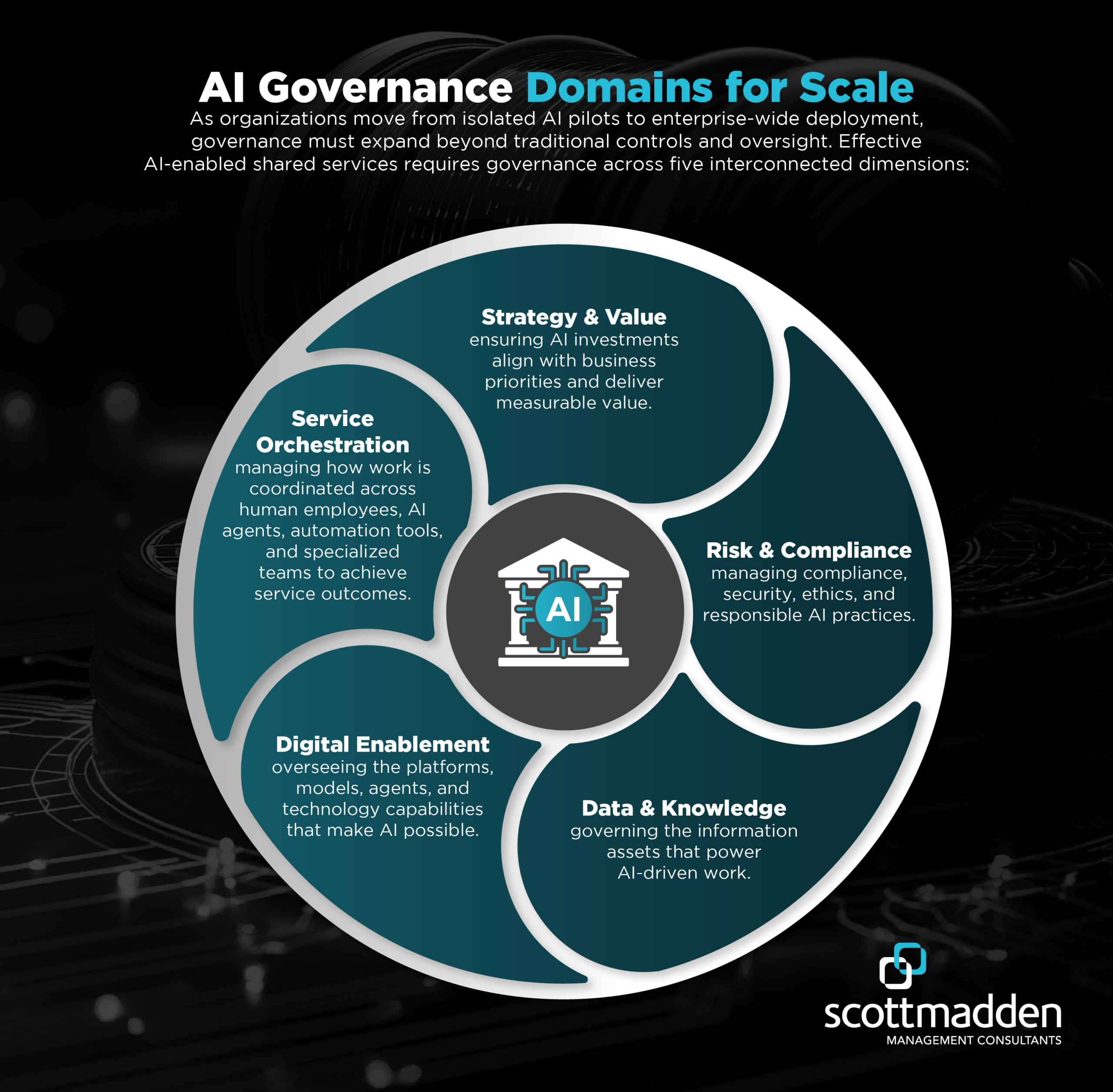
How Should Governance Be Embedded into the AI Operating Model?
Effectively addressing these risks requires embedding governance directly into how service delivery operates. This happens across three levels: design-time, runtime, and post-execution.
At design-time, organizations define what work digital labor can own autonomously and where human intervention is required. This includes setting thresholds, decision boundaries, and escalation rules. These are not abstract policies but rather are built directly into workflows and systems so that governance is enforced automatically as work is executed.
At runtime, governance becomes dynamic, often coordinated through a digital control tower that centralizes visibility into AI performance and human intervention points. Digital labor performance is monitored in real time, with triggers in place to identify when digital labor should escalate work to humans. In higher-risk scenarios, human-in-the-loop models ensure that decisions are reviewed before they are finalized.
Post-execution controls provide an additional layer of assurance. Audit trails capture what decisions were made, what data was used, and how outcomes were generated. Sampling and quality reviews help identify patterns and areas for improvement. Feedback loops ensure that insights are fed back into both the AI models and the processes they support.
When these layers are integrated, governance becomes part of the flow of work rather than an external check. This reflects a broader shift: AI and its governance are not added onto service delivery but embedded directly into how the operating model functions.
Structured Human Oversight
Human oversight remains a critical component of AI-enabled service delivery, but it must be structured differently than in traditional models. Reviewing every output is neither practical nor desirable, as it eliminates the efficiency gains that AI provides.
Instead, oversight is targeted. Humans focus on high-risk, high-impact decisions, as well as exceptions and edge cases where AI confidence is low. This approach requires clearly defined roles. Some individuals are responsible for managing digital labor performance and intervening when digital labor reaches defined limits. Others define policies and guardrails, ensuring that controls remain aligned with business and regulatory requirements. Process owners ensure that AI behavior aligns with operational intent and that work is escalated appropriately.
This model allows organizations to maintain control without creating unnecessary friction. Human effort is applied where it adds the most value, rather than being spread evenly across all activities.
Governance Foundations for Scale: Data, Standardization, and Transparency
While controls and oversight are critical, they are not sufficient on their own. Effective governance at scale depends on a set of underlying foundations.
Data governance is the starting point. AI systems are only as reliable as the data they use. This requires clear ownership of data domains, defined quality standards, and ongoing management processes to ensure that data remains accurate and consistent over time. As digital labor depends on data to execute work, data governance becomes a core dependency for workforce performance, not just system accuracy.
Standardization plays an equally important role. AI performs best in environments where inputs, processes, and decision rules are consistent. Standardization reduces variability, which in turn reduces risk. It also makes it easier to apply controls consistently across different processes and functions.
Transparency and auditability must be built into the system from the beginning. Every AI-driven action should be traceable, including the data used, the decision made, and the resulting outcome. This is essential not only for compliance but also for building confidence among stakeholders. These capabilities are typically surfaced through a control tower environment, where auditability, performance, and risk indicators are visible in real time rather than reconstructed after the fact.
Finally, governance must be continuous. AI systems evolve, and governance must evolve with them. This includes continuous monitoring of model performance, periodic recalibration of thresholds and controls, and structured feedback loops from users and operators. Organizations that treat governance as a one-time setup will fall behind quickly.
Six Practices for Implementing AI Governance Without Slowing Adoption
Translating governance principles into practice is where many organizations struggle. The key is to implement governance in a way that supports adoption rather than slowing it down.
A practical starting point is to segment processes by risk rather than applying a single governance model across all use cases. Low-risk activities can be fully owned by digital labor with lighter controls, while higher-risk processes require stronger oversight. This allows organizations to move quickly where risk is limited while maintaining appropriate safeguards where it is not.
Governance should be built directly into processes and platforms rather than added as a separate review layer. Decision thresholds, escalation triggers, validation checks, and control tower visibility help ensure controls consistently operate without creating unnecessary delays.
Most organizations benefit from starting with tighter controls and expanding autonomy over time. Early in the adoption cycle, higher levels of oversight help build confidence and identify issues. As performance improves, controls can be adjusted to increase automation and reduce unnecessary intervention.
Human oversight should be designed for efficiency, not coverage. Instead of reviewing all outputs, organizations should focus on exceptions, low-confidence decisions, and high-impact scenarios. This targeted approach preserves the benefits of AI while maintaining control.
Clear ownership and accountability are also essential. Responsibility for outcomes delivered by digital labor, model performance, and governance controls should be defined explicitly and coordinated across business, technology, and risk functions. This avoids gaps and ensures that issues are addressed quickly.
Finally, governance should be integrated with existing control frameworks rather than built in isolation. Aligning with established structures for audit, compliance, and risk management reduces duplication and makes it easier to scale.
The common thread across these practices is balance. Governance should be strong enough to manage risk but supportive and agile enough to enable progress.
How We Can Help: Embedding Governance That Scales
Designing governance for AI-enabled service delivery requires more than defining policies. It requires translating those policies into operating models, workflows, and systems that work in practice.
ScottMadden helps organizations build governance models that support both control and scale through:
- Governance model and control framework design: Define risk-based guardrails for digital labor, decision rights, accountability models, and escalation paths aligned to business and regulatory requirements.
- Embedding workflow and platform controls: Integrate thresholds, validation checks, human-in-the-loop review, and real-time monitoring directly into service delivery processes.
- Data and model governance design: Establish data ownership, quality standards, model monitoring, retraining protocols, and version control processes.
- Auditability and compliance readiness: Build traceability, documentation, reporting, and review capabilities that support internal audit and regulatory expectations.
Key Takeaways
Digital labor does not scale on capability alone. Organizations need governance models that build confidence, clarify accountability, and embed controls directly into how work is executed.
- Governance should be treated as an enabler of AI scale, not a checkpoint that slows adoption.
- Digital labor requires clear decision rights, escalation paths, monitoring, and human oversight.
- Control towers can help organizations centralize visibility, enforce thresholds, and manage AI performance in real time.
- Data quality, standardization, transparency, and auditability are foundational to trusted AI service delivery.
- ScottMadden helps organizations design governance models, workflows, and controls that allow AI to operate safely and effectively at scale.
Executive Brief: AI Governance to Scale Digital Labor
Want a scaled-down version of this article? Download the Executive Brief.