



Introduction
Adopting artificial intelligence (AI) in shared services or global business services (GBS) is not about flipping a switch; rather, it’s a deliberate evolution. While the potential benefits are clear, realizing them requires a phased, disciplined approach. Some services are natural candidates for rules-based execution, while others will take time to mature or will always require human judgment. The key is understanding where each process sits along that continuum and moving forward with intention.
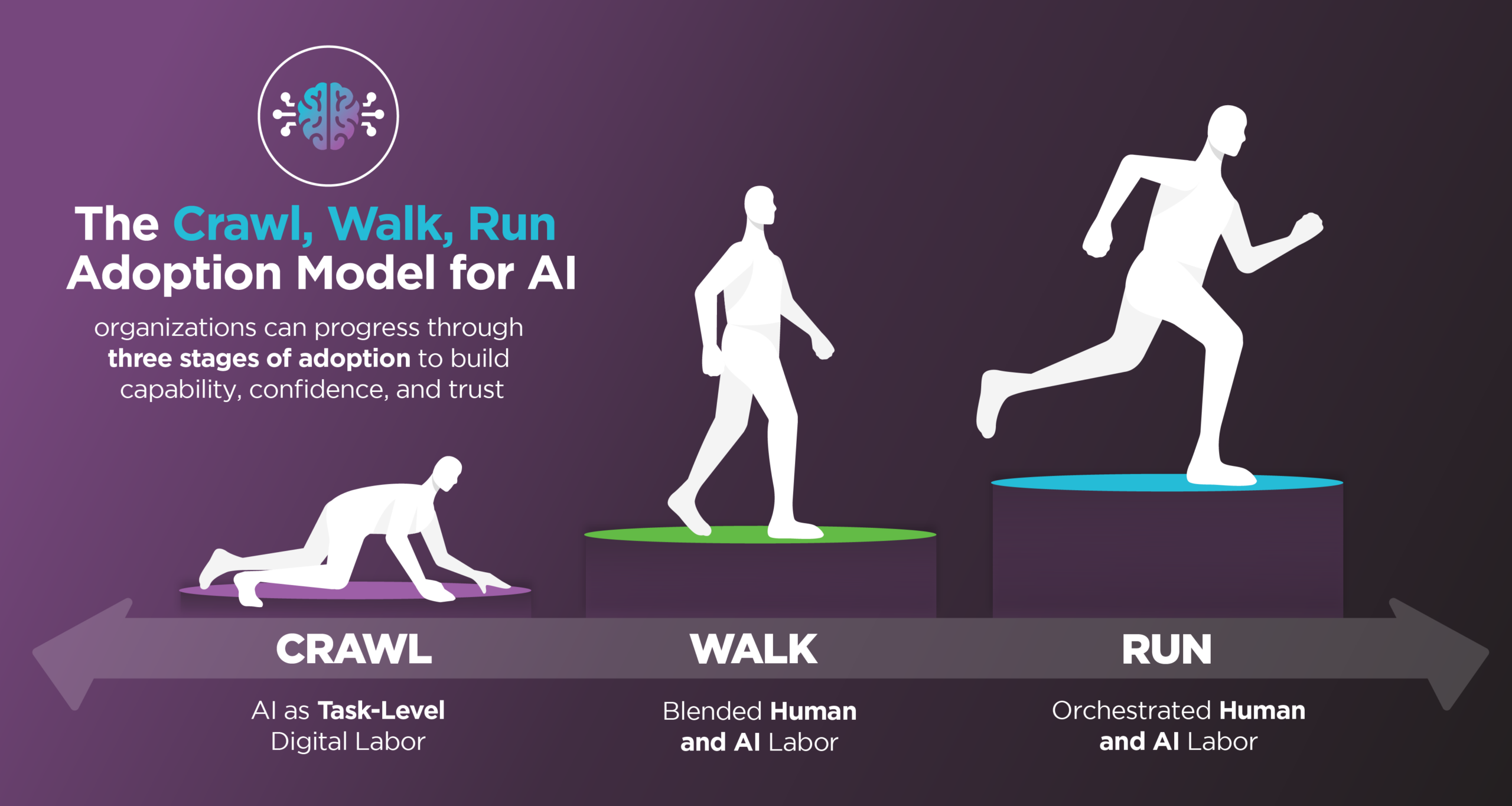
Building on earlier discussions of how AI is reshaping service delivery and establishing a new balance of human and machine work, this article explores how organizations can progress through three phases of adoption: crawl, walk, and run. Each phase represents a step in capability, confidence, and trust.
Importantly, AI should not be viewed simply as a new form of automation. It represents a new category of labor within the service delivery model. As organizations adopt AI, they are not just automating tasks; they are redistributing work across human and digital resources. The crawl/walk/run framework should therefore be understood not only as a progression of capability but also as an evolution in how labor is deployed, governed, and integrated into service delivery.
AI as a Labor Category in Shared Services
To fully realize the value of AI, organizations must distinguish between automation as a method of execution and AI as a form of labor.
Rules-based automation executes predefined instructions, while AI introduces digital labor that can interpret, generate, and act within defined boundaries. Human roles remain accountable for judgment, governance, and outcomes.
This distinction shifts the focus from what can be automated to how work is distributed across human and digital resources.
The Crawl/Walk/Run Framework
AI maturity in shared services develops incrementally. Attempting to deploy AI broadly before the foundation is ready often leads to stalled initiatives or eroded trust. A structured crawl/walk/run progression allows organizations to build measurable success at each phase while preparing the workforce, processes, and data environment for more advanced use cases.
Examples include:
| Dimension | Crawl | Walk | Run |
| Role of AI | Task-level digital labor | Contributing co-worker | Orchestrated labor resource |
| Role of Humans | Define rules, handle exceptions | Validate, decide, oversee | Govern, optimize, intervene |
| Execution Model | Rules-based automation with AI interpretation | AI-assisted workflows | Intelligent work orchestration |
| Decision Ownership | Human-defined rules | Human-led with AI input | Human-led, AI-informed |
| Work Allocation | Predefined processes | Shared across AI and humans | Dynamically routed by context |
| Primary Value | Efficiency and speed | Productivity and consistency | Insight, adaptability, and scale |
Crawl: Introducing AI as Task-level Digital Labor
The crawl phase focuses on introducing AI as a form of task-level digital labor to absorb high-volume, well-defined work. These activities are governed by clear rules and structured processes, making them suitable for a combination of rules-based automation and AI-enabled interpretation.
In this phase, AI performs discrete tasks such as interpreting requests, extracting information, and generating responses, while traditional automation executes the underlying workflows. Human roles remain responsible for defining rules, managing exceptions, and validating outputs.
These early use cases deliver tangible, fast results, including reduced response times, improved accuracy, and relief from repetitive work. More importantly, they help organizations build trust in AI by demonstrating reliability and control. Successful crawl initiatives create both momentum and a foundation of confidence for broader adoption.
Examples include:
| Function | Walk-phase AI Application |
| HR | Policy Q&A, onboarding checklists, case summaries, and knowledge article generation |
| Finance | Accounts payable capture and coding, exception triage, cash application (remittance matching) |
| IT | Password resets, device requests, incident summaries, automated access requests |
| Supply Chain | Order status checks, shipment tracking, and inventory queries through self-service chat |
Walk: Blended Human and AI Labor
In the walk phase, shared services adopt a blended labor model where AI and humans jointly execute work. AI acts as a contributing resource by generating output, performing analysis, and advancing workflows, while humans validate results, apply judgment, and retain accountability.
Work is no longer simply automated; instead, it is co-managed across human and digital labor, with governance defining how responsibilities are shared and when human intervention is required.
During this phase, organizations expand AI into processes that require interpretation or cross-domain judgment. Governance becomes essential where clear oversight, quality checks, and human-in-the-loop validation ensure accuracy and maintain stakeholder trust.
Examples include:
| Function | Walk-phase AI Application |
| HR | Offer letter or contract template drafting; AI-supported employee movement workflows; conversational career guidance with human review |
| Finance | Automated close-preparation narratives, reconciliations, vendor risk triage, and policy-aware expense prechecks |
| IT | Self-healing remediation for recurring issues, predictive incident prevention, and automated pattern recognition |
| Supply Chain | AI-assisted replanning, supplier communication drafting, and exception clustering in control towers |
Run: Orchestrated Human and AI Labor
The run phase represents a mature operating model where AI is fully integrated as a scalable labor category within service delivery. Work is dynamically routed across human and digital resources based on complexity, risk, and the level of required judgment.
AI not only executes tasks but also contributes insight through informing prioritization, identifying risks, and supporting decision-making. The orchestration of work across human and digital labor becomes a core capability of the service model, enabling adaptive, efficient, and scalable operations.
Human roles shift toward governance, decision-making, and continuous optimization of how work is distributed and executed across the organization.
Examples include:
| Function | Walk-phase AI Application |
| HR | Complex employee relations cases, workforce analytics, and compliance reviews supported by AI-generated insights |
| Finance | Strategic financial planning, variance analysis, and model risk reviews using predictive analytics |
| IT | AI Ops oversight and site reliability engineering with AI-driven diagnostics and recommendations |
| Supply Chain | Network optimization, risk modeling, and AI-driven simulations for sourcing and logistics |
The Human Factor in AI Maturity
Regardless of phase, success with AI is not purely technical. The evolution from crawl to run depends on building human capability alongside technology. This includes redesigning roles, embedding governance, and fostering a culture of experimentation and accountability.
AI adoption moves fastest where teams understand how to work alongside digital labor, trust its outputs, and actively improve how work is distributed across human and AI resources. Organizations that balance speed with stewardship will gain the most sustainable advantage—progressing methodically, scaling confidently, and ensuring that every AI initiative strengthens both service delivery and workforce trust.
Conclusion
The progression from crawl to run is not simply a technological journey but rather the evolution of a new workforce model.
As shared services organizations advance, they move from using AI to automate tasks toward operating with a blended workforce of human and digital labor. This shift enables not only greater efficiency but also improved decision-making, adaptability, and scalability.
Organizations that embrace this evolution by treating AI as a core component of their workforce will be positioned to deliver more intelligent, responsive, and value-driven services across the enterprise.
How We Can Help
We help shared services and GBS leaders design and execute a practical, phased road map for AI adoption. Our approach focuses on:
AI Opportunity Mapping
Identifying and prioritizing high-value opportunities where AI can be deployed as digital, including clear definition of where work can be replaced, augmented, or restructured
Data and AI Foundation Development
Establishing the data, governance, and role structures required to support digital labor, including clarity on ownership, quality, and human-AI interaction points
Operating Model Design
Defining how work is executed, routed, and governed across human and digital labor, including service boundaries, escalation points, and decision ownership
Road Map Development
Creating a phased road map that sequences the introduction of digital labor across crawl, walk, and run phases based on value, complexity, and risk
Transition Planning
Equipping teams to operate within a blended workforce model, including role redesign, capability development, and governance to effectively manage human and digital labor
With the right road map and operating model, organizations can move from isolated use cases to a fully integrated service delivery model that delivers sustained value and positions shared services for the next era of performance.
If AI changes the operating model of shared services, what does that mean for service delivery itself? In the next article in our AI series, we discuss redesigning the service delivery model so that AI capabilities can scale.
Discover the strategies, capabilities, and practical considerations shaping the next generation of shared services: AI-Enabled Shared Services