


Introduction
Shared services are entering a new era defined by intelligence, speed, and adaptability. For years, automation and process standardization have driven efficiency. Now, artificial intelligence (AI) is reshaping what efficiency means—enabling service delivery models that anticipate needs, act autonomously, and continuously learn from every interaction.
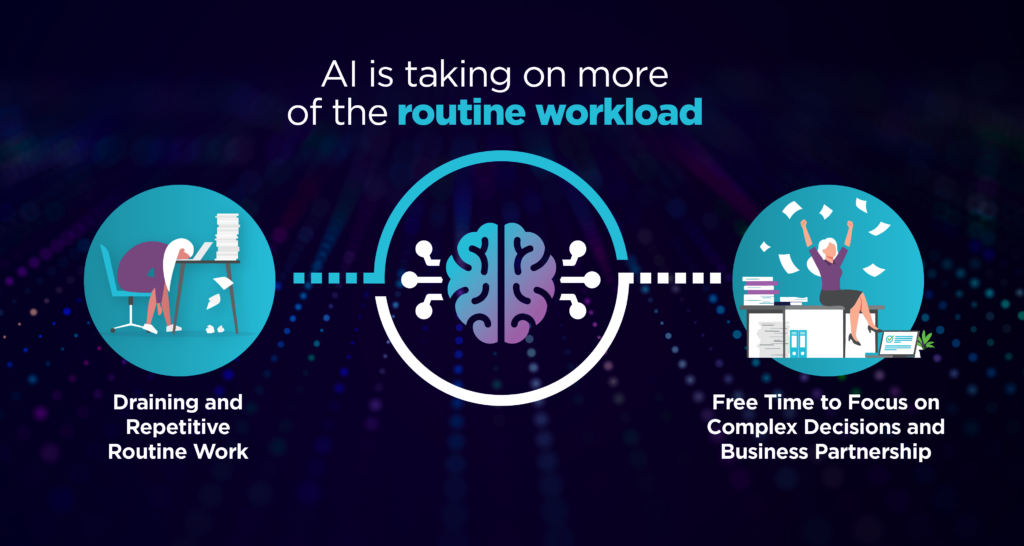
Across industries, shared services and global business services (GBS) leaders are rethinking the fundamentals of how work gets done. AI is transforming not only how requests are handled but who—or what does the work, introducing digital labor alongside human teams. The traditional tiered model of support is being redefined as AI takes on more of the routine workload, freeing human teams to focus on complex decisions, exception handling, and business partnership.
This article, the second in a six-part series, explores how the service delivery model is evolving. We examine what AI means for the Tiers 0–3 structure, how automation is redistributing work, and what new opportunities this creates for shared services organizations to elevate their strategic impact.
The Evolution of Service Delivery with AI
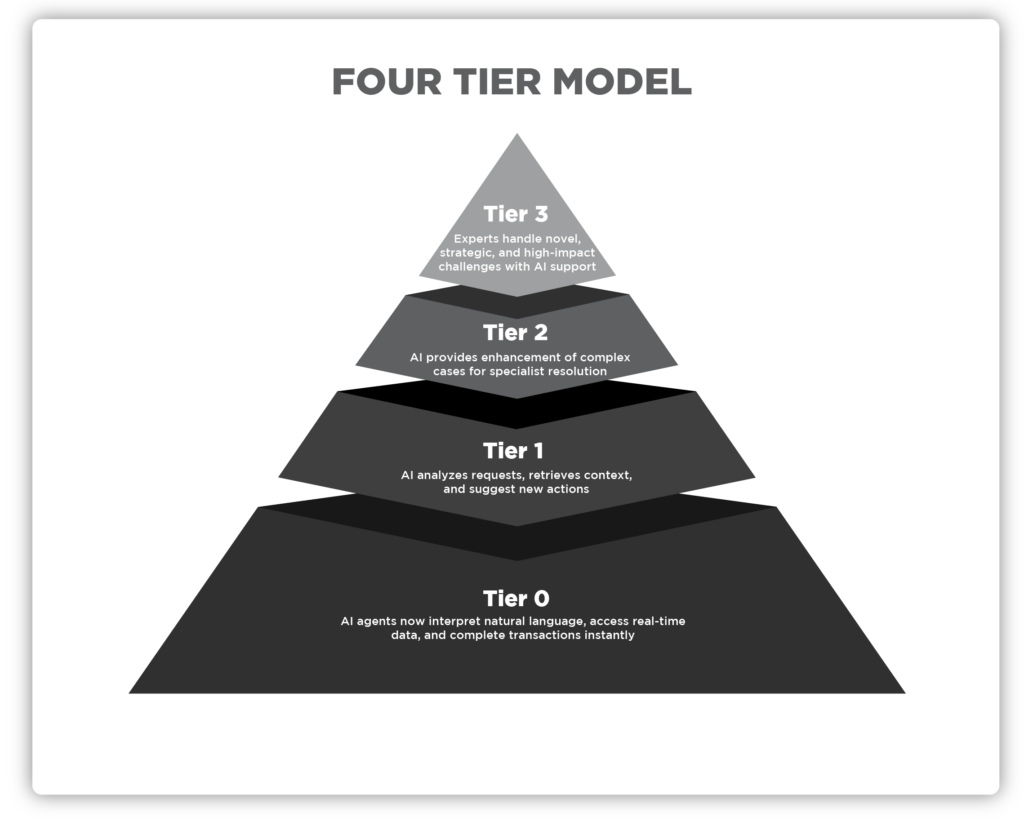
AI is redefining how shared services deliver value across every function—from HR and finance to IT and supply chain. The familiar four-tier model remains, but the boundaries between tiers are blurring. Rather than just augmenting each tier, AI introduces a new form of digital labor that operates across them by owning routine work, supporting complex work, and learning from both.
Tier 0: Intelligent Self-Service
Tier 0 has long been the domain of FAQs, portals, and static knowledgebases. AI is transforming it into an intelligent front door for the enterprise. Conversational agents and virtual assistants now interpret natural language, access real-time data, and complete transactions instantly. An employee can confirm eligibility for a benefit and submit pre-populated forms and schedule process reminders or a manager can trigger workflows across multiple functions to support an employee transfer to another department—all without human intervention, effectively acting as a digital workforce for routine service delivery.
The effect is a step-change in both scale and experience: around-the-clock responsiveness, natural language interaction, dynamic support, consistent accuracy, multi-language interface, and a dramatic reduction in Tier 1 volumes. As AI becomes the primary point of contact, organizations must rethink how they govern information, manage service capacity, and design escalation paths and governance models that balance AI autonomy with human judgment—ensuring AI can learn and act, but not operate without appropriate oversight.
The top three risks are loss of human judgment in complex or nuanced situations, compliance and quality errors from unchecked AI actions, and poor user experience when people can’t easily reach a human for exceptions or support.
Tier 1: AI-Augmented Frontline Support
Human Tier 1 agents focus on cases that require empathy, negotiation, or nuanced problem-solving. They rely on AI tools that surface insights instantly, allowing faster, more informed responses. This hybrid model is giving rise to the concept of the universal agent—professionals supported by AI to handle cross-functional inquiries without deep specialization, improving both flexibility and service quality.
Tier 2: Specialists with AI Assistance
Tier 2 specialists continue to play a critical role in resolving complex cases that require expertise and judgment. AI enhances rather than replaces this work. This reflects a clear division of labor: AI handles preparation and pattern recognition, while humans apply judgment. Before a finance analyst investigates a budget variance or an HR specialist reviews a complex employee case, AI systems can assemble data, identify anomalies, and highlight potential causes. This pre-analysis accelerates resolution and lets specialists focus on interpretation and decision-making rather than manual data gathering. Over time, as AI learns from these human resolutions, it can automate more of the diagnostic and preparatory work, creating a virtuous cycle of continuous improvement.
Tier 3: Human-led Strategy, Program Design, and Development
At the top of the model, Tier 3 experts remain responsible for novel, strategic, and high-impact challenges—from system architecture to policy design. More of the traditional service delivery is shifting to AI-supported Tier 2. At Tier 3, AI functions as a high-powered analytical partner. It can simulate supply chain scenarios, analyze financial data sets, or scan system logs to pinpoint likely root causes. Importantly, the knowledge captured from Tier 3 problem-solving feeds back into AI systems, enriching the collective intelligence of the organization and enabling lower tiers to handle more work autonomously. Human expertise remains the anchor for judgment, innovation, and governance, but its reach expands through AI’s analytical capacity.
A New Balance of Human and Digital Labor
Across all tiers, AI is flattening the traditional pyramid. Predictable, routine work shifts to digital labor; humans concentrate on exceptions, strategy, and relationship-driven work. This shift doesn’t eliminate human roles—it elevates them. Success will depend on how effectively organizations design this new balance: aligning processes, data, and governance to support seamless human-AI collaboration. The challenge is no longer automation, but explicitly designing the boundary between human and digital labor.
Functional Implications of AI Across Shared Services
AI is advancing unevenly across functions, but the pattern is consistent. Rules-based work has largely been automated; AI now enables the automation of judgment-based and knowledge-driven activities. Human teams now focus on exceptions, insight, and relationship management.
Toggle each shared services function below to see how it is evolving
Human Resources
24/7 policy Q&A, benefits guidance, onboarding checklists, and leave management via HR virtual agents: embedded copilots in HCM platforms (Workday, SAP SuccessFactors).
Tier 1: AI-Augmented Frontline Support
AI supports case intake, routing, and summarization; agent assist tools enable resolution of standard HR cases end-to-end within HR service platforms.
Tier 2: Specialist Work with AI Assistance
AI pre-builds case files, compiles documentation and identifies historical patterns for complex disputes or accommodations.
Tier 3: Expert and COE Focus
COE teams focus on policy design, ethics, and governance, including oversight of AI models handling employee data.
Finance & Accounting
Vendor onboarding, invoice status, and expense policy guidance via AI assistants and embedded finance copilots.
Tier 1: AI-Augmented Frontline Support
Automated invoice capture, three-way match, and coding recommendations; AI-enabled cash application across banks and portals.
Tier 2: Specialist Work with AI Assistance
AI performs exception pre-analysis (price or quantity variances, unusual deductions) and drafts flux analysis for month-end close.
Tier 3: Expert and COE Focus
COEs oversee control frameworks, segregation of duties, model risk reviews, and orchestration of automated close processes.
Information Technology
Conversational bots handle password resets, accounts unlocks, device requests, and knowledge queries; voice agents deflect common service desk calls.
Tier 1: AI-Augmented Frontline Support
AI-driven routing, ticket enrichment, and swarming models reduce handoffs; AIOps supports early issue detection and automated remediation.
Tier 2: Specialist Work with AI Assistance
Specialists address deeper application or platform issues using anomaly detection, predictive diagnostics, and guided runbooks.
Tier 3: Expert and COE Focus
Expert teams focus on platform engineering, reliability, and AI governance, defining standards for self-healing.
Supply Chain
AI provides real-time order tracking, delivery status, and proactive shipment updates via chat or voice; predictive alerts for exceptions.
Tier 1: AI-Augmented Frontline Support
Virtual agents assist with supplier claims, returns, and purchase requisition validation; automated PO processing.
Tier 2: Specialist Work with AI Assistance
AI supports exception management across planning and fulfillment, detecting shortages and cash flow risks.
Tier 3: Expert and COE Focus
COEs focus on network optimization, simulation modeling, and supplier risk governance; AI copilots embedded in planning tools.
The Emerging Pattern
Across all functions, AI is fulfilling the high-volume transactional layer in its digital labor role, while expanding human capacity for analytical and strategic work. The next phase of value won’t come from automating individual tasks but from integrating AI across processes—enabling connected workflows, shared data, and real-time insights that cut across HR, finance, IT, and supply chain.
The Future of AI-Enabled Service Delivery
AI is ushering in a new chapter for shared services—one defined by a blend of workforce of human and digital labor, predictive insight, and seamless collaboration between people and technology. The familiar tiered model isn’t disappearing; it’s becoming fluid. Tiers 0 and 1 are expanding dramatically as AI handles most routine activity. Tier 2 shifts toward judgment-intensive exception of handling and interpretation, while Tier 3 becomes more focused on specialized expertise, governance, and innovation.
The organizations that move fastest are those that treat AI not as a point solution but as a workforce and operating model shift. Successfully implementing AI will require more than deploying chatbots or copilots—it means redesigning workflows, governing data differently, and rethinking how people contribute value. Human roles won’t vanish; they’ll rise in importance as judgment, empathy, and creativity become the defining features of high-value work.
In this transformation, shared services can move beyond efficiency to shape enterprise strategy. With AI managing routine execution, service organizations have the bandwidth and intelligence to anticipate needs, influence business outcomes, and drive continuous improvement across functions.
How We Can Help
We help shared services and global business services organizations translate AI potential into measurable results. Our work focuses on five priorities:
Identifying the right opportunities
Focusing on the Fundamentals
Ensuring important qualifiers and enablers set the foundation before model adjustments and orchestration
Redesigning the operating model
Planning for change
Building long-term capability
Moving from intelligent service delivery concepts to enterprise-wide adoption takes more than technology. In the next article in our AI series, we explore how shared services leaders can deploy AI incrementally through a crawl/walk/run framework that balances speed, governance, and long-term value.
Discover the strategies, capabilities, and practical considerations shaping the next generation of shared services: AI-Enabled Shared Services