


Why the Service Delivery Model Must Change Now
AI is changing how service demand flows across the enterprise, where humans are most useful in the process, and what capabilities the operating model must support. Organizations that continue to layer AI onto legacy structures may improve individual tasks, but they will miss the larger opportunity to redesign service delivery around digital labor, human judgment, and cross-functional orchestration.
Most shared services organizations are already experimenting with AI to support their automation realm. Chatbots are enabled to understand employee questions, the intent of invoice inquiries is determined, and IT tickets are interpreted for triage without human intervention. The capability to pull a PTO balance, retrieve the AP status, or run a password reset continues on the back of automation (rules-based execution) for most. These capabilities are described broadly as AI.
It is important to distinguish between traditional automation (rules-based execution) and AI, which interprets context and handles more variable work. These efforts are delivering value, but they are still largely incremental without fundamentally changing how service delivery works. AI can increasingly replace rigid logic orchestration and human intervention, which increases opportunities for pace and coordination of fulfillment across systems and teams.
The real shift – out of necessity and opportunity – is about redesigning the AI-enabled shared services model itself. AI changes how work flows through the organization, what work is owned by digital labor versus humans, how services are experienced by users, where our controls exist, and how we regulate across the model. Organizations that treat AI as another layer of automation will see incremental efficiency gains. Those that redesign their operating model based on a blended model of human and digital labor will see a step change in cost, capacity, and service quality.
The traditional shared services model was built on high volumes of standardized work handled through a tiered structure of human labor. That model worked well when most requests required human interpretation and execution, and therefore was aligned with increasing expertise. Today, that foundation is shifting as AI demonstrates the ability to enable or handle a meaningful portion of inquiries and transactions reliably and at scale.
As work shifts to digital labor, it does more than reduce workload. It removes entire categories of work from the human system. What remains is more complex, less predictable, and more dependent on judgment or human governance. This redistribution of work will make aspects of the current model increasingly minimized and inefficient, which is why redesign is necessary.
How AI Shifts Shared Services from Workflow Routing to Orchestration
One of the most visible changes is how work flows. Traditional service delivery relies on linear workflows: a request is logged, routed, worked, and escalated if needed. Each step introduces handoffs, and each handoff introduces delay, duplication, and loss of context. This structure made sense to manage a human-centered model, but it becomes a constraint in an AI-enabled shared services model.
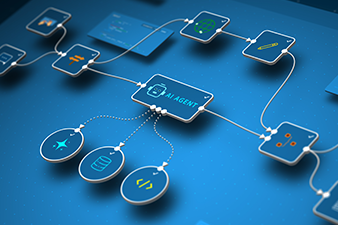
In this model, orchestration becomes a core responsibility of the shared services organization, which coordinates work across systems, AI agents, and human teams. Instead of pushing work through predefined steps, orchestration determines in real time how each request should be handled. Some requests are resolved end-to-end by digital labor, particularly where processes are highly standardized and rules are clear. Others are partially handled and then passed to a human with full context. Still others are routed directly to specialists based on complexity or organizational governance. In this model, orchestration is not just routing work, but about coordinating how work is executed across digital and human labor.
This shift has a direct operational impact. Context travels with the work, eliminating the need for repeated diagnosis. Handoffs are reduced, which shortens cycle times and minimizes rework. The experience becomes faster and more seamless, not because individual tasks are faster, but because the system itself is designed to move work more intelligently.
Rebalancing People, Process, and Technology
Designing an AI-enabled shared services model requires rethinking people, process, and technology together. Optimizing one without the others will not deliver meaningful change.
From a people perspective, the shift is from execution to judgment and managing digital labor. In the traditional model, a large portion of the workforce is dedicated to processing transactions, answering routine questions, and following procedures. As AI takes on that work, human roles shift toward exception handling, decision-making, and governing digital labor. Employees are no longer measured by volume handled, but by how effectively they resolve complex issues and improve the system over time. New roles emerge to support this model, including individuals responsible for monitoring digital labor performance, refining processes, and maintaining the knowledge base that AI relies on. The workforce shifts in composition, with more emphasis on higher-value, judgment-based work. Over time, this may also reduce the overall size of the workforce.
Process design must evolve alongside this shift. Many organizations attempt to overlay AI onto existing processes, but that approach limits its effectiveness. AI performs best when processes are designed with it in mind from the start. That requires standardization with consistent inputs, clear rules, and defined outcomes. Over time, work is segmented into two categories.
High-volume, repeatable work is structured so that digital labor can handle it end-to-end. Leaders should design exception pathways that move ambiguous, sensitive, or judgment-based work to the right human roles with full context. AI also introduces a continuous improvement loop, surfacing patterns and insights that help refine processes on an ongoing basis.
Technology needs to move beyond fragmented tools to treating AI as both a core platform capability and a workforce component within service delivery. Early efforts often rely on standalone solutions, but these do not scale. The target state includes a single conversational entry point for users, an orchestration layer that determines how work is handled, and integration with core systems to execute transactions. This platform approach enables consistency, scalability, and the ability to operate seamlessly across functions.
Redefining the Human and Digital Labor Model
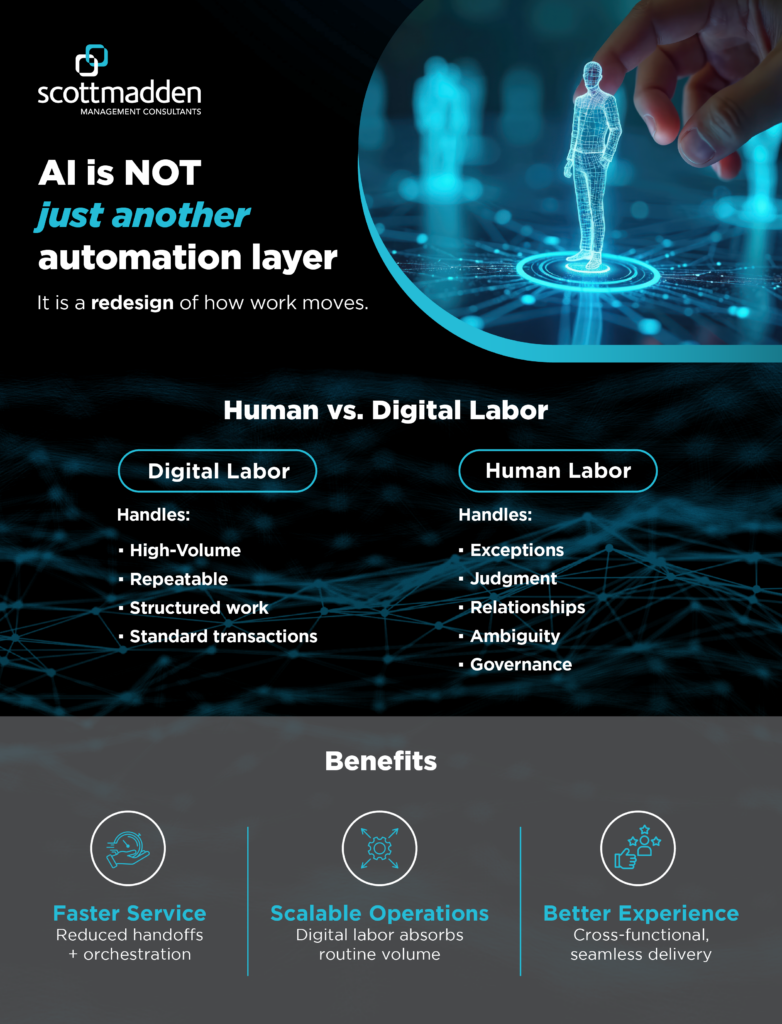
As the model evolves, the division of work between humans and AI becomes clearer. Digital labor is well-suited for high-volume, repeatable tasks and for interpreting requests that rely on both structured data and unstructured context. It can retrieve information, process transactions, and execute workflows with speed and consistency. Humans, on the other hand, remain essential for situations that are ambiguous, sensitive, or require judgment.
Human roles shift toward interpreting outputs, handling exceptions, and managing relationships where context and nuance matter. They also take on responsibility for overseeing AI performance and continuously improving how it operates. This creates a partnership model rather than a replacement model. A useful way to frame the balance is that digital labor handles clarity, while humans handle uncertainty. The goal is not to eliminate human involvement, but to ensure that human effort is applied where it adds the most value.
Designing for Cross-Functional Shared Service Delivery
One of the most significant opportunities in an AI-enabled shared services model is the ability to break down functional silos. Traditional shared services are typically organized by function, with separate entry points and processes for HR, IT, finance, and supply chain. This structure reflects how organizations are built, but it does not reflect how users experience services.
User needs often cut across multiple functions. In the traditional model, that means multiple cases, multiple teams, and multiple handoffs. In an AI-enabled model, a single request can trigger coordinated actions across functions. A digital labor orchestration layer manages the complexity behind the scenes, routing tasks to the appropriate systems and teams while maintaining a unified user experience. This shift reduces fragmentation and improves both speed and transparency. It also allows shared services to deliver end-to-end outcomes rather than isolated tasks, which is where much of the value is created.
AI-Enabled Operating Model Implications and Benefits
As organizations move toward an AI-enabled shared services model, the implications extend beyond individual processes. Capacity planning changes as the focus shifts from handling volume to managing the mix of automated and exception work. Performance measurement evolves to include metrics that reflect how work is executed across human and digital labor, such as autonomous completion rates, escalation patterns, and cost per outcome. Knowledge management becomes dynamic, with AI identifying gaps and continuously improving content.
Perhaps most importantly, change becomes continuous. AI-enabled models do not remain static. They evolve as the system learns, as processes are refined, and as new use cases are introduced. This requires a different approach to management, one that requires establishing feedback loops where AI performance, user interactions, and process outcomes are continuously monitored and used to refine how work is handled.
The end state is clear. Over the next several years, a significant portion of routine work will be owned and executed by digital labor, while human teams focus on complex, high-value activities. Service delivery becomes seamless across functions, and the underlying platform enables work to flow efficiently. Organizations operating this way are more efficient, responsive, scalable, and better aligned with user expectations.
How We Can Help: Designing the AI-Enabled Shared Service Model
For most organizations, the challenge is not identifying where AI can be applied but rather redesigning the service delivery model so those capabilities can scale. That requires making deliberate design choices across workflows, roles, and platforms, rather than layering AI onto existing structures. We focus on helping organizations translate AI potential into a working operating model by concentrating on a few critical areas:
- Focusing on the fundamentals: Important qualifiers and enablers set the foundation before model adjustments and orchestration become critical. Data accessibility, data quality, tooling choices, and enablement (GenAI, workflow, RPA, platforms), workflow design, system integration for workflow connections, security and access controls, governance determination, and application
- Service delivery model design: Define the future-state model across people, process, and technology, including clear human and digital labor boundaries and an orchestration-based approach to workflows
- Process segmentation and redesign: Identify which work can be automated end-to-end, where augmentation is needed, and how exception pathways should be structured
- Platform and orchestration architecture: Design the target-state architecture, including the front door, orchestration layer, and system integrations required to enable cross-functional service delivery
- Workforce and role redesign: Align roles, skills, and organizational structure to support AI-enabled delivery, including oversight, process ownership, and knowledge management
The Bottom Line
AI will not deliver its full value if organizations simply layer it onto legacy shared services structures. To capture step-change improvements in cost, capacity, service quality, and scalability, leaders need to redesign the service delivery model around digital labor, human judgment, orchestration, and continuous improvement.
- AI-enabled service delivery requires a detailed operating model redesign
- Digital labor should own high-volume, repeatable work, while human teams focus on exceptions, judgment, oversight, and relationship management
- Orchestration becomes a core shared services capability, coordinating work across systems, AI agents, and human teams
- Cross-functional service delivery can reduce fragmentation by allowing one request to trigger coordinated actions across HR, IT, finance, supply chain, and other functions
- ScottMadden helps organizations translate AI potential into scalable service models by redesigning workflows, roles, governance, platforms, and performance measures
If AI changes the operating model of shared services, what does that mean for service delivery itself? In the next article in our AI series, we discuss how organizations can move through three adoption phases: crawl, walk, and run.
Discover the strategies, capabilities, and practical considerations shaping the next generation of shared services: AI-Enabled Shared Services