


Redesign Shared Services and GBS for an AI-Enabled World
For years in shared services, work moved through tickets, queues, and handoffs designed to deliver services at scale across HR, finance, IT, supply chain, and other functions.
That model is rapidly changing.
Employees now expect fast, intuitive support with immediate answers and fewer transfers. Business leaders want greater speed, visibility, and flexibility across operations. At the same time, AI is making it possible to resolve many routine requests instantly and connect processes more seamlessly across functions.
Shared services and GBS organizations are well-positioned to lead this shift because they already sit at the center of enterprise operations. The opportunity is not just to improve efficiency, but to redesign how support functions operate and deliver value.
We help organizations modernize shared services for this new environment by combining AI, workflow, governance, and workforce redesign that improve service, reduce effort, and support better business outcomes.
This is Not Another Automation Wave
Shared services has already evolved through standardization, centralization, and traditional automation. AI introduces a more fundamental shift that enables additional value.
Work that once required human effort, such as answering questions, processing transactions, and checking status, is moving into systems that operate continuously and at scale. At the same time, expectations are rising. Employees want immediate answers rather than waiting for case resolution. Leaders want insight, not just processing.
This changes the role of shared services:
- From processing transactions to delivering outcomes
- From reactive support to proactive service
- From siloed functions to integrated service delivery
The result is a different operating model, not just a more efficient one.
ScottMadden Insights

Shared Services as a Platform: Why AI Changes the Model, Not Just the Math
To keep pace with the rapid deployment and innovation AI demands, fundamental shifts in your organization are required that support and secure enterprise change.

Evolution of Service Delivery with AI
Shared services are entering an AI-driven era of speed, intelligence, and adaptability—where efficiency means predicting needs, automating decisions, and continuously learning.

Employing a Crawl/Walk/Run Approach to AI in Shared Services
AI is reshaping service delivery and establishing a new balance of human and machine work. Explore how organizations can progress through three phases of adoption: crawl, walk, and run.

Designing an AI-Enabled Shared Services Model
Organizations that continue to layer AI onto legacy structures may improve individual tasks, but they will miss the larger opportunity to redesign service delivery around digital labor, human judgment, and cross-functional orchestration.

AI Governance in Shared Services: How to Scale Digital Labor with Trust and Control
For shared services organizations, governance is no longer a back-office control function; it is the operating model capability that determines whether AI can move safely from pilots to production.

AI-Enabled Shared Services: New Service Offerings and Emerging Roles
By harnessing AI’s analytical and generative power, shared services are redefining their value proposition from process execution to enterprise enablement.
From Intelligent Automation to Dynamic Service Delivery
Many organizations today are using AI to interpret requests, resolve routine inquiries instantly, and route work without human involvement. This allows a growing share of work to bypass traditional queues entirely. What changes now is using AI at scale and orchestrating digital and human labor. Together, these capabilities shift shared services from people-centered routing to intelligence-led resolution. Shared services operates as a platform of capabilities to serve its customers.
- Automation executes defined steps. Routine, rules-based work is completed consistently and at scale.
- AI interprets requests and context. Digital labor understands natural language, retrieves information, and generates responses.
- Humans apply judgment and expertise. Teams focus on more complex issues, analysis, exceptions, and improvement.
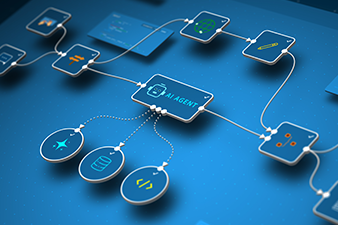
- Orchestration connects systems, AI, and human teams. Work moves across systems, processes, and teams to complete requests end-to-end.
The idea of fixed tiers becomes less relevant as AI operates across all levels simultaneously by handling routine work end-to-end, supporting frontline decisions in real time, and accelerating specialist analysis. The future state is a platform model providing dynamic service delivery where:
- A unified entry point provides a conversational interface
- Work flows to the best resource, whether human or digital, based on the nature of the work
- Resolution paths are non-linear and continuously optimized
The result is a model that is faster, more adaptive, and less dependent on volume-driven staffing, enabling shared services to shift from managing cases to achieving outcomes.
Orchestration is What Makes it Work
AI on its own does not transform shared services. Orchestration does. Orchestration coordinates how work moves across the organization and consists of multiple aspects:
- Technology orchestration connects AI, workflow, and enterprise systems
- Process orchestration links end-to-end activities across functions
- Workforce orchestration aligns human roles with digital labor capabilities
- Service orchestration delivers a unified experience across HR, finance, IT, and supply chain
Shared services, or GBS, is uniquely positioned to own the orchestration layer that turns AI from isolated use cases into an integrated, scalable service delivery model.
Where AI is Already Delivering Results
AI is already in use by leading shared services operations today. These are not theoretical use cases, but examples in production.
Human Resources
- Employee inquiries and policy support
- Benefits and onboarding workflows
- Case intake and routing
IT
- Service desk and password management
- Incident detection and routing
- Knowledge and troubleshooting support
Supply Chain
- Order status and tracking
- Claims and returns processing
- Supplier and inventory support
Finance
- Invoice processing and matching
- Expense management and compliance
- Vendor inquiries and status updates
Across functions, the pattern is consistent: AI handles high-volume, repeatable work, while humans focus on exceptions and decisions.
Beyond Efficiency: New Service Capabilities
AI does more than improve existing processes. It enables services that were not practical before. These capabilities are emerging now, typically with human oversight and clear boundaries.
- Proactive support
Identifying and resolving issues before users raise them - Enterprise-wide insights
Providing insights from data and analysis - Dynamic knowledge management
Continuously improving and updating service content - Cross-functional service delivery
Handling requests that span multiple functions - Expanded service scope
Supporting work that was previously too complex or costly to centralize
This is where AI starts to change the value of shared services, not just its cost structure.
Turning AI into Operational Reality
The limiting factor is rarely the technology. It is how the organization adapts. Successful implementation requires focus in six areas:

Prioritization
Identify high-volume, high-impact use cases with clear ROI

Service Model Redesign
Define what AI handles and where human judgment is required

Workforce Transition
Redesign roles across digital and human labor, build skills, and manage change

Orchestration
Connect AI, human teams, and workflow across functions

Integration
Structure data for quality, connect tools and systems to enable AI applications

Governance and Controls
Ensure security through quality controls, compliance standards, and accountability
Most organizations start with targeted use cases, then expand as capabilities mature. Unlike traditional automation, AI systems learn from usage. This creates a continuous improvement cycle rather than periodic transformation efforts. Over time, responses become more accurate and relevant and exception handling improves.
What Success Looks Like
Organizations that adopt AI-enabled shared services see measurable results:
- Lower cost per transaction and interaction
- Faster response times and 24/7 availability
- Improved user experience across channels with a unified interface
- Better end-to-end resolution across processes and functions
- Higher quality and consistency, not just accuracy
- Better visibility into operations and risks
- Increased capacity for higher-value work
Success is not just about accuracy. It is about speed, experience, and effective resolution.
How We Can Help
We help organizations move from isolated use cases to a fully AI-enabled service delivery model.
Opportunity Assessment and Roadmap
Identify where AI will create measurable value
Focusing on the Fundamentals
Examine data accessibility, quality, tooling choices and enablement (GenAI, workflow, RPA, platforms), workflow design, system integration for workflow connections, security and access controls, governance determination and application
Operating Model and Governance Redesign
Establish control, ownership, and performance management
AI-enabled Service Delivery Redesign
Define how work is distributed across human and digital labor
Use Case Development, Platforms, and Orchestration
Develop priority use cases; align AI, workflow, and enterprise systems
Workforce Transition, Scaling, and Continuous Improvement
Equip teams to operate in a blended workforce model, expand capabilities, and embed ongoing improvement
AI is already changing how shared services operates. The organizations seeing the most value are not just deploying AI—they are redesigning service delivery around the mix of human and digital labor. We help clients make that shift in a practical, controlled way that delivers real results.