



Why AI Governance Is the Scaling Enabler for Shared Services
AI solutions rarely fail because the technology cannot perform the task. They fail to scale because leaders cannot yet prove that digital labor is accurate, explainable, compliant, cost-effective, and accountable. To safely scale AI, shared services leaders need governance directly embedded into the operating model. That means defining clear ownership, managing risk and data quality, establishing human-in-the-loop controls, monitoring performance in real time, and measuring whether AI is contributing to the intended business outcomes.
AI introduces a different risk profile than traditional automation. Unlike rule-based automation, digital labor can interpret data and context, which can introduce variability in outputs and decision-making. As AI performs work at scale with limited human intervention, familiar concerns around accuracy, compliance, transparency, bias, and operational resilience become amplified. In many cases, the reasoning behind decisions is not immediately visible, making accountability and oversight more challenging. Without effective governance, organizations either slow adoption out of caution or move forward with unnecessary exposure.
The organizations that successfully scale AI take a different approach. They treat governance as a critical part of the operating model itself. The key is finding the right balance with governance so that it provides the necessary guardrails while accelerating progress. Done well, governance does not restrict AI but enables it to efficiently and safely operate at scale.
AI Governance Foundations for Scale
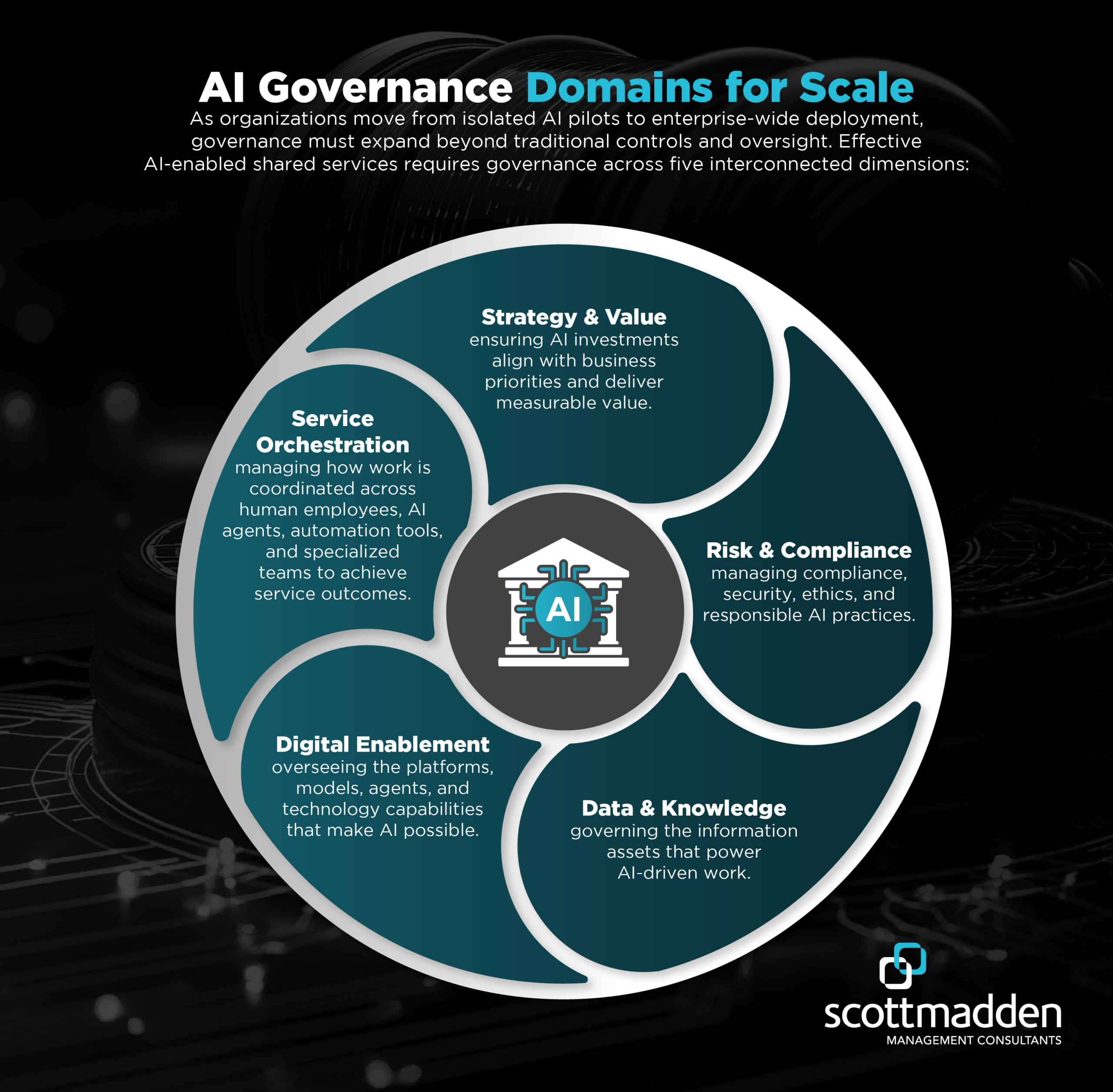
As organizations move from isolated AI pilots to enterprise-wide deployment, governance must expand beyond traditional controls and oversight. Effective AI-enabled shared services require governance across five interconnected dimensions:
- Strategy and Value – ensuring AI investments align with business priorities and deliver measurable value.
- Risk and Compliance – managing compliance, security, ethics, and responsible AI practices.
- Data and Knowledge – governing the information assets that power AI-driven work.
- Digital Enablement – overseeing the platforms, models, agents, and technology capabilities that make AI possible.
- Service Orchestration – managing how work is coordinated across human employees, AI agents, automation tools, and specialized teams to achieve service outcomes.
Together, these dimensions provide a comprehensive framework for governing AI-enabled operations.
Three Principles That Build Trust in Digital Labor
While the five governance domains define what must be governed, three principles should apply across every domain, process, and decision.
Accountability ensures clear ownership for outcomes, decisions, risks, and performance. Every AI-enabled process should have defined owners for the business outcome, data, technology, and risk. Business accountability remains with the process owner even when AI performs the work.
Transparency ensures that AI-driven actions can be understood, audited, and challenged. Stakeholders should be able to trace the data used, the decision made, the action taken, and the resulting outcome.
Value Realization ensures that AI is measured by business impact, not deployment activity. Governance should track whether AI improves service quality, increases capacity, reduces cost, lowers risk, enhances customer experience, and delivers expected ROI.
Together, these principles allow AI-enabled shared services to remain trusted, measurable, and aligned to business outcomes as digital labor becomes a larger part of service delivery.
How Should Governance Be Embedded into the AI-Enabled Shared Services Model?
Effective governance is not a separate layer applied after AI is deployed. It must be directly embedded into the operating model and applied across all five governance domains: Strategy and Value, Risk and Compliance, Data and Knowledge, Digital Enablement, and Service Orchestration. Organizations operationalize governance across three interconnected stages: design time, runtime, and post-execution.
At design time, governance establishes the rules under which approved use cases move forward following ROI and portfolio goals. Organizations assign accountability, determine what work digital labor can perform autonomously, and specify where human intervention is required. Leaders design decision boundaries, escalation paths, risk thresholds, data requirements, and service expectations directly into workflows, models, and operating procedures. While governance addresses this set of guardrails, it should be deployed in such a way that it effectively enables superior design, supported outcomes, and better adoption.
At run time, governance becomes active and supports efficient work. Digital labor, AI agents, automation platforms, and human workers operate within the controls established during design. A digital control tower provides visibility into operational performance, service delivery, AI behavior, risk indicators, and human intervention points. The control tower provides corrective action in real time, as needed, to either take action, notify a process owner, or shut down a solution. Escalation rules, exception management processes, and human-in-the-loop controls ensure work is routed appropriately when confidence thresholds, risk tolerances, or service requirements are not met. This real-time visibility reinforces transparency by making decisions, actions, and outcomes observable as work is performed.
Post execution, governance focuses on learning, accountability, and value realization. Audit trails provide traceability into what decisions were made, what data was used, and how outcomes were generated. Quality reviews and compliance monitoring identify control gaps and improvement opportunities. Equally important, organizations evaluate whether AI is delivering the intended business outcomes, including improved service performance, increased workforce capacity, reduced costs, lower risk, and enhanced customer experiences. Teams use these insights to refine models, workflows, controls, and operating practices to continuously improve performance and to consolidate and retire solutions.
When these three stages are connected, governance becomes part of the flow of work rather than an external checkpoint. Accountability is established during design, transparency is maintained during execution, and value realization is measured after outcomes are achieved. This reflects a broader shift in AI-enabled shared services: governance is not added onto service delivery—it is embedded directly into how the operating model functions.
Executive Brief: AI Governance to Scale Digital Labor
Want a scaled-down version of this article? Download the Executive Brief.
Example: Finance Accounts Payable Processing
This approach across stages becomes easier to understand when applied to a real business process. Consider an AI-enabled accounts payable process that extracts invoice data, validates invoices, and recommends coding and approval actions.
Key Takeaways
- Governance should be treated as an enabler of AI scale, not a checkpoint that slows adoption.
- Digital labor requires clear decision rights, escalation paths, monitoring, and human oversight.
- Control towers can help organizations centralize visibility, enforce thresholds, and manage AI performance in real time.
- Data quality, standardization, transparency, and auditability are foundational to trusted AI service delivery.
- ScottMadden helps organizations design governance models, workflows, and controls that allow AI to operate safely and effectively at scale.
How ScottMadden Can Help
Effective AI governance requires more than policies and oversight. Organizations need governance embedded into operating models, service delivery processes, and digital workforce management. ScottMadden helps clients design and operationalize governance frameworks that support AI adoption while maintaining accountability, transparency, and control.
- AI Governance Strategy – Define governance structures, decision rights, accountability models, and oversight mechanisms across the five governance domains.
- Digital Labor Governance – Establish governance models for AI agents, automation, and digital workers, including ownership, escalation paths, decision authorities, and performance management.
- Service Orchestration and Process Redesign – Embed governance directly into workflows through process redesign, exception management, human-in-the-loop controls, and clear decision boundaries.
- Performance, Value Realization, and ROI Measurement – Develop governance processes, metrics, and reporting mechanisms that measure operational performance, business outcomes, and realized value from AI investments.
- Change Management and Adoption – Build organizational trust, workforce readiness, and adoption through clear accountability, transparent operating practices, and targeted change management strategies.
To safely scale AI, shared services leaders need governance embedded directly in the operating model, but how does that affect existing and new services? In the next article in our AI series, we explore how organizations are using AI to enhance existing services and unlock entirely new categories of services that can be centralized, scaled, and delivered through shared services.
Discover the strategies, capabilities, and practical considerations shaping the next generation of shared services: AI-Enabled Shared Services