




HR costs per employee are rising at a notable pace, even relative to the current high-inflation environment. Organizations are expanding HR capabilities, investing in AI-enabled technologies, responding to workforce pressures, and modernizing service delivery models. While these changes are intended to improve efficiency and scalability over time, they are also increasing near-term operating costs.
The challenge for HR leaders is determining which cost increases reflect strategic investment, which signal structural inefficiency, and which indicate the need for operating model transformation. Addressing this growth requires organizations to rethink how HR services are delivered, where technology can reduce manual effort, and which investments create long-term value.
HR Costs Are Rising Significantly
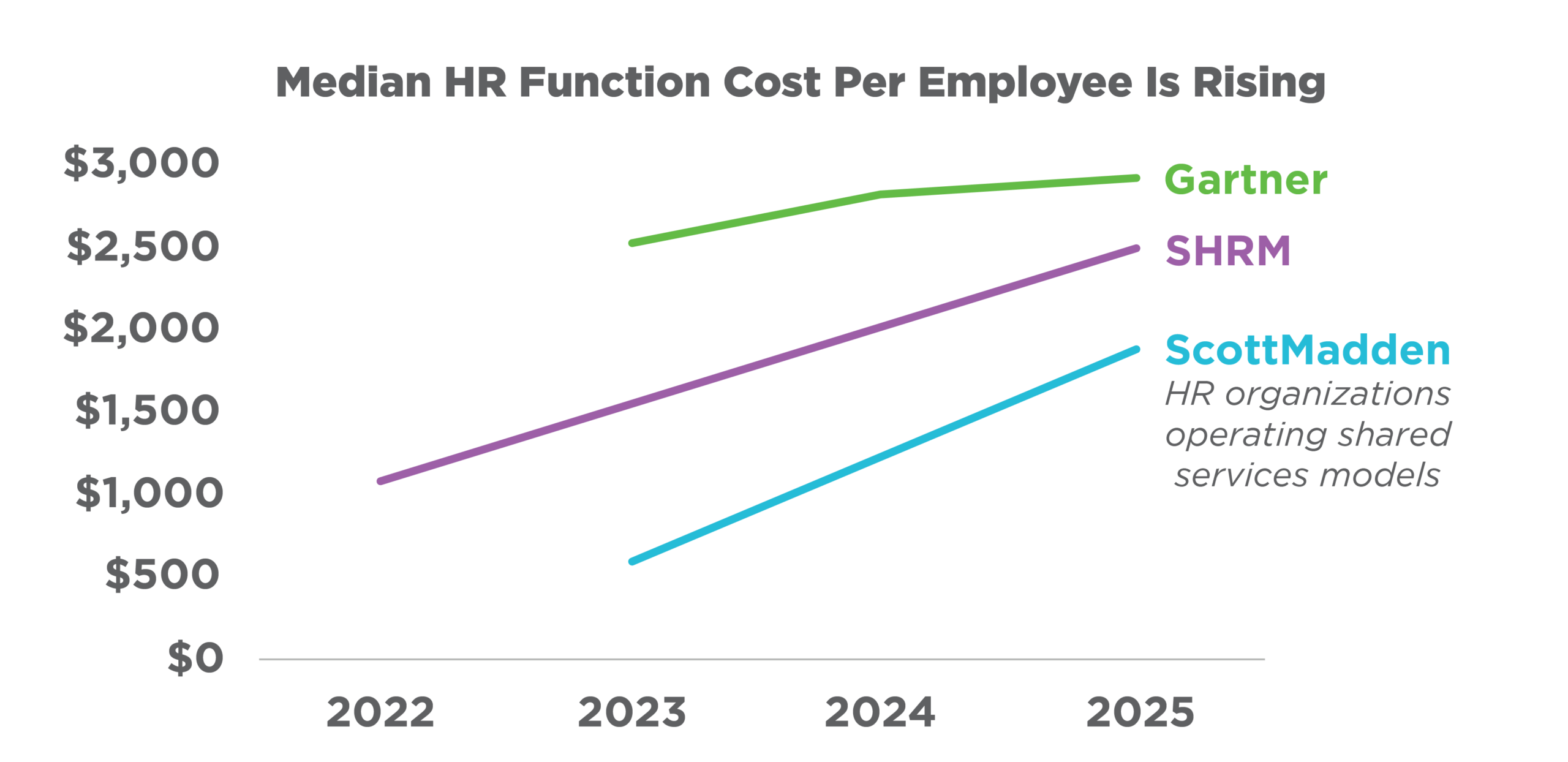
HR costs are increasing across organizations regardless of operating model. Gartner reports a 15% rise in HR costs since 2023, across organizations globally,1 while SHRM shows HR spending among U.S.-based member organizations up 127% since 2022.2 Additionally, the ratio of HR expense to operating expenses has grown from 1.4% in 2022 to 2.4% in 2025,3 indicating a larger share of enterprise spend is being directed toward HR.
Within HR functions operating shared services models, the median reported total cost per employee has more than doubled since 2023, based on the 2025 ScottMadden and APQC HR Shared Services Benchmarking Study. While the participant mix across the two study cycles showed some variation, the median cost per employee increased materially across each major industry and all levels of shared services maturity, indicating a broad-based increase in HR cost in recent years.
At the median, organizations operating shared services models still report lower overall HR costs per employee than organizations across all operating models,4 likely due to centralized delivery, standardized processes, shared infrastructure, and economies of scale. However, even these lower-cost delivery models are experiencing significant cost growth.
Understanding the Benchmark Populations
ScottMadden and APQC HR Shared Services Benchmarking Study
- Organizations operating with an HR shared services model
- Large enterprises across more than 15 industries in North America, with nearly all reporting annual revenue of more than $1 billion
- Personnel, outsourcing, technology, and overhead costs included
- Centralized and standardized delivery models that typically operate at lower overall HR cost levels
Gartner HR Budget and Efficiency Benchmarks
- Global benchmarks across organizations of varying industries, geographies, sizes, and operating models
SHRM Benchmarking
- U.S.-based survey of member organizations across varying industries, sizes, and operating models
What’s Driving Cost Increases?
Rising HR costs are being driven by expanding expectations for HR, outsourcing cost pressures, and accelerating technology and AI investment.

Expanding Expectations

Pressures from Outsourcing

Investment in Technology
Expanding HR Expectations
The growth in HR costs is driven in part by expanding demand for HR support. HR’s role is evolving as it becomes more strategically important to the business. Growing emphasis on employee experience, workforce analytics, and personalized services is expanding HR’s involvement in higher-value activities.5 This shift is visible at the executive level, with 59% of CEOs expecting CHRO influence to increase over the next several years.6 These expectations are increasing the volume, complexity, and specialization of HR work.
HR leaders have been navigating evolving workplace regulations, employee well-being concerns, return-to-office policies, and workplace conduct requirements as organizations adapt to workforce changes following the COVID pandemic, shifting social expectations and increasing regulatory requirements.7 Employee relations activity provides one measure of these demands: the average number of discrimination, harassment, and retaliation allegations rose 24% year over year.8 As the volume and complexity of workforce issues increases, organizations need more HR capacity to address them. Indeed, industries with greater regulatory requirements, workforce management demands, and specialized talent needs tend to have larger HR organizations than their peers.9
With this increased complexity, organizations are investing in new capabilities to help manage evolving workforce needs. Competition for talent and advances in AI are reshaping workforce requirements, increasing HR’s focus on workforce planning, upskilling, and balancing work between human and digital labor.10 People analytics is another area of growth, with staffing ratios for this function increasing 60% since 2020, and 38% of organizations expanding their people analytics teams in the past year.11 Moreover, personalized HR services are becoming more important as well. While 62% of HR professionals reported increased emphasis on personalized HR services in 2023-2024, nearly three-quarters (73%) expected that importance to continue increasing through 2025-2026.12 Delivering these capabilities requires new skills, resources, supporting technologies, and operating model adjustments, which adds cost.
As HR handles more strategic, complex, and specialized work, staffing levels are rising to support the additional expectations. The median HR organization staffed 90.1 employees per HR FTE in 2022, compared to 50.5 employees per HR FTE in 2025,13 meaning HR FTEs are growing faster than the employee base. Furthermore, HR employment growth has consistently outpaced overall employment growth. Over the past decade, the number of HR professionals employed in the United States grew 64%, compared to 14% growth in overall employment, while more recently between 2020 and 2025, HR employment grew 16%, compared with 3% growth in overall employment.14 Similarly, within HR organizations operating shared services models, the median employee-to-HR ratio has declined by 30% since 2023,15 indicating that even models designed for efficiency are affected by rising staffing levels. Expanding HR staffing relative to the employee base contributes directly to higher HR cost per employee.
Outsourcing Cost Pressures
Outsourcing can increase HR costs even when internal staffing levels remain unchanged. Spending on outsourced services continues to grow, with global services market revenue increasing by 2%–5% annually in recent years.16 Similar growth is seen in health and wellness benefits administration outsourcing market revenue.17 Even more standardized outsourced employment administration services have experienced rising price levels. Producer price data for professional employer organizations shows approximately 8% year-over-year pricing increases.18
Among organizations operating shared services models, nearly three-quarters (72%) outsource at least one service,19 and 36% of shared services leaders expect to expand outsourcing within HR.20 Additionally, rising costs are a challenge in outsourcing arrangements cited by more than one in five shared services leaders.21
As outsourcing becomes a larger component of HR service delivery, provider pricing and contract costs can have a greater impact on overall HR spending. In this environment, even stable service volumes can translate into higher costs, particularly where scope, governance, or contract structures are not tightly managed.
Technology and AI Investment
Even without platform changes or expansion, technology costs can rise as pricing models change. The range of annual HR tech cost per employee has widened in recent years, which may be related to emerging pricing models based on platform usage and delivered value. 24 This also indicates greater divergence in how organizations invest in their HR technology, suggesting that some organizations are growing tech spend more aggressively than others, contributing to rising HR costs for those companies.
Meanwhile, investment in AI and intelligent tools is a newer priority. Enterprise-wide spending on generative AI increased 130% in 2024, while in 2025, 31% of organizations allocated a dedicated budget for AI in HR.25 The share of HR organizations increasing investment in intelligent tools also rose from 22% to 33% in 2025, placing AI among the top HR technology investment categories.26 Organizations allocate GenAI spending across new AI technologies, existing systems, and internal development efforts.27 The strongest performance impact comes from organizations that combine embedded AI capabilities within HR platforms with specialized AI point solutions, which increases the need for integration and governance across systems.28 HR technology integrations increased 42% year over year, likely due to organizations preparing systems for data connectivity and AI agents. 29
Even where AI creates productivity gains, organizations may not immediately realize full benefits. Currently, about 37% of AI-enabled time savings is being offset by rework, with HR functions reporting more AI-related rework than other areas of the business due to the high need for accuracy, review, and oversight in HR activities.30 Moreover, much of AI’s impact remains concentrated at the individual level. While 81% of HR professionals report using AI personally, more than 31% report using AI in workforce processes, consistent with cross-functional evidence that AI has delivered stronger gains in individual productivity than enterprise-wide performance. 31
In practice, HR technology investment is becoming more focused on advanced capabilities that require integration, governance, and new ways of working. While many of these investments are intended to improve efficiency and scalability over time, they can also introduce additional implementation, oversight, and support costs before efficiency gains are realized.
Additional Labor and Economic Pressures
In addition to these HR-specific drivers, broader market factors like inflation, rising labor costs, and skills shortages continue to contribute to cost increases. Half of employers cite rising prices as a driver of business transformation, 52% report that wages are increasing as a share of revenue, and 63% identify skills gaps as a primary barrier to transformation.32 These pressures are increasing the cost of both internal HR teams and outsourced providers. Although AI and self-service offer a path to offset some of this impact, those benefits often lag initial investments.
Implications for HR Leaders
How these pressures affect overall function cost depends on how HR work is organized. Fragmented delivery models, limited AI maturity, and processes still designed solely around human effort can all contribute to higher costs. In many cases, HR organizations are delivering enhanced services to meet demands without corresponding changes to how work is structured or executed.
This creates a risk: without structural changes, new technology and automation investments can add cost faster than they reduce it. Applying new tools to existing processes or service models with unclear role boundaries and unnecessary handoffs often increases complexity, duplicative effort, and long-term support requirements.
Not all cost growth is problematic. Increased investment in areas such as analytics, digital tools, and employee experience can improve decision-making and organizational performance. However, these investments need discipline, with clear links between spend and measurable outcomes.
At the same time, most HR functions are under pressure to deliver more value with constrained resources. This places greater importance on directing investment toward areas that meaningfully improve service delivery.
Over time, managing HR costs will hinge on rebalancing work between human and AI labor, optimizing what is handled through self-service, automation, and AI versus higher-value human support.
How Leading Organizations Respond
Leading organizations make targeted changes to how work is structured, delivered, and supported:
- Redesign the delivery model: Shift transactional work out of field HR and functional teams into shared services, while clarifying roles, accountabilities, and service boundaries and optimizing the flow of work. This reduces duplication and ensures work is performed by the appropriate resources in the organization.
- Enable customers: Identify high-volume transactions and routine support inquiries currently handled by human-assisted customer service and escalated to functional experts and redesign them for resolution in AI-enabled self-service. ScottMadden estimates that well-structured, tiered service delivery models that integrate rules-based automation and AI can enable 40%–60% of routine inquiries and transactions to be handled without human intervention. This percentage is expected to increase as AI-enabled solutions become more common and mature.
- Deploy AI to enhance decision-making and service delivery: Redesign workflows for use cases that require interpretation, personalization, and prediction, such as employee support, case triage, and workforce insights. AI expands the scope of what can be handled digitally, enabling more dynamic interactions, improving how cases are routed and resolved, and increasing the share of work resolved without human involvement over time.
- Simplify and integrate the HR technology stack: Reduce system overlap, strengthen governance, and limit long-term support costs. Consolidating around AI-capable platforms that embed analytics, natural language processing, and process orchestration can enable more consistent and scalable HR support.
- Rebalance outsourcing and in-house delivery: Reassess which activities are best delivered internally versus externally, using benchmarks and performance data to validate ROI, ensure that the service providers are delivering on their contract value, and prevent cost creep over time.
From Rising Costs to Strategic Alignment
Rising HR costs are often interpreted as a loss of efficiency. In practice, they more often indicate a function in transition. As HR expands its role and invests in new capabilities, costs increase but not always in a coordinated or sustainable way.
Organizations that treat this moment as a signal to modernize rather than simply reduce spend are better positioned to respond. Aligning around AI-enabled shared services, more disciplined service delivery models, and data-driven decision-making can help reset the cost structure while improving the quality and consistency of HR support.
ScottMadden works with organizations to assess HR cost drivers, redesign service delivery models, and build practical road maps for AI integration and technology investment. For leaders navigating rising costs, the opportunity is not just to contain spend but to realign HR for long-term efficiency and impact.
If you would like to be notified when participation opens for our next HR or Finance benchmarking reports, fill out the form here.
Data Sources
2 SHRM, SHRM Benchmarking Report: CHRO Metrics (2025); SHRM, Human Capital Report (2022).
3 ibid.
4 ScottMadden & APQC, HR Shared Services Benchmarking Study (2025); Gartner, CHRO Budget Benchmarks (2025); SHRM, SHRM Benchmarking Report: CHRO Metrics (2025).
5 iSolved, 7 HR Trends in 2025 (2025); Insight222, People Analytics Trends (2024); HR.com, Future of Personalized HR Services and Experiences (2023-2024); The Economist, How HR Took Over the World (2025).
6 IBM Institute for Business Value, Rewiring the C-suite: The Fast Track to 2030 (2026).
7 The Economist, How HR Took Over the World (2025).
8 HR Acuity, Ninth Annual Employee Relations Benchmark Study (2025).
9 SHRM, Trends in HR Employment and Labor Demand (2026).
10 SHRM, 2026 Talent Trends (2026); World Economic Forum, Future of Jobs Report (2025); SHRM, 2026 CHRO Priorities and Perspectives (2026).
11 Insight222, People Analytics Trends (2025).
12 HR.com, Future of Personalized HR Services and Experiences (2023-2024).
13 SHRM, SHRM Benchmarking Report: CHRO Metrics (2025); SHRM, Human Capital Report (2022).
14 Bureau of Labor Statistics via The Economist, How HR Took Over the World (2025); IPUMS CPS via SHRM, Trends in HR Employment and Labor Demand (2026).
15 ScottMadden & APQC, HR Shared Services Benchmarking Study (2025).
16 Everest Group, Outsourcing Services Cost and Pricing: The Trends to Know to Focus on the Win (2024).
17 Everest Group, Health and Wellness (H&W) Benefits Administration Outsourcing (BAO) US Market Primer (2026).
18 U.S. Bureau of Labor Statistics, Producer Price Index by Industry: Professional Employer Organizations (2025-2026).
19 ScottMadden & APQC, HR Shared Services Benchmarking Study (2025).
20 SSON, Business Process Outsourcing in 2026 (2026).
21 SSON, Business Process Outsourcing in 2026 (2026).
22 Gartner, CHRO Budget Benchmarks (2025); Sapient Insights Group, 28th Annual HR Systems Survey Report (2025-2026).
23 Sapient Insights Group, 28th Annual HR Systems Survey Report (2025-2026).
24 Ibid.
25 Wharton School, University of Pennsylvania, Accountable Acceleration: Gen AI Fast-Tracks Into the Enterprise (2025).
26 Sapient Insights Group, 28th Annual HR Systems Survey Report (2025-2026).
27 Wharton School, University of Pennsylvania, Accountable Acceleration: Gen AI Fast-Tracks Into the Enterprise (2025).
28 Sapient Insights Group, 28th Annual HR Systems Survey Report (2025-2026).
29 World Economic Forum, Future of Jobs Report (2025).
30 Workday, Beyond Productivity: Measuring the Real Value of AI (2026).
31 Sapient Insights Group, 28th Annual HR Systems Survey Report (2025-2026); MIT NANDA, State of AI in Business (2025).
32> World Economic Forum, Future of Jobs Report (2025).