



Intelligent automation is delivering measurable benefits within HR shared services, but the efficiency gains are relatively modest. In the 2025 ScottMadden and APQC HR Shared Services Benchmarking Study, HR organizations operating shared services models with intelligent automation implemented report leaner staffing models, lower HR costs, and higher productivity. Yet the magnitude of those improvements suggests that most organizations are still capturing incremental efficiencies rather than fundamentally changing HR’s work. Greater gains will depend on integrating intelligent automation and AI into the design and delivery of HR services.
So why aren’t these gains larger? Interest in AI is accelerating in both HR and shared services, but adoption remains uneven.¹ Many HR organizations are still applying intelligent automation to transactional activities and using AI in limited, process-driven use cases.² Upfront enablement costs, integration challenges, process complexity, and governance concerns continue to limit the scale and impact of these efforts.³
The greater benefit comes from redesigning end-to-end HR service delivery rather than deploying isolated use cases. Emerging AI capabilities change the nature of the work itself, enabling HR to handle more complex, judgment-based tasks and generate predictive insight.4 What is currently driving modest efficiency gains has the potential to increase service capacity, improve the employee experience, and enable HR shared services to support a larger and more complex workforce without proportional cost growth.
Intelligent Automation and HR Shared Services Performance
Among organizations operating HR shared services models, HR operating performance varies with intelligent automation maturity, with differences between organizations that have implemented intelligent automation and those that are piloting, considering, or not using it. While these organizations may differ in other ways that influence performance, comparing organizations at different stages of intelligent automation maturity helps identify meaningful patterns in HR operating performance.
Organizations with Intelligent Automation Outperform Those Without
Efficiency and Capacity Gains
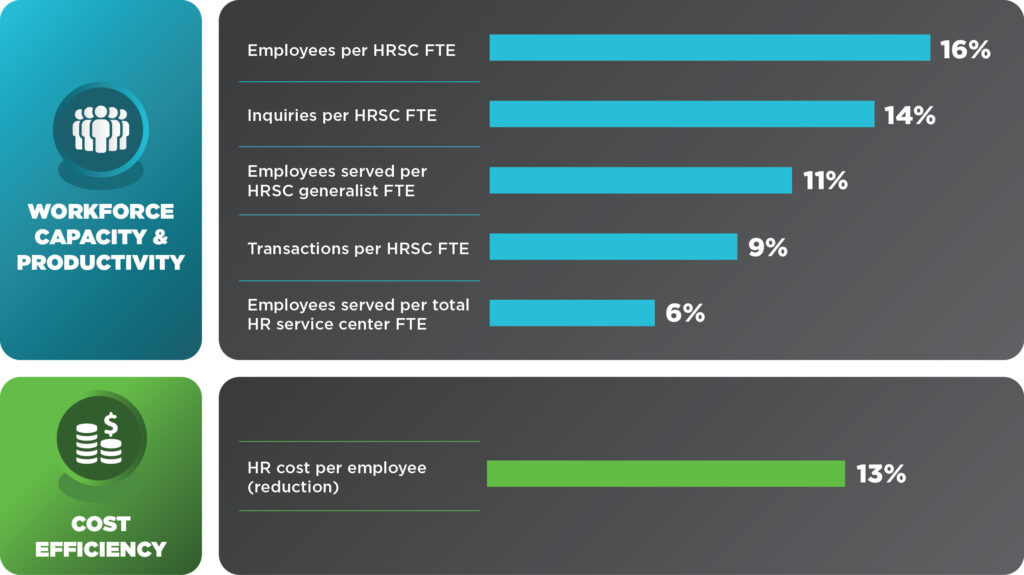
Function-level staffing and cost: Organizations with intelligent automation support 16% more employees per HR full-time equivalent (FTE) and operate with 13% lower total HR cost per employee at the median.
Service center staffing: Organizations with intelligent automation report 6% more employees served per HR shared services center FTE and 11% more employees served per HR service center generalist FTE at the median. Importantly, the leaner staffing does not appear to come from a narrower scope of services. At the median, organizations with and without intelligent automation provide 9 of 11 HR services in scope. This suggests that intelligent automation is reducing reliance on manual intervention in high-volume activities while maintaining service capacity.
Productivity: Automated service centers handle 14% more inquiries and 9% more transactions per service center FTE at the median, indicating increased efficiency in both case management and transactional work.
Service Quality and Resolution
Service quality is maintained despite leaner staffing and higher throughput. Median first-contact-resolution rates show no meaningful difference between organizations with and without intelligent automation. In addition, customer satisfaction is similar across both groups. This implies that the current efficiency gains do not come at the expense of customer service experience.
Intelligent Automation Maturity and Scaling
Adoption: Intelligent automation adoption is widespread in HR shared services. More than half of HR organizations with shared services models report having implemented intelligent automation, with another 30% in pilot stages.
Use cases: Among HR organizations operating shared services models, intelligent automation is primarily concentrated in transactional and routing activities, such as onboarding workflows, approval routing, and case triage. A smaller group reports more advanced use cases, including chatbot-enabled support, workload balancing, and predictive escalation. This emphasis on transactional work helps explain why organizations are realizing only modest efficiency gains and why much of the potential remains untapped.
Conversational capabilities: Conversational solutions, including self-service chatbots, virtual agents, and digital assistants, are used by organizations at all stages of intelligent automation maturity. Among organizations using these conversational tools, those with intelligent automation implemented report a higher median chatbot resolution rate than those still piloting: 40% compared to 30%. Resolution rates are fairly consistent across different types of conversational solutions, suggesting that performance differences are driven less by the type of solution and more by how conversational technologies alongside intelligent automation are integrated and scaled within the service delivery model.
Maturity and scale: While intelligent automation adoption is widespread, implementation does not necessarily mean scaled deployment. Within the overall shared services market, only about one-third of organizations report intelligent automation deployed at scale.5 In HR, intelligent automation maturity is concentrated in task-level and partially automated processes, while AI usage is largely in assisted and semi-automated environments.6 Similarly, in shared services and GBS organizations, AI maturity is low, with 25% reporting AI in production and fewer than 1% operating AI as business as usual.7 The efficiency gains organizations are realizing today are occurring even as AI capabilities are generally early in maturity, suggesting that deeper integration into HR service delivery could deliver substantially greater operational benefits.
Priorities for AI-enabled HR Service Delivery
The impacts of intelligent automation are encouraging, but the next wave of value depends on whether organizations can embed automation and AI into how HR work is done. Today’s gains are driven by intelligent automation focused on transactional activities; the greatest benefits will come from integrating it into end-to-end workflows. This is an operating model decision: organizations must redesign how work is routed, resolved, and escalated, clarify where human judgment remains essential, and embed AI into everyday service delivery.
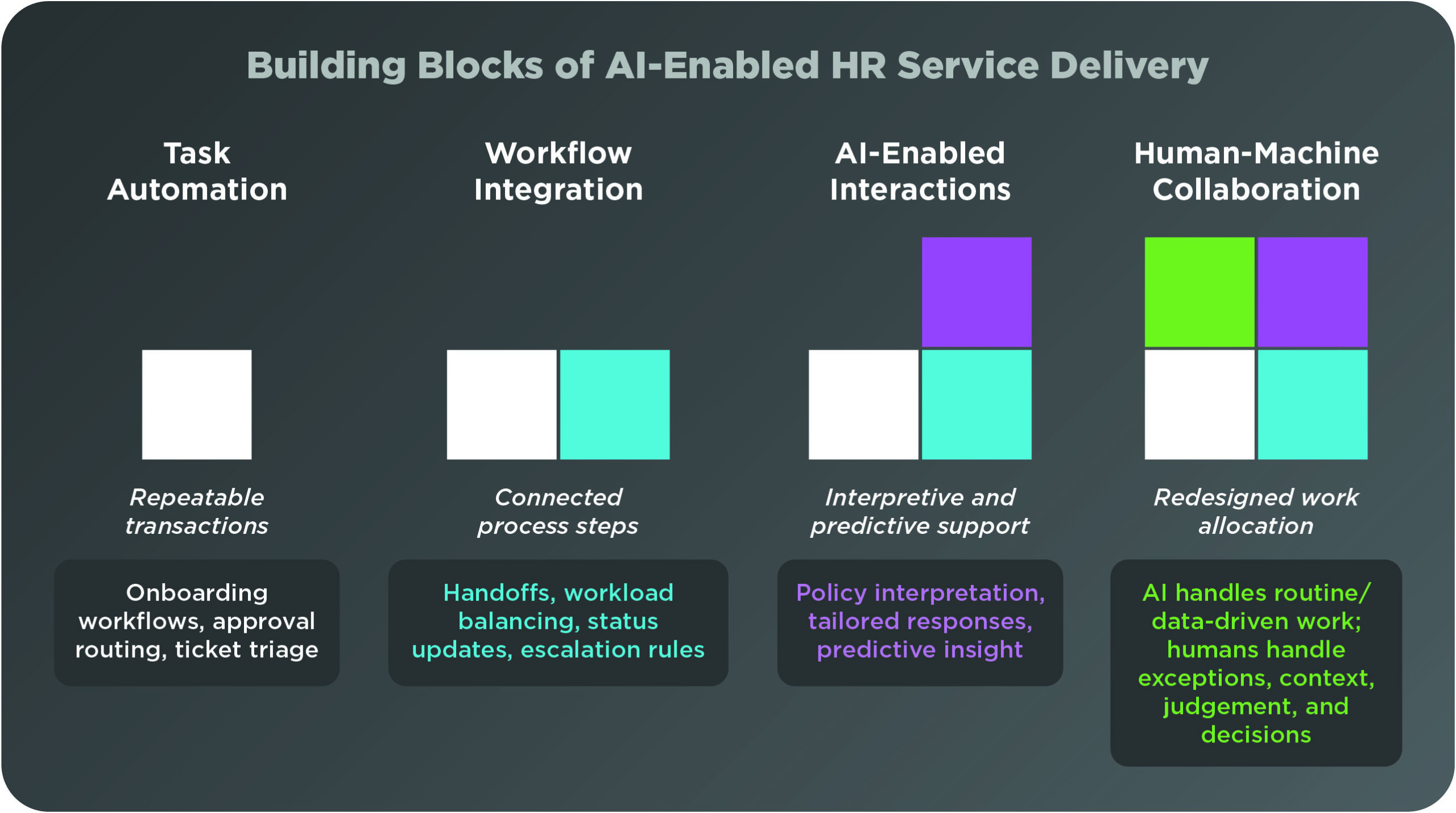
As AI capabilities mature, the challenge is to adapt to new requirements for how HR work is designed and managed. AI enables more dynamic interactions, such as interpreting employee questions, generating tailored responses and content, and using data analysis and forecasting to anticipate service demand.9 To make AI work at scale, organizations must enable new governance models, different skill sets, and processes designed for human and digital collaboration where AI handles routine and data-driven tasks while humans focus on exceptions, context, and decision-making.
For HR leaders, the challenge is determining how work should be distributed among automation, AI, and human support, while balancing cost, service quality, and employee experience. Organizations must balance the need to scale with the need to manage cost and maintain service quality, identifying where automation can reduce manual effort, where AI can support more complex interactions, and where human expertise remains essential.
Five Actions for AI-Enabled HR Service Delivery
Leading organizations are focusing on practical steps that both improve current intelligent automation performance and prepare HR for more advanced AI capabilities:
- Expand intelligent self-service. Combine AI-enabled self-service, conversational technologies, and workflow automation to resolve common HR inquiries like pay, benefits, and onboarding status updates before inquiries require live HR support. ScottMadden estimates mature environments that integrate rules-based automation and AI-enabled self-service can enable 40%–60% of routine inquiries and transactions to be handled without human intervention. This percentage increases significantly as AI-enabled solutions become more common and mature.
- Apply AI to higher-value work. Implement AI to support tasks that require interpretation, analysis, and judgment, including policy interpretation, eligibility checks, and analytics. This can complement transactional automation to help human HR teams make faster, evidence-based decisions and support more complex work within HR shared services.
- Redesign workflows for AI-enabled service delivery. Standardize and simplify processes before introducing AI, then redesign routing, escalation, and resolution so work flows to the most appropriate resources. AI delivers the greatest value when it is embedded into the workflow, rather than layered onto existing processes.
- Strengthen governance and workforce readiness. Define ownership for automation and AI use cases and supporting data, establish controls for privacy and bias, reskill staff to support exception handling and analytics, and ensure consistent process oversight.
- Evolve performance metrics for continuous improvement. Use insights from both traditional service metrics and AI-specific measures, such as autonomous resolution rate, AI-to-human escalation rate, and human override rate, to refine processes, identify where work should shift between digital and human channels, and guide ongoing improvements to service delivery.
In Practice: Applying AI to High-Volume Recruiting
A food service and facilities management organization, hiring approximately 80,000 employees annually, partnered with ScottMadden to modernize its talent acquisition process through conversational AI. ScottMadden led requirements gathering, vendor selection, and implementation planning before helping develop a roadmap to expand AI use cases across the enterprise.
Outcomes
- Automated candidate communications and interview scheduling through the Paradox conversational AI platform
- Reduced interview scheduling time to less than three minutes per candidate
- Scheduled interviews for nearly 30,000 candidates through the solution
- Enabled more than 80% of candidates to reschedule after a weather-related hiring event cancellation, avoiding days of manual recruiter effort
Scaling Intelligent Automation into HR Service Delivery
Intelligent automation in HR shared services is showing its value, enabling smaller, faster, and more capable teams.
The next step is building on the gains from intelligent automation by integrating AI into HR service delivery. As organizations move beyond pilots and point solutions, the focus shifts to applying AI to support decision-making, enhance analysis, and improve employee support. This expands the role of HR shared services from improving efficiency to strengthening the employee experience and supporting the business.
Organizations that evolve from automation to AI-enabled shared services will achieve more than cost advantage and operational efficiency. They will build adaptive, insight-driven service models that continuously improve and respond to changing workforce needs. AI amplifies operational excellence by expanding what HR shared services can do rather than replacing the fundamentals that make shared services effective.
ScottMadden works with organizations to assess technological maturity, identify high-impact use cases, and design practical road maps for scaling intelligent automation and integrating AI into service delivery. For HR leaders, the opportunity is not only to improve efficiency but also to expand the strategic contribution of HR shared services by reshaping how HR services are delivered and experienced.
The Bottom Line
Intelligent automation is delivering measurable efficiency gains in HR shared services, but deeper integration of AI into the service delivery model can expand its operational and business impact.
- Organizations using intelligent automation are achieving leaner staffing, lower costs, and higher productivity while maintaining service performance.
- Most organizations operating HR shared services have implemented intelligent automation, but its use is concentrated in transactional activities and has not yet been deployed at scale, limiting the impact of current investments.
- Future value will depend on integrating intelligent automation and AI into HR service delivery to support more complex work, improve decision-making, and strengthen business support.
- Organizations that make this transition will expand the role of HR shared services from improving efficiency to delivering greater operational and business value.
References
2 ScottMadden & APQC, HR Shared Services Benchmarking Study (2025); SHRM, The State of AI in HR (2026).
3 SSON & ScottMadden, How GenAI Can Augment the Conventional Shared Services Model (2024); SHRM, The State of AI in HR (2026).
4 ScottMadden, Shared Services as a Platform: Why AI Changes the Model, Not Just the Math (2026); Phenom, State of AI & Automation in HR: 2026 Benchmarks Report (2026).
5 SSON, State of Intelligent Automation (2025).
6 Phenom, State of AI & Automation in HR: 2026 Benchmarks Report (2026).
7 Everest Group, Rethinking GBS Operating Models: Sourcing & Talent in an AI World (2026).
8 SSON & ScottMadden, How GenAI Can Augment the Conventional Shared Services Model (2024); HR Executive, Feeling Pressure to Apply AI? Three Research-Based Foundations for Success (2025).
9 SHRM, The State of AI in HR (2026); APQC via HR Executive, What’s the ROI of AI in HR? (2025); Everest Group, Beyond the Hype: What’s Really Working for Agentic AI in HR? (2025).