


Recent announcements reveal that America’s largest utilities are planning more than $1.2 trillion in investments through their utility capital plans, which illustrates that projected industry-wide spending is likely to be even higher than previously estimated.
A Historic Surge in Utility Investment
The U.S. is entering one of the largest utility investment cycles in modern history. EEI projects that investor-owned utilities (IOUs) will invest roughly $1.1 trillion over the next five years, reflecting the scale of grid modernization, clean energy development, and resilience work ahead.
ScottMadden’s review of the largest U.S. electric utility capital plans, including several public power entities not captured in IOU-only forecasts, shows a greater level of planned investment of more than $1.2 trillion. This reinforces that industry-wide capital spending is tracking above widely cited projections, and the full scope of activity across all utility types may be even larger.
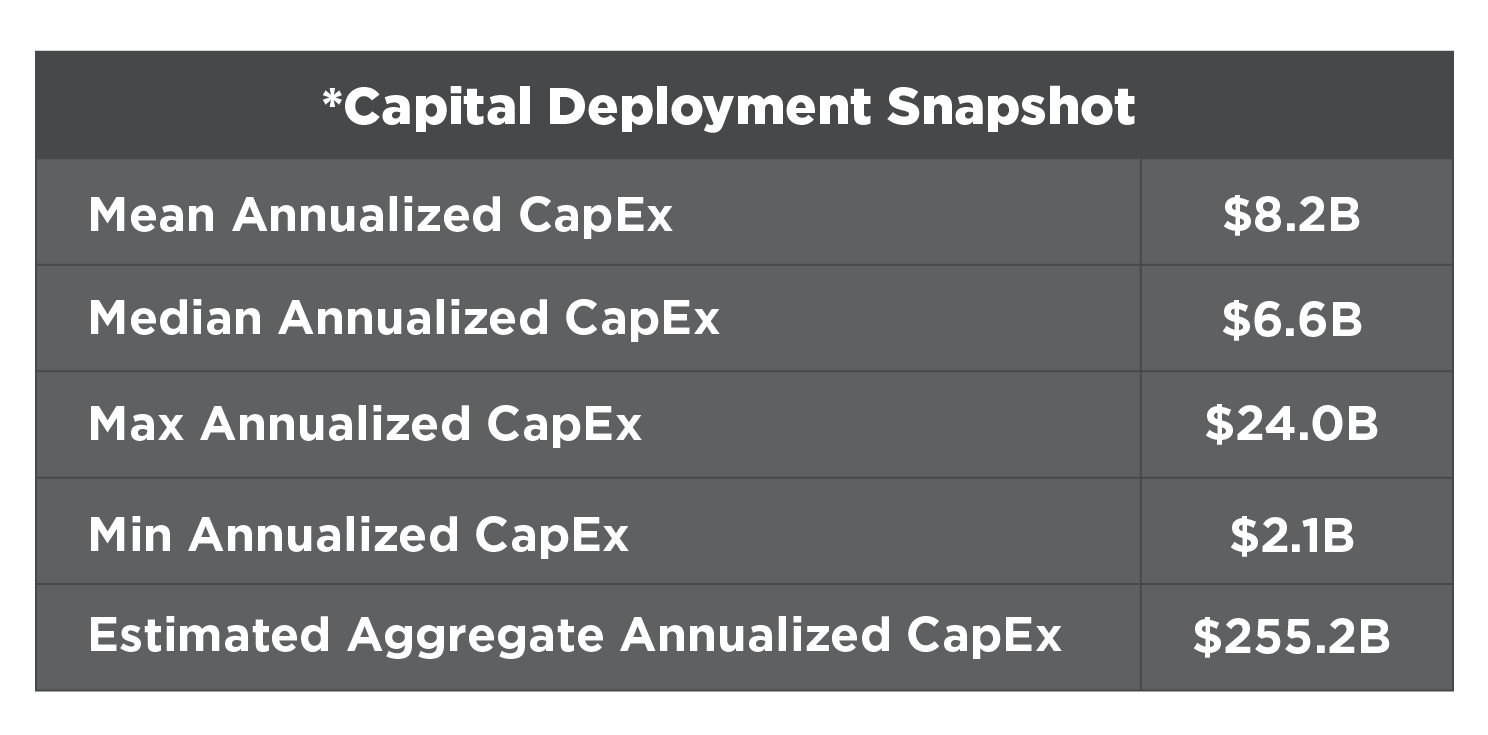
*Annualized CapEx calculated from announced capital plans divided by stated investment horizons. Panel statistics reflect values across the utilities included in the analysis.
What We Found and What's Driving the Investment
ScottMadden analyzed the most recent utility capital plans, regulatory filings, and large-load data for the largest U.S. electric utilities. Our review highlights both the scale of investment underway and the forces shaping it.

Record Capital Plans
The largest U.S. utilities plan more than $1.2 trillion in utility capital spending over the next five years, signaling that total industry investment will likely far exceed current forecasts.

Where the Money Is Going
Most utility capital spending is concentrated in new generation, generation fleet capacity upgrades, transmission and distribution modernization, and grid resilience.

Large Loads Are a Major Driver, but Not the Only One
Many utilities are seeing significant large-load growth, and it is clearly shaping capital plans. However, the scale of investment is also influenced by other major factors, including resilience needs, asset age, electrification, and regulatory expectations. Capital plans reflect the combined effect of these pressures, not just the size of a utility’s large-load queue.
Record Capital Plans
The 30 largest U.S. utilities plan close to $1.1 trillion in utility capital spending over the next five years, signaling that total industry investment will likely far exceed current forecasts.
Where the Money Is Going
Most utility capital spending is concentrated in new generation, generation fleet capacity upgrades, transmission and distribution modernization, and grid resilience.
Large Loads Are a Major Driver but Not the Only One
Key Drivers:

Large-Load Growth
Improving Resilience
Aging Infrastructure

Clean Energy Transition
Electrification

Regulatory Requirements
Together, these findings indicate that utilities are responding to a combination of pressures rather than to a single dominant driver.
The table below presents utility capital plans and infrastructure investments for large loads across several major U.S. utilities. Capital plan information reflects the most recent disclosures as of March 2026. Because these programs are rapidly scaling, some in-year updates or increases may not be captured. For the full dataset, complete the form at the bottom of this article.
Assets Managed, Horizon, Investment Highlights, and Large Load Exposure
Duke Energy
Generation, Transmission, Distribution, and Natural Gas
Horizon: 2026-2030
CapEx Plan (in billions): $103.0
Investment Highlights:
- Grid modernization and resilience
- New gas generation capacity
- Utility-scale solar generation and BESS
- Nuclear license renewals and potential SMRs
Large Load Exposure:
- 7.6 GW
- Only includes recently signed electric service agreements (ESAs)
Southern Company
Generation, Transmission, Distribution, and Natural Gas
Horizon: 2026-2030
CapEx Plan (in billions): $81.0
Investment Highlights:
- New transmission and grid resilience ($17B)
- Utility-scale solar generation and BESS ($1B)
- New gas generation capacity ($21B)
- Existing generation fleet upgrades ($3B)
Large Load Exposure:
- 16 GW through 2030
- Contracted (9GW)
- Committed (2GW)
- Late-Stage (5GW)
NextEra Energy
Generation, Transmission, and Distribution
Horizon: 2026-2030
CapEx Plan (in billions): $94.2
Investment Highlights:
- Transmission and distribution expansion (~$26.8B)
- FPL regulated generation additions (~$19.8B)
- NEER renewables and storage development (~$25B)
- Renewable repowering and nuclear fleet investments (~$10B)
Large Load Exposure:
- 9.0 GW in advanced discussions
- Meta agreements for 2.5 GW
- Google/Duane Arnold restart
- 20+ GW of large-load power interest
PG&E Corporation
Generation, Transmission, Distribution, and Natural Gas
Horizon: 2026-2030
CapEx Plan (in billions): $73.0
Investment Highlights:
- Grid hardening and wildfire risk mitigation
- Grid modernization and microgrids
- Transmission and substation upgrades
Large Load Exposure:
- 10 GW through 2035
- 8.45 GW in application and preliminary engineering
- 1.5 GW in final engineering
- 0.05 GW in construction
Exelon Corporation
Transmission, Distribution, and Natural Gas
Horizon: 2026-2029
CapEx Plan (in billions): $41.7
Investment Highlights:
- Grid modernization and resilience investments
- EV infrastructure, DERs enablement, and renewables interconnection
- AMI, automation, and digital platforms
- Sustainability and clean-energy transition
Large Load Exposure:
- 18 GW
- Only accounts for projects in an official phase of engineering with deposits paid
American Electric Power (AEP)
Generation, Transmission, and Distribution
Horizon: 2026-2030
CapEx Plan (in billions): $78.0
Investment Highlights:
- New solar, wind, and BESS projects
- New gas generation capacity
- Heavy transmission build
- Distribution network upgrades
Large Load Exposure:
- 63 GW
- Incremental contracted load by 2030; 89% data centers, 11% industrials
Edison International
Generation, Transmission, and Distribution
Horizon: 2026-2030
CapEx Plan (in billions): $41.0
Investment Highlights:
- Grid hardening and wildfire mitigation
- Transmission and distribution modernization
- EV infrastructure, DERs enablement, and renewables interconnection
- NextGen ERP and advanced metering infrastructure
Large Load Exposure:
- Expected ~30-40% load growth by 2035
- Primary driver: transportation electrification
Dominion Energy
Generation, Transmission, Distribution, and Natural Gas
Horizon: 2026-2030
CapEx Plan (in billions): $64.7
Investment Highlights:
- Coastal Virginia Offshore Wind (CVOW) farm
- Transmission and distribution modernization to serve large loads
- Nuclear life-extension and related investments
- Utility-scale solar generation and BESS
Large Load Exposure:
- 48.5 GW
- 27.4 GW with SELOA
- 11.0 GW with CLOA
- 10.2 GW with ESA
First Energy Corp.
Generation, Transmission, and Distribution
Horizon: 2026-2030
CapEx Plan (in billions): $36.0
Investment Highlights:
- Heavy transmission build
- Distribution system network upgrades and AMI
- Utility-scale solar generation and offshore wind connect
Large Load Exposure:
- 17.0 GW
- Forecast estimate beyond 2035
- 4.1 GW estimated contracted
- 12.9 GW estimated pipeline
Sempra Energy
Transmission, Distribution, and Natural Gas
Horizon: 2026-2030
CapEx Plan (in billions): $65.0
Investment Highlights:
- Oncor ($38B): system resiliency plan, transmission build and upgrades, distribution system upgrades
- SDG&E and SoCalGas ($23.5B): wildfire mitigation, distribution/transmission upgrades, gas infrastructure
- Sempra Infrastructure ($3.2B): LNG, storage, wind
Large Load Exposure:
- 38 GW expected in ERCOT planning process
- Total pipeline includes 650 active requests from LC&I customers, representing 273 GW
What Utilities Must Get Right
Below are four emerging areas of scrutiny and how utilities can get ahead.
1. Project Justification: Are We Investing in the Right Projects?
Our perspective: Utilities should establish a well-documented capital planning and allocation process where projects are consistently evaluated, prioritized, and selected based on transparent criteria.
- Create standardized business case templates tied to system needs and customer outcomes.
- Maintain clear documentation of cost-benefit analyses, alternatives considered, and scoring methodologies.
- Integrate governance checkpoints to ensure funding aligns with strategic priorities and regulatory commitments.
2. Evaluation of New Technologies: Can We Spend Smarter?
Our perspective: Integrate technology evaluation directly into your system planning framework.
- Model the potential impact of GETs, such as dynamic line ratings, advanced power flow control, topology optimization, and advanced reconductoring, and evaluate non-wires options like storage.
- Formalize a review process to document when and why these technologies were adopted or ruled out.
- Use pilot programs and cost-recovery mechanisms to accelerate learning while managing risk.
3. Leveraging Grants, Tax Credits, and Government Incentives
Our perspective: Treat external funding like a capital asset.
- Establish a dedicated grants and incentives management function responsible for scanning opportunities, submitting applications, and managing compliance.
- Maintain a central repository of grant eligibility criteria, deadlines, funding status, and reporting requirements.
- Integrate this function into capital budgeting to maximize customer benefit and minimize rate impact.
4. Execution Transparency: Can You Deliver and Prove It?
Our perspective: Build execution visibility from the ground up.
- Implement portfolio-level reporting tools that aggregate project data in real time, reducing manual intervention and errors.
- Expand tracking beyond budget and schedule to include procurement milestones, resource deployment, and risk exposure.
- Use execution scorecards to directly link investment performance to reliability, resilience, or customer outcomes.
Operationalizing Capital Excellence
The scale of planned investment will challenge utilities to deliver faster, more effectively, and with greater transparency than ever before. The focus is shifting from announcing big spending plans to proving real outcomes by driving reliability, capacity, and customer value.
ScottMadden can help utilities build the discipline and visibility to execute utility capital plans at unprecedented scale while ensuring every dollar invested advances system reliability, resilience, and performance.
Interested in more detail?
The full table includes additional utilities, such as Ameren, Consolidated Edison, Xcel, Entergy, DTE Energy, PSEG, and TVA.
To access the repository, please complete the brief form below with your name and contact information.