


Originally published in Energy Central. Co-authored by Stephen Haubrich, Wallace Kenyon, Ph.D., Director of Product, encoord, and Carlo Brancucci, Ph.D., CEO, encoord
Meeting utilities’ three core objectives of providing clean, reliable, and affordable power is more challenging than ever before. From a clean perspective, reliability and affordability considerations challenge the ability to quickly integrate large amounts of clean energy into the grid. From a reliability perspective, clean energy integration creates challenges to grid stability, requiring technical solutions and new capital investments to manage the impacts. From an affordability perspective, both clean energy investments and system reliability investments contribute to upward pressure on rates, challenging utilities’ ability to maintain affordable rates for customers.
Through a three-part series, we will look at how integrated system planning (ISP) helps utilities better manage these conflicts than traditional planning processes used by most utilities today. This first article in the series focuses on how integrated systems planning supports the utility objective of maintaining affordability for its customers.
What is ISP and How Does it Work?
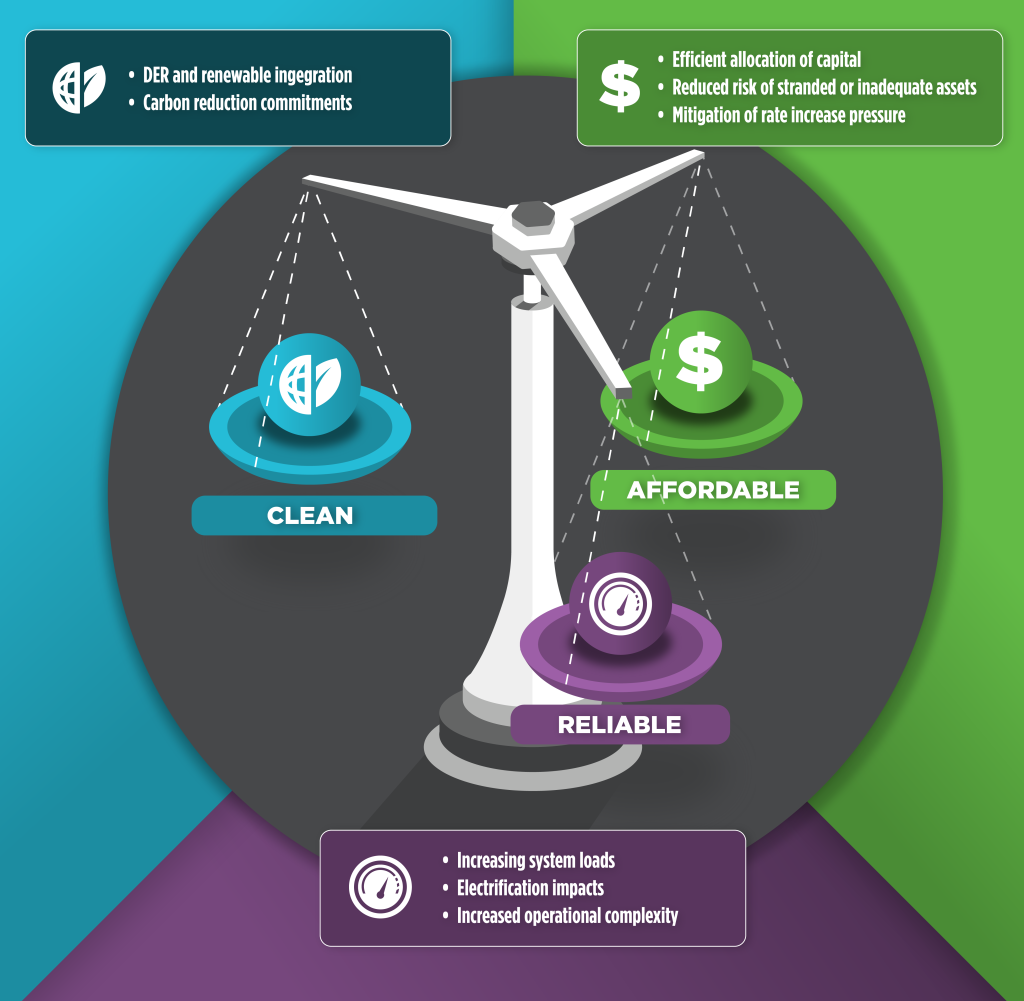
Integrated system planning is the ability to coordinate across different planning domains, such as electric generation, transmission, and distribution, as well as between electric and gas networks, with the goal of balancing the competing objectives of reliability, affordability, and decarbonization.
The specific domains included in integrated systems planning may differ across utilities, or even within the planning teams of the same utility, based on their unique operating environment, assets, and system planning objectives. However, in all cases, integrated system planning supports the need for more strategic planning practices to address today’s ever-increasing system-planning complexity and affordability challenges. Identifying solutions across asset classes and siloed planning processes can help utilities manage costs by optimizing aggregate utility investments at the system level in concert with longer-term carbon-reduction targets, reducing the risk of insufficient, underutilized, or stranded assets.
Under traditional planning approaches, identifying the most cost-effective capital investment depends upon the specific objective, or set of objectives, of the planning group evaluating the system constraint. When tasked with identifying the best solution to a system constraint, different planning groups (e.g., resource, transmission, and distribution) may each arrive at different solutions based on the objectives and criteria used for their respective planning functions. However, the most effective and least-cost solution for the system as a whole may be different from any of the solutions identified by the individual planning groups and represents the solution enabled through integrated system planning.
Why is Maintaining Affordability Such a Challenge for Utilities Today?
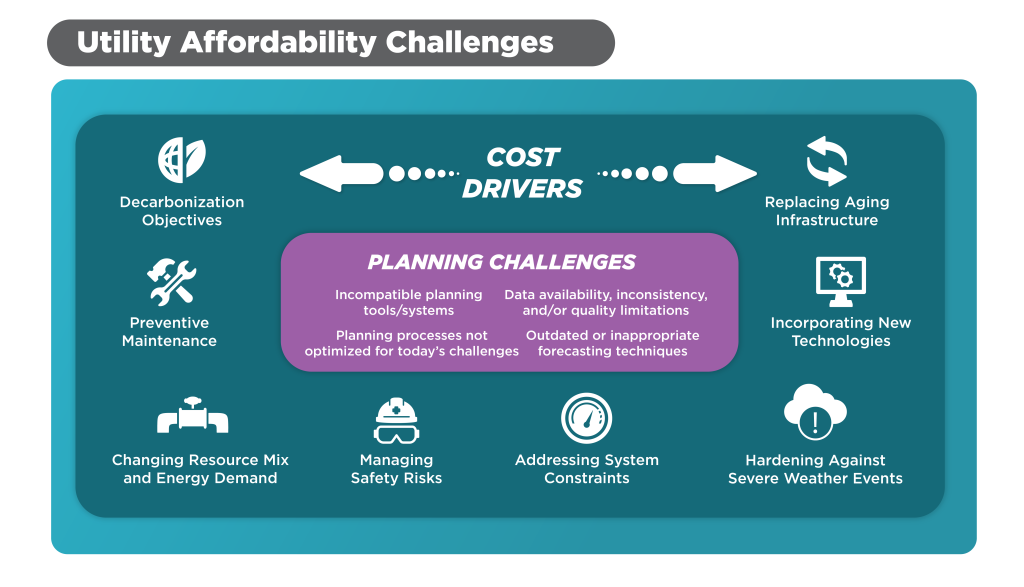
Utilities face numerous challenges and capital investment cost drivers that must be considered in their system planning processes. Some of these competing capital investment drivers include meeting decarbonization objectives, managing a changing resource mix and energy demand, incorporating new technologies, addressing system constraints, hardening the system against severe weather events, performing preventive maintenance, replacing aging infrastructure, and managing safety risks. Each of these, individually and, to a greater extent, when taken together, can represent significant capital investment needs and create pressure to increase rates.
Internally, utilities face challenges in adapting their system planning processes to address the capital investment and affordability challenges noted above. Many utilities currently have generation, transmission, and distribution planning functions designed for a variety of market constructs that developed in the late 1990s and early 2000s in an era that did not contemplate decarbonization, electrification, or DERs. As such, planning was organized to optimize for different objectives (e.g., access to low-cost generation) and is often not optimal for addressing today’s planning needs. Additionally, many utilities struggle with data availability, inconsistency, and/or quality limitations, incompatible planning tools/systems, and outdated or inappropriate forecasting techniques relative to those needed to support integrated system planning.
What are Some Specific Use Cases for Integrated System Planning?
As previously noted, there are many different combinations of planning domains that can be included in integrated systems planning, depending upon the specific needs and operating environment of each utility. Below are three use cases that illustrate how integrated system planning can be employed to meet specific planning objectives and deliver affordability benefits. These use cases can be employed in limited-scope studies to test the effectiveness of ISP on specific planning needs.
Use Case 1: Integrating Resource and Transmission Planning
Objective: Identify optimal investment strategies among competing and complementary generation, storage, and transmission assets, accounting for the costs associated with system reliability and stability impacts.
Approach: Establish lines of coordination between resource and transmission planning teams, identify required systems of record and data, define planning scenarios and required integrated modeling (e.g., capacity expansion and production cost optimizations, power flow simulations, power system dynamic simulations), perform modeling iterations and identify optimal investments considering economics and reliability.
Affordability Benefits: The economically optimal dispatch of generation assets may mask potential reliability constraints or benefits of these assets that are only captured by diligent transmission planning. These reliability constraints are uncovered through integrated system planning so the true cost and benefits of potential investments and operational solutions can be compared.
Use Case 2: Integrating Resource and Distribution Planning
Objective: Identify optimal investment strategies for competing and complementary utility-scale and distributed resources, accounting for the costs associated with system reliability impacts and required infrastructure upgrades.
Approach: Establish lines of coordination between resource and distribution planning teams, define a modeling and analytical workflow that iterates between planning models (e.g., capacity expansion and production cost optimizations, unbalanced power flow simulations), perform modeling iterations, and identify optimal investments.
Affordability Benefits: Integrated system planning brings together different planning domains, allowing the costs and benefits of utility-scale and distributed resources to be evaluated and compared within a common framework. Incorporating the impacts of distributed resources within resource planning studies is key to realizing the financial benefits of these assets, while power flow simulations of these devices at the distribution level identify infrastructure upgrades required for adequate capacity and reliability.
Use Case 3: Integrating Electricity and Gas Distribution Planning
Objective: Define optimal electrification strategies that capture the costs of upgrading electric infrastructure and the avoided costs of upgrading gas infrastructure. This use case could also consider the costs of stranded assets and potential incentives for upgrading energy infrastructure in disadvantaged communities.
Approach: Establish lines of coordination between utility gas and electric distribution planning teams, identify targeted points of planning process integration, define required modeling and analytical workflow that iterates between their respective planning models (e.g., gas hydraulic simulations and power flow simulations), perform modeling, and identify optimal investments.
Affordability Benefits: Integrated system planning uncovers the spatial impacts and required upgrades associated with the precise locations of new electric system demands. The time dependence of impacts informs the types of upgrades a planning team can consider.
As an example of use case findings, recent experience supporting Use Case 3 (above) for a large U.S. utility uncovered the affordability benefits of combined electric and gas distribution utility system planning processes. By bringing these disparate network planning processes together, the precise location, magnitude, and consumption of electrified gas customers was captured on the electric distribution system. Physical simulations were used to accurately inform any necessary upgrade requirements. In some cases, the capital cost of decommissioning portions of a depreciated gas system consisted of minimal electric distribution system upgrades, such as fuses and service transformers. In other cases, substantial upgrades to substation transformers and some subtransmission build-out were required; however, these costs were far lower than they would have been in a non-integrated planning environment, because the precise location and consumption patterns of the electrified gas demand informed a lower-cost alternative. Understanding this variance in electrification costs across a utility’s territory is critical for making strategic planning decisions about which territories to upgrade first and how to prioritize electrification adoption in preferred regions through incentives.
Additionally, recent experience supporting Use Case 1 revealed a potential need for voltage-regulation capabilities of distant non-synchronous generation assets during periods when system demand was not at peak. This highlights the need to conduct a full 8,760-hour operational analysis of systems experiencing substantial generation change, as the system’s stress points may no longer occur at the traditionally defined peak summer/light spring dispatches.
How to Get Started with Integrated System Planning
Integrated systems planning is a powerful approach to helping utilities manage costs by identifying the most cost-effective set of investments to meet near- and long-term utility objectives. There is no single way to perform integrated system planning; it can be adapted to meet the needs of each utility based on its current objectives, operating approach, and operating environment. Because of this, we recommend utilities interested in ISP consider starting their journeys with specific use cases designed to answer discrete questions.
In starting with a single use case that spans planning silos, the organization has an opportunity to both study a discrete challenge and understand what will be required to expand this coordination to other questions. A limited study will provide valuable insights about the organization, process, and tools required to perform analyses across traditional silos. These should inform a path to further integrating these functions to the benefit of reliability, affordability, and clean energy objectives.
About ScottMadden’s Energy Practice
We know energy from the ground up. Since 1983, we have served as energy consultants for hundreds of utilities, large and small, including all 20 largest. We focus on Transmission & Distribution, the Grid Edge, Generation, Rates & Regulation, Gas, and Energy Corporate Services. Our broad, deep utility expertise is not theoretical – it is experience-based.
ScottMadden, Inc.
ScottMadden is a management consulting firm focused on Transmission & Distribution, the Grid Edge, Generation, Energy Markets, Rates & Regulation, Enterprise Sustainability, and Corporate Services. We have served hundreds of utilities, large and small.
About encoord
encoord is a software company that helps energy stakeholders plan for the future, supporting integrated system planning across the industry. encoord’s Scenario Analysis Interface for Energy Systems (SAInt) is an integrated energy network planning software that enables coordination across planning domains, helping utilities, system operators, and asset developers navigate the energy transition.