

Originally published on Energy Central.
The owners and operators of electric systems are under increasing pressure to provide customers with energy that is reliable, affordable, and clean.
In the 1990s, wholesale and, in many states, retail deregulation segregated portions of the electric system in different ways across the country, leading to siloed system planning organizations. As FERC, state regulators, and other stakeholders made decisions to further reliability and affordability, the entities responsible for providing electric service-from RTOs/ISOs to local utilities-made decisions about how to plan the system to align to these two objectives. In many regions, planning functions for generation, transmission, and distribution became disconnected as they focused on optimizing within their respective functions for reliability.
In recent years, we have added clean energy objectives to the mix as states and regions committed to net-zero GHG targets, 100% renewables, and RPS standards. In adding this third objective, the industry is finding that planning within electric siloes, rather than integrated systems planning, is insufficient. For instance, the operating characteristics of utility-scale renewable resources and the locations where they perform best require that the transmission system expand to accommodate them. Distributed energy resources (DERs) at the distribution level can affect transmission assets and may ultimately alter the need for wholesale generation. FERC Order 2222 contemplates these resources playing an active role in wholesale markets.
Many utilities are recognizing that continuing to plan within generation, transmission, and distribution rather than across these functions and assets will lead to suboptimal results in the areas that the industry cares most about-reliability, affordability, and clean energy. This brings us to the question of why planning across these functions is difficult. As previously mentioned, these functions were often kept separate for very good reasons, whether due to market structures and the divestiture of generation in wholesale markets, or to regulatory constructs that incentivized the separation of transmission (e.g., formulaic ratemaking and incentive treatment). We now have a system that is often optimized as discrete functions rather than through integrated systems planning. These may have different rate treatments, and the assets may have different owners. In some cases, transmission and distribution have different ratemaking constructs and even different ROEs, incentivizing investment in one set of assets or the other.
The way we plan the electric system needs to evolve to accommodate both new requirements and new resources (renewables, DERs), and this new paradigm is often referred to as integrated systems planning. This approach increases coordination among system planning processes that have been largely siloed, with the goal of planning infrastructure to meet reliability, affordability, and decarbonization objectives concurrently. There is no single way to implement integrated system planning, but common approaches include greater organizational alignment of planning functions, updated, better-aligned processes, and advanced tools that enable evaluation of disparate system impacts. The focus of this article is organizational considerations.
How Are These Functions Organized Today?
In a recent study performed by ScottMadden, we examined the organization structures through which integrated systems planning is performed and found the following:
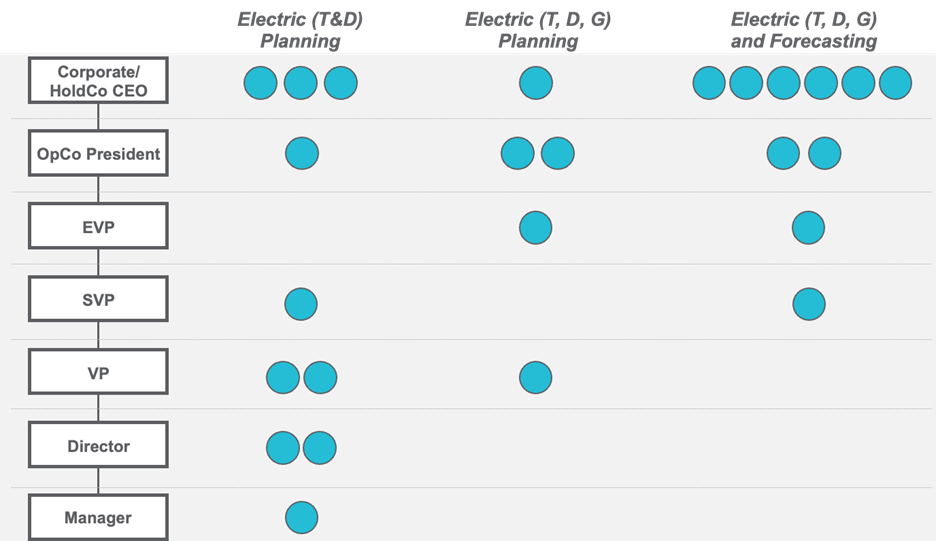
- For companies that own generation, transmission, and distribution, the first place in the organization where those planning functions have a common executive varies significantly and may not be until the president or CEO. In many companies, transmission and distribution report to separate executives, again lacking a common executive until the most senior levels. Put another way, the ultimate arbiter for alignment or coordination across these functions is often one of the most senior executives in the company.
- In some cases, as with independent transmission companies or generation and transmission cooperatives, the executives leading transmission and distribution planning may reside in entirely different companies.
- Load forecasting is often outside planning organizations and may report into organizations such as regulatory or finance.
- At the other end of the spectrum, we found a handful of companies where transmission and distribution report to a lower level in the organization (VP or below), and these groups actively coordinate transmission and distribution solutions for the benefit of customers and reliability. Importantly, in one case, the VP of T&D planning rationalized solutions across the two project portfolios to ensure the company’s overarching goals were being met.
- One company had consolidated all of its planning functions (generation, transmission, and distribution) under a single VP to begin aligning planning practices.
The graphic below, developed from ScottMadden’s benchmarking of integrated system planning, illustrates the first level in the organization into which the identified functions report. The left column shows transmission and distribution, the middle column adds generation, and the third column includes electric planning and load forecasting.
Myriad studies are underway to determine how best to address these disconnects across a highly complex and physically interconnected system-they attempt to solve data or process challenges or focus on a very specific question (e.g., integration of DERs into wholesale markets). The challenge in integrated systems planning is knowing where to begin. As mentioned above, one company we interviewed opted to start by placing all planning functions under a single VP. Not every organization can do this.
Where to Start?
We suggest some simple questions to start:
- What is the most urgent issue to be addressed in integrated system planning? For instance:
- Optimizing spend across transmission and distribution;
- planning transmission in anticipation of the generation portfolio;
- using DER to offset the need for transmission investment
- Which organizations need to participate in performing this study?
- How can we establish governance over a study to access the right people, systems, and data?
ScottMadden recommends starting with a single use case to inform further integrated system planning. Such a study might assess opportunities to use DERs to offset the need for additional transmission capacity. In this case, even if transmission and distribution report to different executives, a team could be appointed to identify the systems, data, and people that would need to participate in this study. The learnings from this pilot could inform a plan to further integrate transmission and distribution to optimize the investment portfolio in other ways. This plan could become the initial step toward integrated systems planning for transmission and distribution.
Organizational changes are difficult. Proving out a single use case, and ideally using the findings with regulators or stakeholders, could both demonstrate the value of integrated systems planning and lay the groundwork for further organizational evolution.
In Conclusion
Meeting myriad objectives of the clean energy transition requires optimization of planning across, rather than within, traditional siloes. Aligning planning functions within an organization enables integrated systems planning, which is needed to meet our reliability, affordability, and clean energy goals.
ScottMadden is actively working with our clients to evolve integrated systems planning and enable the clean energy transition.
Note: While this article focuses on the integration of electric system planning, integration across electric and gas systems is becoming increasingly urgent. We will address this topic in a separate article.