
- Establish an enterprise-wide data center strategy defining target project types, preferred locations, acceptable concentration levels, and minimum community benefits.
- Develop a portfolio of pre-screened sites using consistent criteria for power deliverability, transmission contingencies, water availability, fiber access, land use, emissions, and permitting.
- Provide phased service options—such as smaller initial capacity, interim non-firm service, or customer-supplied resources—rather than promising the full ultimate load immediately (see the Operational Flexibility section below).
- Use a cross-functional team to assess projects, involving economic development, forecasting, planning, regulatory, finance, operations, legal, and community relations.
- Establish an enterprise-wide data center strategy defining target project types, preferred locations, acceptable concentration levels, and minimum community benefits.
- Develop a portfolio of pre-screened sites using consistent criteria for power deliverability, transmission contingencies, water availability, fiber access, land use, emissions, and permitting.
- Provide phased service options—such as smaller initial capacity, interim non-firm service, or customer-supplied resources—rather than promising the full ultimate load immediately (see the Operational Flexibility section below).
- Use a cross-functional team to assess projects, involving economic development, forecasting, planning, regulatory, finance, operations, legal, and community relations.
- Establish an enterprise-wide data center strategy defining target project types, preferred locations, acceptable concentration levels, and minimum community benefits.
- Develop a portfolio of pre-screened sites using consistent criteria for power deliverability, transmission contingencies, water availability, fiber access, land use, emissions, and permitting.
- Provide phased service options—such as smaller initial capacity, interim non-firm service, or customer-supplied resources—rather than promising the full ultimate load immediately (see the Operational Flexibility section below).
- Use a cross-functional team to assess projects, involving economic development, forecasting, planning, regulatory, finance, operations, legal, and community relations.
- Establish an enterprise-wide data center strategy defining target project types, preferred locations, acceptable concentration levels, and minimum community benefits.
- Develop a portfolio of pre-screened sites using consistent criteria for power deliverability, transmission contingencies, water availability, fiber access, land use, emissions, and permitting.
- Provide phased service options—such as smaller initial capacity, interim non-firm service, or customer-supplied resources—rather than promising the full ultimate load immediately (see the Operational Flexibility section below).
- Use a cross-functional team to assess projects, involving economic development, forecasting, planning, regulatory, finance, operations, legal, and community relations.
- Establish an enterprise-wide data center strategy defining target project types, preferred locations, acceptable concentration levels, and minimum community benefits.
- Develop a portfolio of pre-screened sites using consistent criteria for power deliverability, transmission contingencies, water availability, fiber access, land use, emissions, and permitting.
- Provide phased service options—such as smaller initial capacity, interim non-firm service, or customer-supplied resources—rather than promising the full ultimate load immediately (see the Operational Flexibility section below).
- Use a cross-functional team to assess projects, involving economic development, forecasting, planning, regulatory, finance, operations, legal, and community relations.
- Establish an enterprise-wide data center strategy defining target project types, preferred locations, acceptable concentration levels, and minimum community benefits.
- Develop a portfolio of pre-screened sites using consistent criteria for power deliverability, transmission contingencies, water availability, fiber access, land use, emissions, and permitting.
- Provide phased service options—such as smaller initial capacity, interim non-firm service, or customer-supplied resources—rather than promising the full ultimate load immediately (see the Operational Flexibility section below).
- Use a cross-functional team to assess projects, involving economic development, forecasting, planning, regulatory, finance, operations, legal, and community relations.
- Establish an enterprise-wide data center strategy defining target project types, preferred locations, acceptable concentration levels, and minimum community benefits.
- Develop a portfolio of pre-screened sites using consistent criteria for power deliverability, transmission contingencies, water availability, fiber access, land use, emissions, and permitting.
- Provide phased service options—such as smaller initial capacity, interim non-firm service, or customer-supplied resources—rather than promising the full ultimate load immediately (see the Operational Flexibility section below).
- Use a cross-functional team to assess projects, involving economic development, forecasting, planning, regulatory, finance, operations, legal, and community relations.

Key Question
How much of the pipeline is real, and where can the utility serve it most effectively?
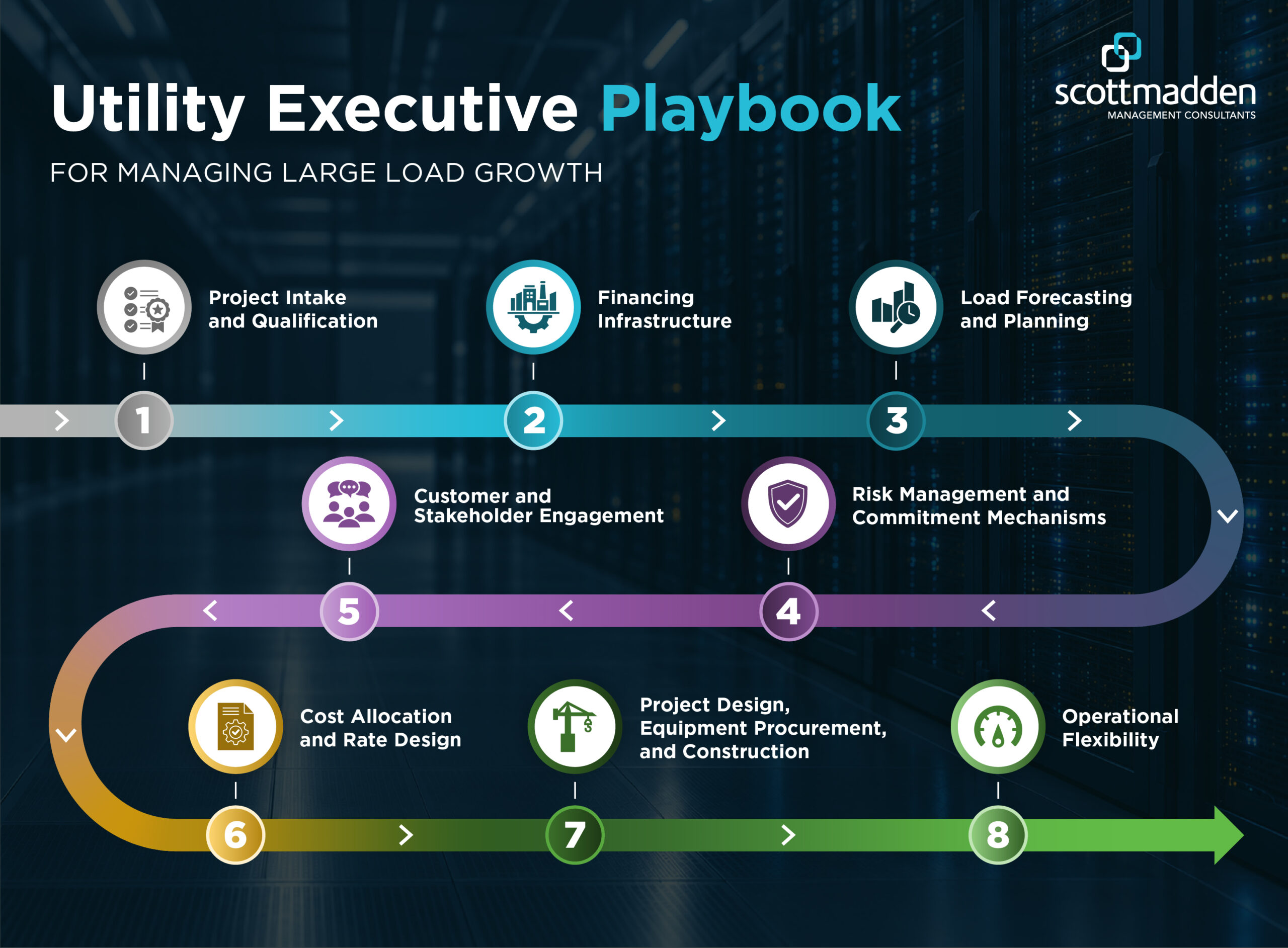
Data center requests can enter a utility’s pipeline well before the developer has secured a site, financing, permits, equipment, or an end user. Often there is significant uncertainty around the amount of power required and the timing of the need. Utilities therefore need a disciplined intake process that captures consistent information about the applicant, site, load profile, ramp schedule, development milestones, power-quality requirements, on-site generation, flexibility, and requested service date. The objective is to distinguish actionable projects from speculative inquiries before either is incorporated into forecasts or drives significant engineering and investment.
Initial intake should be followed by structured commercial and technical vetting. Utilities should verify site control, customer creditworthiness, financing, permitting status, development experience, equipment and construction plans, and the credibility of the proposed load ramp. This sets the stage for projects to advance through defined readiness gates, with increasing information, study payments, and commitments required as the utility devotes resources, reserves capacity, or initiates infrastructure development. Cross-functional reviews are critical because no single function can fully assess system impacts, customer readiness, financial exposure, regulatory implications, and community concerns. Each gate should define the information required, functional reviews to be completed, customer commitments expected, decision authority, and conditions that must be satisfied before the project advances.
Siting is one of the utility’s most important tools for reducing cost, risk, and time to power. Utilities can guide projects toward locations with sufficient—or more readily expandable—generation, transmission, and distribution capacity, while also considering other factors important to large load customers (e.g., rights-of-way, land, water, fiber, permitting, and environmental impacts). Site guidance must clearly distinguish preliminary capacity indications from studied, deliverable capacity and ultimately from a contractual commitment to serve.
- Establish an enterprise-wide data center strategy defining target project types, preferred locations, acceptable concentration levels, and minimum community benefits.
- Develop a portfolio of pre-screened sites using consistent criteria for power deliverability, transmission contingencies, water availability, fiber access, land use, emissions, and permitting.
- Establish a standardized intake process and stage-gate criteria, defining the information required for advancing projects.
- Use a cross-functional team to assess projects, involving economic development, forecasting, planning, regulatory, finance, operations, legal, and community relations.
- Screen for duplicate or overlapping requests involving the same developer, end user, campus, or alternative sites.
- Communicate capacity in progressively firmer terms, such as indicative, technically feasible, reserved, and contractually committed, to avoid treating preliminary guidance as a promise to serve.
Peer Utility Examples



Georgia Power
Maintains site-selection and site-assessment tools that help prospects identify viable locations and coordinate utility and community considerations early.
AEP
Provides interactive GIS and energy and location advisory services, helping customers screen sites across its service territories.
Dominion Energy Virginia
Uses a dedicated data center portal and standardized load-letter requirements to consistently collect location, capacity, ramp, and project information before developing site-specific power plans.

Key Question
How much capital can we commit without weakening the balance sheet or crowding out other priorities?
A project can require major investments in generation, transmission, substations, and distribution facilities years before the load reaches full utilization. Utility leaders must determine how to finance that growth while preserving credit quality, liquidity, and capacity for reliability and modernization investments. Traditional utility financing may be appropriate for facilities that create broad system benefits. Customer-specific or accelerated infrastructure should be paired with appropriate customer funding, financial assurance, or contractual protections so existing customers do not bear the downside if a project is delayed, downsized, or abandoned.
Internally generated cash and balance-sheet debt remain the foundation, but record capital plans are increasing reliance on public bond markets, common and hybrid equity issuance, private credit, and ring-fenced special-purpose vehicles. Each source carries different implications for cost, speed, asset life, regulatory recovery, and credit metrics. Higher-cost private capital is most defensible when ratepayers are insulated and where tailored terms or faster execution justify the premium.
- Stress-test credit metrics, financing headroom, and equity needs under multiple load-growth scenarios.
- Separate dedicated, directly assigned, local network, and systemwide infrastructure costs.
- Establish regulatory preapproval, tracker, or rider mechanisms where system-beneficial investments require utility financing.
- Sequence public debt, equity, private credit, and partnership structures based on cost, timing, and asset characteristics.
- Align regulatory recovery and ring-fencing strategies with rating agency and investor expectations.
- Track large-load capital commitments separately so executives and regulators can see effects on cash flow, credit, and the broader capital plan.
- Align customer financial commitments with the utility’s capital exposure before major procurement or construction commitments are made.
Peer Utility Examples


Duke Energy and Xcel Energy
Have explored private lenders for portions of their long-term infrastructure programs, illustrating how utilities are adding financing options as capital needs grow.
NiSource
Uses a ring-fenced NIPSCO Generation entity to structure agreements with data center developers while separating specified risks from other customers.

Key Question
Which megawatts belong in the base forecast, and which should remain in scenarios?
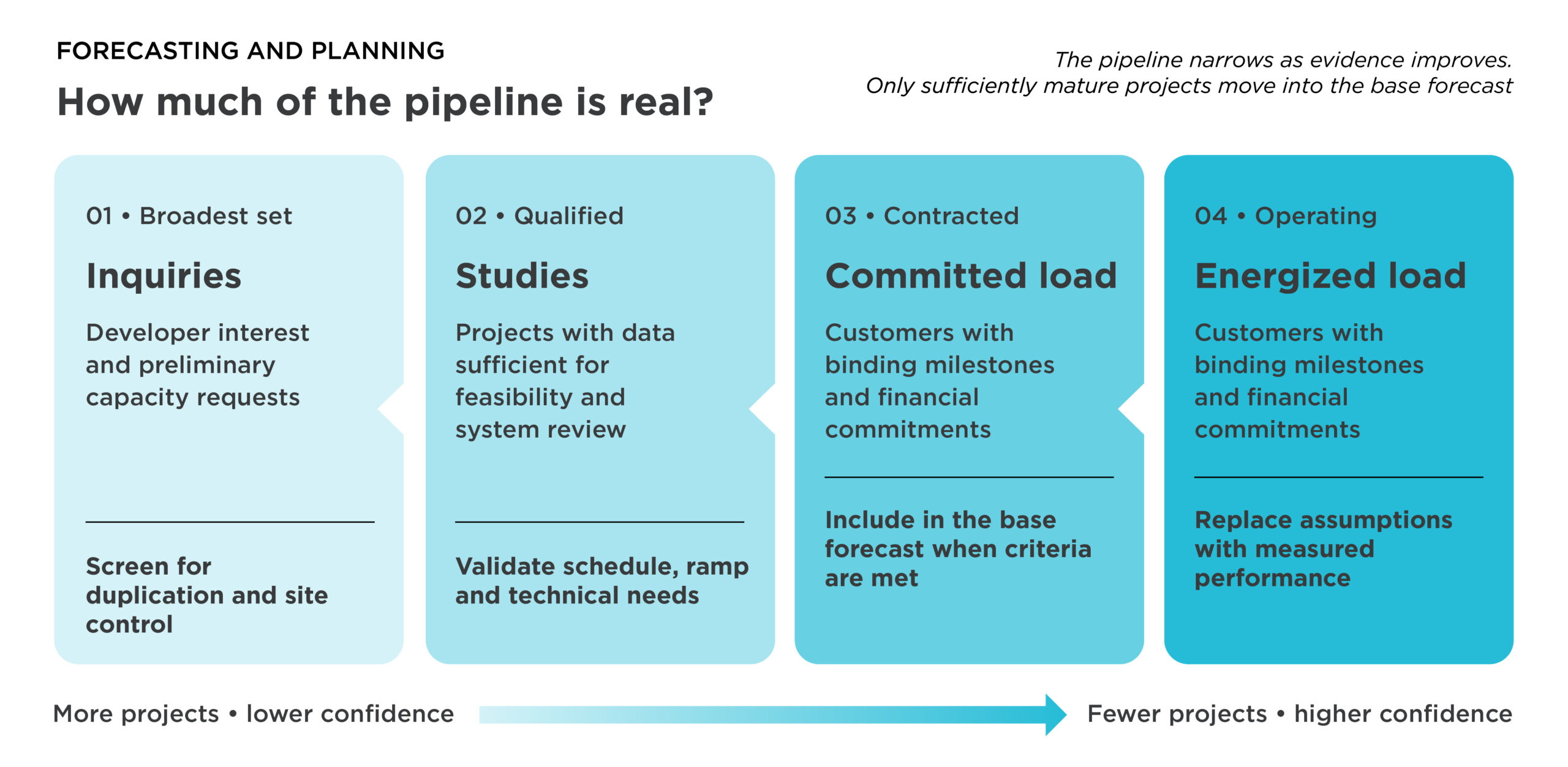
Data center forecasts are unusually difficult because requests can be duplicated across utilities, submitted before financing or land control is secured, and are highly concentrated spot loads (vs. the more diffuse adoption of air conditioning that characterized past load growth booms). AI-related load profiles, chip efficiency, and ramp rates are also evolving rapidly. The risks cut both ways. Over-forecasting can produce stranded generation and grid assets, while under-forecasting can compromise reliability and delay legitimate economic development. Executives therefore need both a range of system outcomes and a probability-weighted, project-level forecast that can keep pace with the project portfolio.
The utility should maintain distinct measures for inquiries, study requests, contract capacity, committed load, energized load, and actual demand. Only projects that pass defined readiness milestones should enter the base planning forecast. Less mature projects can be reflected in sensitivities or contingent resource portfolios. Resource, transmission, distribution, fuel, and workforce planning should use common assumptions and explicitly account for coincidence, ramp schedules, on-site generation, flexibility, efficiency trends, and the possibility that multiple requests represent the same end customer.
- Establish stage-gated forecast categories with documented inclusion criteria and probabilities.
- Require evidence of site control, permits, financing, equipment orders, construction milestones, and binding service commitments.
- Use base, high, low, delayed-ramp, cancellation, and high-flexibility scenarios.
- Perform more granular forecasts (e.g., customer level or by stage) rather than apply a single realization percentage to the entire queue.
- Update near-term forecasts quarterly and require executive review when changes trigger major capital commitments.
- Back-test forecasts against actual energization dates, ramp rates, peak demand, and energy consumption to update planning assumptions.
- Maintain one project record so forecasting, planning, and customer team leadership are working from the same project characteristic and status information.
Peer Utility Examples

AEP Ohio
Reduced its reported large-load forecast from approximately 30 GW to 13 GW after applying tariff and readiness requirements, showing how stronger commitments can screen speculative demand.
Duke Energy Carolinas
Uses updated load assumptions and a diversified portfolio while retaining the ability to adjust quantities and timing as demand evolves.
Georgia Power
Explicitly incorporated major projected load growth and evaluated the generation and transmission resources required to serve it.
Dominion Energy
Uses scenario and multi-model forecasting to project customer demand across high- and low-growth cases. It blends these into a moderate baseline and applies spatial forecasting, allowing the utility to pinpoint where load growth will occur to guide transmission and generation planning.

Key Question
Who bears the risk of delays, underuse, or project failure?
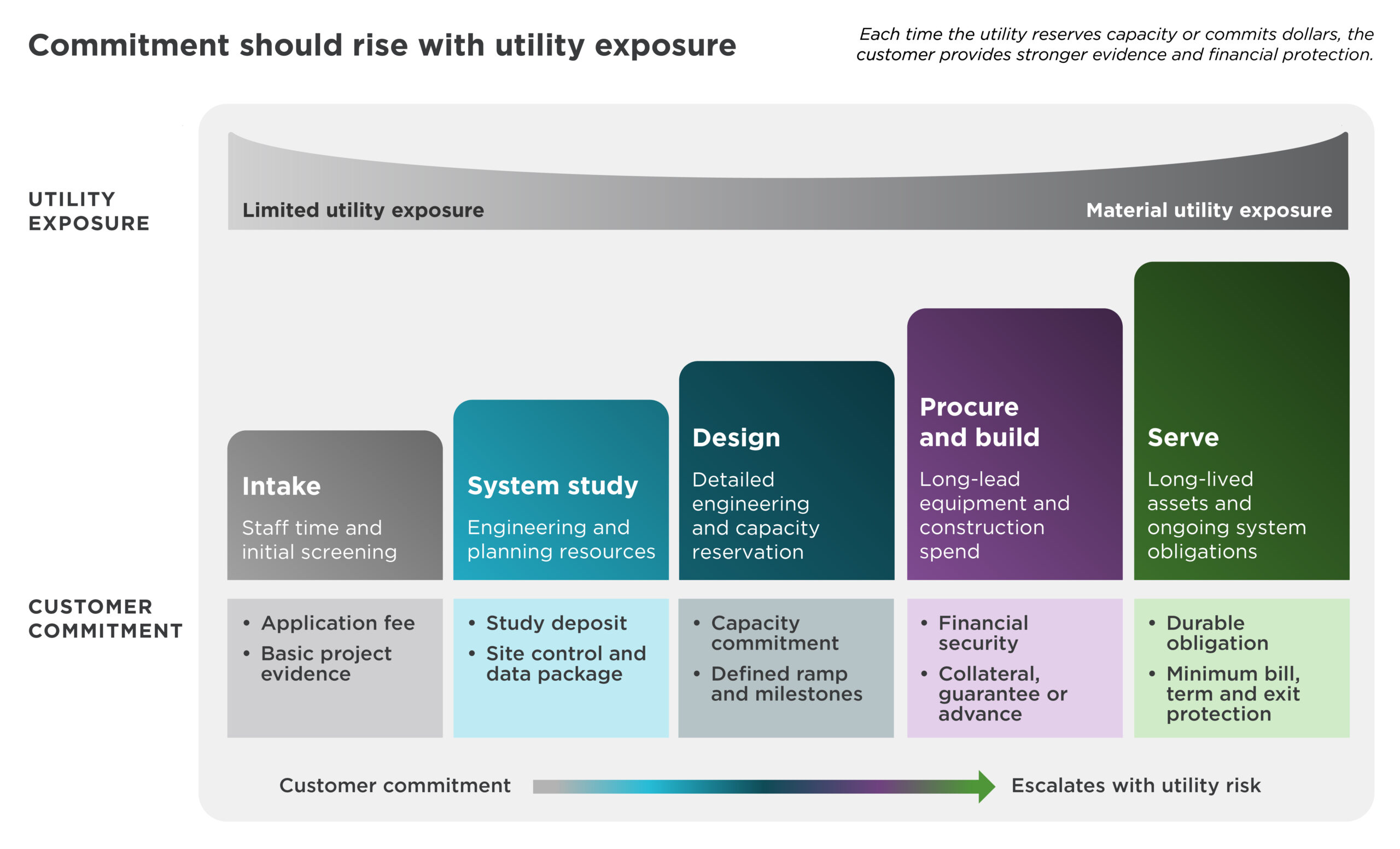
The utility’s principal commercial risks related to data center development are that a project does not materialize, ramps more slowly than forecast, reserves more capacity than it needs, terminates early, or fails after infrastructure has been committed. There are also concentration, counterparty, technology, cyber, regulatory, and reputational risks. These risks should be managed through a standard large-load service framework rather than ad hoc negotiations with each developer that can create inconsistent treatment or hidden exposure.
Customer/developer commitments should increase as the utility’s exposure increases. An initial inquiry may require only an application fee, while entry into detailed studies, procurement, and construction should require progressively stronger financial and contractual commitments. Minimum bills, take-or-pay provisions, reservation charges, exit fees, collateral, and parent guarantees serve different purposes and should be calibrated to reasonably foreseeable utility exposure rather than used punitively.
- Create a standardized readiness and risk score for every large-load project.
- Require deposits, study payments, construction advances, or contributions in aid of construction before material spending occurs.
- Use letters of credit, parent guarantees, escrow accounts, or other security appropriate to the customer’s creditworthiness.
- Model cancellation, delay, lower utilization, customer bankruptcy, and asset-reuse scenarios before capital approval.
- Include defined ramp schedules, minimum billing demand, contract terms, notice periods, and early-termination charges.
- Limit the ability to reserve multiple sites or speculative future phases without additional commitments.
- Monitor aggregate exposure by customer, parent company, geography, technology, and projected in-service year.
Peer Utility Examples


AEP Ohio
Uses a data center tariff with minimum-demand commitments, longer contract terms, collateral, and exit provisions to reduce stranded cost and nonperformance risk.
Evergy
Directly assigns interim capacity costs to customers when the customer’s load cannot be served using the utility’s existing system capabilities through an additional “Interim Capacity Adjustment” demand charge.

Key Question
Have we engaged the parties whose support is needed before key decisions are locked in?
Data center development requires coordinated engagement with both the customer and broader stakeholder community. Customer discussions should address schedule, technical design, load profile, on-site resources, sustainability, flexibility, and commercial terms. Engagement with regulators, communities, consumer advocates, local governments, water providers, environmental organizations, and existing customers should address affordability, land and water use, emissions, noise, tax incentives, employment, and infrastructure impacts. Unanswered questions can derail an otherwise viable project.
Commercial confidentiality must be protected but does not prevent disclosure of aggregate demand, system impacts, investment requirements, customer protections, and decision criteria. Early engagement gives stakeholders a meaningful opportunity to shape the approach and allows the utility to explain benefits, risks, approvals, and open issues before construction begins.
- Assign an executive sponsor and a single accountable customer lead for each major project.
- Create a stakeholder engagement plan before seeking regulatory approval or beginning visible construction.
- Publish aggregate queue, forecast, infrastructure, ratepayer protection, and project status information where confidentiality permits.
- Coordinate messaging with local governments, economic development agencies, water utilities, transmission providers, and regulators.
- Quantify employment, tax, reliability, water, emissions, noise, land use, and bill impacts; understand and clearly communicate the benefit of these projects on customer bills.
- Continue community engagement through construction and operations rather than ending it after site approval.
Peer Utility Examples


Humboldt Utilities and TVA
Local officials published project-specific information, addressing capacity, reliability, infrastructure funding, water use, noise, interruptibility, tax revenue, and expected utility revenue, an example of issue-by-issue community communication.
Avista Utilities
Maintains a data center homepage focused on reliability, cost-shifting, planning, and project benefits, giving non-data center customers a direct source of information.

Key Question
Does the tariff appropriately recover costs and risks?
Rate design should ensure revenue adequacy, follow cost causation principles, provide efficient price signals, and protect existing customers against both stranded investment and elevated power-market costs. High load-factor usage alone does not mean a project will necessarily lower rates. Whether existing customers benefit depends on available system headroom, the incremental infrastructure required and associated costs, wholesale energy and capacity cost exposure, the accuracy of the load forecast, and the relevant tariff provisions.
A dedicated large-load class may be appropriate when data centers have materially different load profiles, service requirements, infrastructure needs, or risk characteristics from other commercial and industrial customers. The complete package should be evaluated—not just the cents-per-kWh rate—including customer-specific facilities, generation and transmission costs, demand ratchets, minimum bills, capacity reservation, backup service, contract duration, flexibility credits, and termination obligations.
- Conduct an incremental and embedded cost-of-service analysis across generation, transmission, distribution, ancillary services, and customer functions.
- Test whether the tariff recovers costs under varying scenarios (e.g., expected, delayed, low utilization, early exit).
- Consider a separate large-load class or rider where material cost and risk differences exist.
- Directly assign dedicated facilities and other clearly identifiable customer-caused costs.
- Conduct periodic reporting showing actual incremental revenues, costs, utilization, and impacts on other classes.
Peer Utility Examples

Dominion Energy Virginia
Created the GS-5 large-load rate class for customers whose size and service characteristics differ from the traditional general-service population.
Georgia Power
Operates under regulatory rules that permit additional contract protections for new customers expected to exceed 100 MW, including provisions for infrastructure costs and customer commitments.
East Kentucky Power Cooperative
Uses a PSC-approved data center power tariff for facilities at or above 15 MW and a monthly load factor above 60%, requiring these facilities to enter into special contracts with EKPC and serve the local cooperative.

Key Question
What steps are on the critical path and how can they be accelerated?
When new power infrastructure is required, data center development timelines (18 to 36 months) are often shorter than utility construction timelines (5 to 10 years if new generation, transmission, and substations are required). Generation, transmission lines, substations, transformers, breakers, and protection systems require extensive design, permitting, engineering, procurement, construction, and commissioning, spanning several years.
Speed-to-power is increasingly constrained by the physical capacity to procure and build the infrastructure to serve the large loads. As noted in ScottMadden’s summer 2026 Energy Industry Update, supply deficits across transformers, switchgear, breakers, substation equipment, and cable; average Q2 2025 lead times reached 143 weeks for generation step-up transformers and 128 weeks for power transformers, while transformer prices rose roughly 80% over five years. [1] Labor is another limiting constraint: more than four in five contractors with openings reported difficulty filling hourly craft positions.[2]
Utilities should therefore manage equipment and workforce capacity across the capital portfolio, using standardized specifications, framework agreements, pooled inventories, strategic stockpiles, partnerships with Engineering Procurement Construction (EPC) firms, training pipelines, and digital tools to improve field productivity.
- Standardize substation, protection, metering, communications, telemetry, cybersecurity, and backup-generation requirements.
- Reserve long-lead equipment only after sufficient customer commitment and financial security.
- Develop strategic supplier agreements and portfolio forecasts for transformers, switchgear, breakers, cable, and protection equipment.
- Evaluate refurbishment, spare-equipment pools, mobile substations, and interchangeable designs.
- Coordinate transmission, distribution, generation, and customer construction under one program-management structure.
- Include schedule contingencies for permitting, land acquisition, right-of-way, environmental review, supply-chain delays, testing, and commissioning.
- Establish change control procedures to reassess material project changes and determine whether prior studies, assumptions, or infrastructure plans remain valid.
Peer Utility Examples

Entergy
Plans to deploy a standardized combined-cycle design to reduce engineering and execution risk and provide craft labor with years of continuous regional work, helping attract and retain skilled workers while allowing crews to become more efficient with each successive project.
Georgia Power
Operates under regulatory rules that permit additional contract protections for new customers expected to exceed 100 MW, including provisions for infrastructure costs and customer commitments.
NRG
Emphasizes transferring experienced workers’ knowledge to incoming employees to preserve quality, reduce rework, and prevent labor constraints from delaying otherwise construction-ready projects.

Key Question
How much flexibility can the utility rely on?
Data centers can reduce grid demand during constrained periods by shifting computing workloads, using storage, or transferring load to on-site generation. Co-located resources can include customer-owned generation behind the meter, dedicated utility generation, or adjacent generation connected to the bulk power system. These configurations may accelerate energization, reduce the amount of firm grid capacity initially required, and provide a bridge while permanent generation and transmission are constructed.
However, co-location does not eliminate the need for careful system planning. Customer-owned generation or storage should not automatically eliminate otherwise applicable transmission, capacity, commercial, or operating requirements. Treatment should depend on the configuration, level of grid reliance, tested performance, and approved service arrangement (including non-performance consequences). To receive planning or reliability value, backup capacity should be measurable, dispatchable, regularly tested, and governed by enforceable operating agreements. This may require utility solutions for visibility and control.
- Define flexibility products based on different generation co-location and grid service configurations with clear event limits, notification periods, response speeds, duration, restoration, and testing requirements.
- Require interval metering, real-time telemetry, baselines, measurement and verification, and secure dispatch communications.
- Incorporate flexibility into planning only after demonstrating performance and appropriate visibility/controls.
- Test flexibility and backup-power performance periodically rather than relying solely on equipment specifications or customer attestations.
- Use nonperformance charges or reduced credits when contracted flexibility is unavailable.
- Offer flexible or non-firm service as a bridge—not an implicit promise of future firm capacity.
Peer Utility Examples


Indiana Michigan Power and TVA
Included data center demand response in an agreement with Google, allowing computing load to be shifted or reduced under defined grid conditions.
EPRI DCFlex participants
Is developing and demonstrating methods for integrating flexible data center demand into grid planning and operations through its DCFlex initiative.
Texas
Requires protocols for curtailing large loads interconnected after December 31, 2025 during emergencies as part of Senate Bill 6.