


Despite years of investment in digital tools, procure-to-pay processes continue to struggle with predictable bottlenecks. Requests stall when basic details are missing. Payments are delayed when invoice information doesn’t match what’s in the system. Teams spend time tracking down answers that should be easy to find.
Modern tools may be more capable than ever, but because of this persistent friction in the process, many P2P structures can’t take full advantage of them. As Trey Robinson, partner and supply chain co-lead at management consulting firm ScottMadden, observes, organizations often deploy solutions to address isolated problems, leaving underlying workflows unchanged. John Francis, also a partner and supply chain co-lead at ScottMadden, describes the outcome as “a lot of activity, but not enough achievement,” a dynamic that limits the impact of even sophisticated tools.
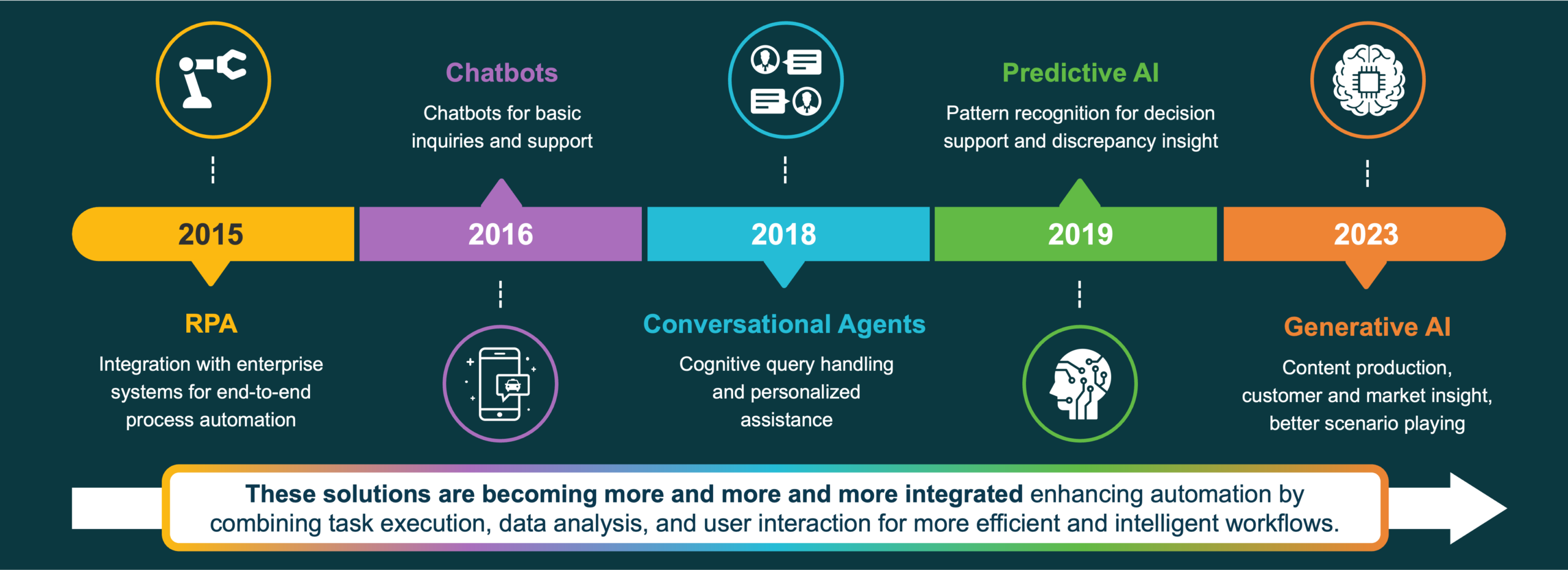
A tiered service delivery model offers a clearer structure for addressing these challenges. It channels routine needs through self-service portals, directs high-volume work to service centers, and reserves expert attention for decisions that shape value. When technology supporting each layer becomes more integrated, intelligent automation and AI tools can begin to reduce friction, speed up interpretation, and make information easier to find. Over time, these developments have begun to help mature organizations run more reliable and responsive end-to-end processes (see Figure 1).
Intelligent Automation’s (IA) Impact on Organizations over the Years
What P2P Needs From Technology
The widespread challenges inside P2P highlight a broader point: technology must do more than automate existing process steps. It needs to make the process easier to navigate, reduce the rework that absorbs so much time, and give teams a clearer view of emerging issues.
In a recent presentation to APQC’s supply chain management audience, Robinson and Francis both noted that even the most advanced tools fall short when roles are unclear, data is inconsistent, or work enters the system in unpredictable ways. Technology delivers real value only when it’s introduced into a process that can support it.
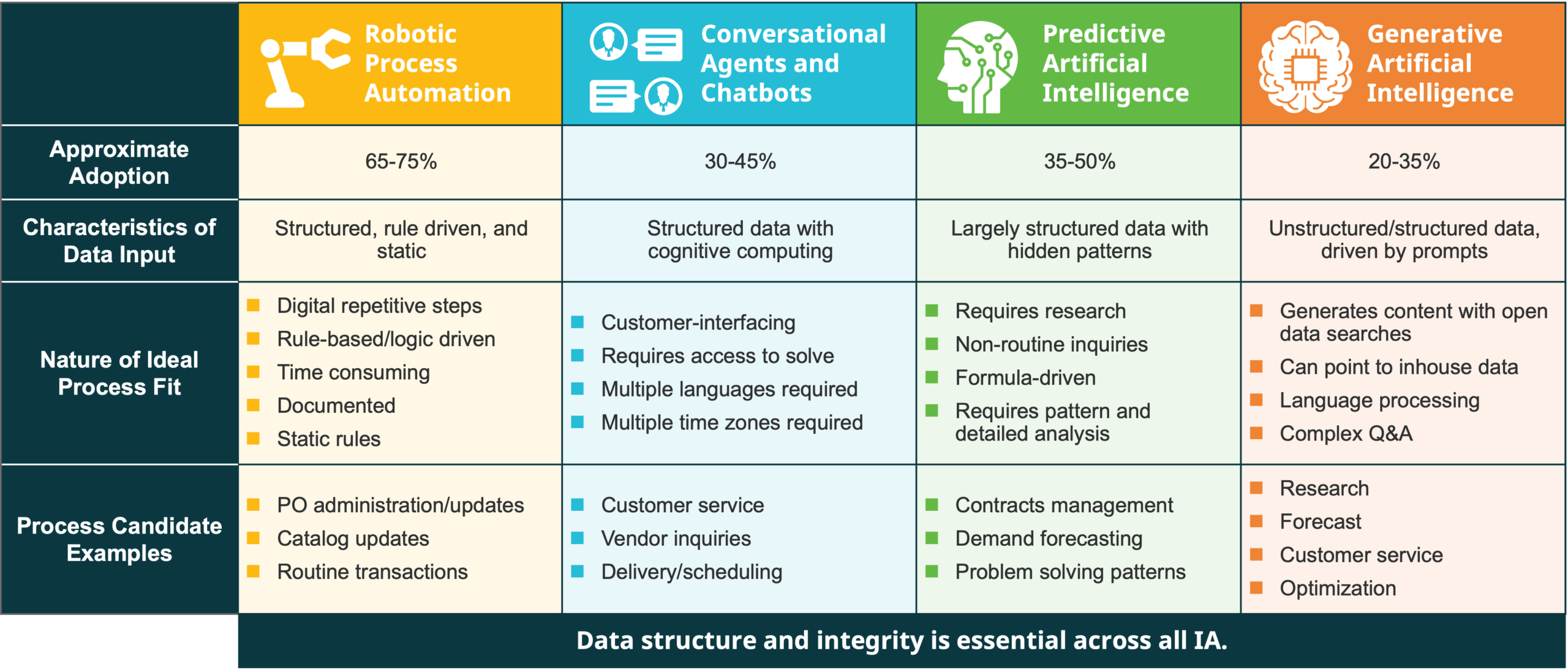
Data shared by Robinson and Francis show that adoption of sophisticated automation and AI platforms that could smooth P2P processes remains relatively low. For those organizations that can revamp underlying roles and processes, this spells opportunity to increase speed and efficiency compared with peers (see Figure 2).
Enabling IA Technologies and Adoption Levels
In mature P2P organizations, digital tools help people start requests the right way, keep routine work moving without unnecessary interruptions, and provide better insight into what is happening across procurement and finance. They can also strengthen the structure of a tiered model by making it easier to route work where it belongs.
How Technology Strengthens Each Layer of the Model
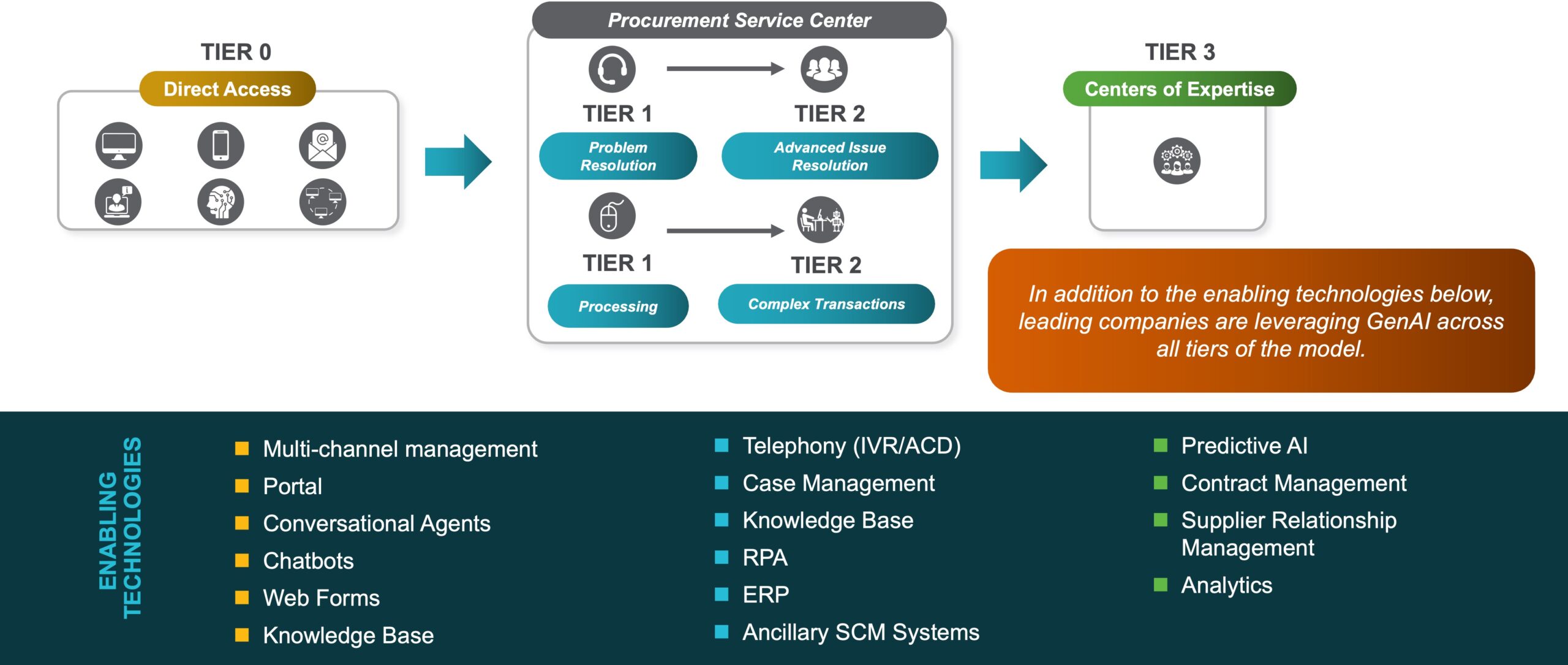
The tiered service delivery model creates a framework for organizing P2P work, and technology gives that framework the ability to function at scale. Each tier depends on different kinds of support, and the traditional tools available make it easier for organizations to match the work with the right level of expertise (see Figure 3). In addition to the traditional tools, generative AI is adding to this technology landscape and introducing opportunities across the tiers.
Enabling Technologies Across the Procurement Service Delivery Model
Tier 0: Helping People Get What They Need Quickly
At the front end, employees want straightforward answers. They want to know how to submit a request, check the status of a payment, or find the right form. Technology makes this easier. Modern self-service portals guide users through the steps, ask for the information needed to avoid rework, and provide updates without requiring someone to answer a message. Some organizations are also experimenting with generative AI to interpret questions and point users in the right direction. These tools reduce the back-and-forth that often slows P2P and free staff to focus on work that requires judgment.
Tiers 1 and 2: Bringing Order to High-Volume Activity
The procurement service center tiers handle much of the daily workload. Here, technology plays a different role. Systems help route requests, flag issues earlier, and keep information tied to the right cases. Automation supports tasks such as validating invoices, matching data, or checking compliance with established rules. Robinson emphasizes that technology works best when it feels intuitive to the people using it. When tools are easy to navigate, teams can resolve questions faster and with fewer handoffs.
Integration is key in these tiers. When the tools that manage requests, purchase orders, receipts, and invoices share information, fewer issues fall through the cracks. Service center staff gain a clearer view of what needs their attention, and the process moves with more consistency.
Tier 3: Supporting Decisions That Shape Value
The highest tier focuses on work that relies on expertise. This is where sourcing specialists, category managers, and analysts use information to guide decisions about suppliers and spending. Technology helps here by offering better insight. Analytics highlight where the process slows or where spending patterns are shifting. Predictive models can identify potential risks earlier. Generative AI can summarize documents or draft initial content for supplier communications, giving experts more time to focus on strategy.
Francis noted that when the foundational layers are steady, experts can direct more of their attention to improvement rather than troubleshooting. Technology amplifies that shift by giving them better data and fewer distractions.
When each tier has the right tools, the whole end-to-end process becomes easier to navigate. The tiers reinforce one another, and technology holds the model together.
The Expanding Role of Generative AI
Generative AI is introducing new possibilities across the P2P process, and these tools are evolving quickly. The early use cases are practical and aimed at easing the steady volume of work that flows through procurement and finance each day.
APQC’s cross-industry data shows that 71% of organizations are already using generative AI somewhere in P2P. Many are still experimenting, but early signs point to a future where manual processing declines and higher-level decision-making grows more central.
One area of progress is intake. Instead of searching through documents or navigating multiple systems, employees can ask natural-language questions and receive accurate guidance. GenAI tools can interpret what the user is trying to do, gather the details needed to start the process correctly, and direct the request to the right place. This reduces misrouted tickets and incomplete submissions.
GenAI is also beginning to streamline invoice and purchase-order support. Tools can compare documents, identify mismatches, and explain what needs attention. While humans still make the final decisions, AI shortens the time required to understand an issue. This matters because, as Francis noted, many exceptions that reach accounts payable could have been prevented earlier. GenAI helps identify these breakdowns before they disrupt payment.
Content-heavy tasks see similar benefits. Drafting sourcing language, summarizing supplier materials, and preparing initial analyses once took significant time. GenAI can produce a starting point in minutes, allowing specialists to refine and apply judgment rather than build from scratch.
Robinson notes that these tools not only improve efficiency but also make work systems more intuitive to navigate for employees.
What Leaders Need to Get Right
Technology can improve the performance of P2P, but only when the surrounding conditions support it. Robinson and Francis advise organizations to focus first on the fundamentals.
Clear roles are essential. When responsibilities are well defined, teams know what needs to happen at each stage of the process and who is accountable for it. This keeps routine work from escalating and gives experts space to focus on higher-value decisions.
High-quality data lays the foundation. Clean supplier records, consistent coding, and reliable use of systems allow automated tools to function as intended. Without this, even strong technology will produce the same exceptions and delays.
Process simplicity matters. Removing unnecessary steps makes it easier for employees to follow the workflow and for technology to support it. Leaders who revisit long-standing practices often find opportunities to streamline.
Intake must be clear. When employees know where to begin, the process runs with fewer detours and work moves more predictably through the tiers and tools used in the service delivery model.
Together, these elements create an environment in which technology can deliver sustained improvement rather than isolated fixes.
Looking Ahead
Procure-to-pay has long been a source of frustration for organizations, even as they adopt new systems and tools. The model is beginning to change. A clearer structure for the work, supported by automation, integrated platforms, and emerging AI capabilities, is giving teams better ways to work.
The organizations that benefit most pair these tools with straightforward processes, reliable data, and defined roles. When those pieces come together, P2P becomes not only easier to run but more able to support and provide value to the business.
About ScottMadden
ScottMadden has been a pioneer in corporate and shared services and has been helping supply chain organizations move beyond their conventional “order taker” role for over two decades. Through deep expertise and practical know-how, ScottMadden assists clients across the full range of supply chain processes and has the unique ability to create alignment between the supply chain function and its internal customers and stakeholders. ScottMadden has developed a supply chain maturity model to differentiate the phases that companies pass through on their journey to world class. Our solutions provide lasting improvements and allow our clients’ supply chain organizations to better serve their internal customers. Our clients span a variety of industries from energy to healthcare to higher education to retail. To learn more, visit https://www.scottmadden.com/topic/procure-to-pay/.
About APQC
APQC (American Productivity & Quality Center) is the world’s foremost authority in benchmarking, best practices, process and performance improvement, and knowledge management (KM). With more than 1,000 member organizations worldwide, APQC provides the information, data, and insights organizations need to support decision-making and develop internal skills. Learn more.
This content includes median values sourced from APQC’s Open Standards Benchmarking database. If you’re interested in having access to the 25th and 75th percentiles or additional metrics, including various peer group cuts, they are either available through a benchmark license or the Benchmarks on Demand tool depending on your organization’s membership type.
APQC’s Resource Library content leverages data from multiple sources. The Open Standards Benchmark repository is updated on a nightly cadence, whereas other data sources have differing schedules. To provide as much transparency as possible, APQC will always attempt to provide context for the data included in our content and leverage the most up-to-date data available at the time of publication.