


Between 2020 and 2024, the Biden administration enacted a historic wave of federal funding and tax incentives that drove a significant shift toward clean energy. Programs introduced through the Inflation Reduction Act (IRA) and Infrastructure Investment and Jobs Act (IIJA) unlocked billions in clean energy tax credits and financing programs supporting renewable generation, grid modernization, and resiliency investments.
With policy direction shifting since President Trump’s inauguration, highlighted by the passage of the One Big Beautiful Bill Act (H.R.1) and a series of energy-related executive orders, many clean energy incentives are now being altered, reduced, or in some cases, eliminated.
Additionally, H.R.1 introduced new support for traditional energy infrastructure and directs more than $1 billion toward dispatchable generation to repower or extend the life of these assets.
As a result, energy providers face mounting uncertainty as they navigate evolving opportunities and assess risks to capital projects that rely on these incentives.
Clean Energy Tax Credit Revisions and Other H.R.1 Implications
President Trump signed H.R.1 into law on July 4, 2025. The legislation introduced several changes to clean energy tax credits and largely rolled back the Investment Tax Credit (ITC) and Production Tax Credit (PTC) established under the IRA. The following sections summarize key changes and implications for projects and energy providers.
Accelerated Expiration of the ITC and PTC for Wind and Solar
Wind and solar projects must be placed in service by the end of 2027 to qualify for tax credits unless construction begins by July 3, 2026, which is within 12 months of H.R.1’s enactment. Projects starting construction by that date may receive 100% of the ITC and PTC, provided they enter service within four years under existing IRS safe harbor rules. These rules define the “start of construction” as either (a) incurring at least 5% of total credit-eligible project costs or (b) initiating physical work (excluding preliminary activities such as surveying or site clearing). After satisfying one of these tests, the project must continue without undue delay.
Following enactment, President Trump issued the executive order Ending Market-Distorting Subsidies for Unreliable Foreign-Controlled Energy Sources, tightening restrictions on imported solar panels, wind turbines, and battery technologies. It also directed the Department of the Treasury to update the “start of construction” guidance to prevent “artificial acceleration.”
In August 2025, the Department of Treasury released updated guidance, effective September 2, 2025, for determining when wind and solar projects are considered to have started construction. The 5% safe harbor will be eliminated and the sole method for establishing “start of construction” will be the physical work test. Physical work may occur either at the project site (e.g., excavation or installation of foundations, installation of equipment) or offsite (e.g., assembly or manufacturing of turbines). After establishing “start of construction,” energy providers must maintain a continuous program of construction.
Lastly, any wind and solar projects commencing construction after 2025 will be subject to strict and complex foreign entity of concern (FEOC) provisions that limit the percentage of materials sourced from covered nations, such as China. More details on FEOC provisions are provided in a dedicated section below.
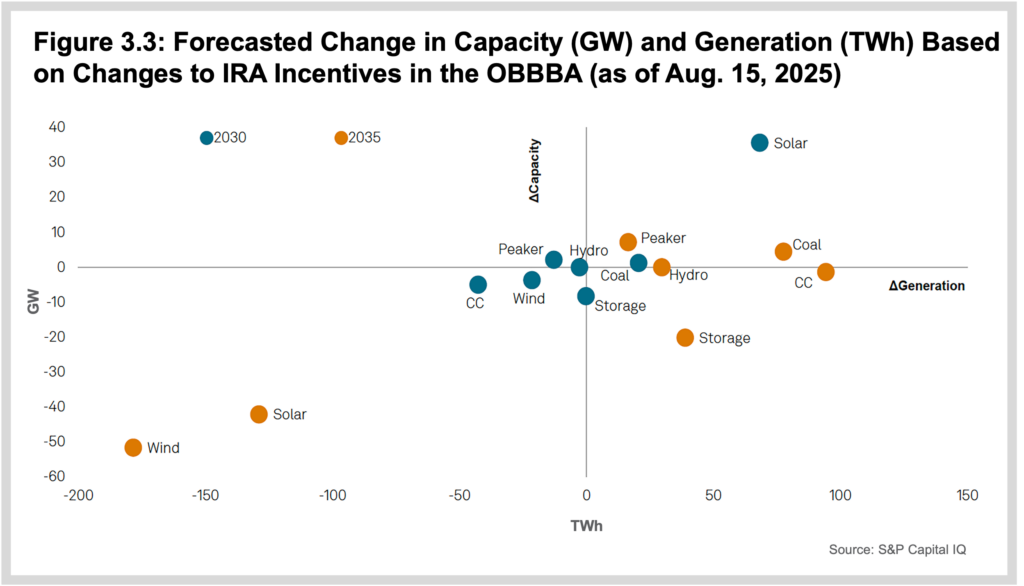
Due to these changes, both wind and solar capacity growth forecasts are lower for 2030 and 2035 (Figure 3.3).
Clean Energy Tax Credit Revisions and Other H.R.1 Implications
Phase-Out of the ITC and PTC for Other Technologies
For other qualified technologies, such as energy storage, geothermal, hydropower, and nuclear, the ITC and PTC begin phasing out in 2034. Projects beginning construction in 2034 qualify for 75% of the full credit, 50% for those starting in 2035, and none thereafter. H.R.1 also terminates the clean hydrogen PTC for any project starting construction after 2027.
Domestic Content Adder for ITC and PTC
H.R.1 increases the domestic content requirements for clean energy tax credits. For projects beginning construction after June 16, 2025, the required percentage of U.S.-sourced components rises from 40% to 45%, reaching 55% by 2027. These tighter standards, along with new FEOC provisions, aim to bolster U.S. manufacturing and supply chains. Developers must now focus more heavily on domestic sourcing to access the bonus credit.
Retention of Carbon Oxide Sequestration (COS) Tax Credit
H.R.1 retains the COS credit designed to incentivize the capture and utilization or storage of carbon dioxide to reduce greenhouse gas emissions for qualified facilities that start construction before 2033. Beginning in 2027, the credit’s value is favorably indexed for inflation. H.R.1 also aligns the credit value of enhanced oil recovery with geologic sequestration, ensuring consistent credit for each capture type.
New FEOC ownership restrictions are applied for taxable years beginning after the H.R.1’s enactment. The credit is unavailable to any taxpayers that are specified foreign entities or foreign-influenced entities as outlined in dedicated FEOC sections below.
Tightened Foreign Entities of Concern (FEOC) Provisions
H.R.1 expands eligibility restrictions for clean energy tax credits by imposing stricter FEOC rules. Beginning in tax years after July 4, 2025, any “prohibited foreign entity” is barred from claiming key tax credits, including the PTC, ITC, and COS. A prohibited foreign entity includes both “specified foreign entities” that have ties to countries such as China, Iran, Russia, or North Korea and “foreign-influenced entities,” including U.S.-based companies substantially owned or controlled by such entities through equity, debt, board control, or contractual rights. The ownership test applies annually and includes a 10-year recapture period for certain violations.
These provisions are designed to prevent taxpayer-funded technologies from being leveraged by foreign adversaries. They establish a complex vetting framework to maintain eligibility, requiring companies to assess ownership structures, board composition, and contract terms.
In addition to restrictions on FEOC involvement, H.R.1 imposes FEOC-related supply chain restrictions for projects that begin construction after 2025. For projects starting in 2026 and beyond, under the “material assistance cost ratio” test, a company is disqualified from claiming tax credits if a substantial portion of their project’s components or materials are sourced from prohibited foreign entities. From 2026 onward, each year introduces gradually tightening thresholds for allowable foreign content, ranging from 40% to 60% (or higher for certain technologies like inverters or battery components). Projects falling below these thresholds are deemed to have received “material assistance” from a prohibited foreign entity and lose eligibility. The Department of the Treasury is expected to issue safe harbor tables to aid in cost attribution, but companies bear the burden of interpreting and complying with this complex set of provisions.
These rules are meant to shift U.S. supply chains’ dependencies away from geopolitical adversaries by aligning tax credit eligibility with domestic sourcing. Companies must now carefully assess procurement strategies and contracts or risk disqualification from billions in tax credit value.
Other Implications
H.R.1 also repeals all unobligated funds from several IRA-backed Department of Energy (DOE) loan and financing programs, including $3.6 billion in credit subsidy and $40 billion in additional commitment authority for the Loan Programs Office’s Energy Financing Program, as well as $3 billion for the Advanced Technology Vehicles Manufacturing (ATVM) Loan Program.
In place of the DOE’s repealed Energy Infrastructure Reinvestment Program, H.R.1 reauthorizes Section 1706 of the Energy Policy Act as the new Energy Dominance Financing Program, appropriating more than $1 billion through September 30, 2028. The program aims to fund “traditional energy projects” and reorient federal energy financing toward fossil fuel infrastructure, including repowering or extending the life of assets that “produce, transport, or process energy and critical minerals.”
These policy changes are impacting project economics and forcing utilities and developers to re-evaluate the risks and timelines for their clean energy portfolios. Many are unsure how to navigate this new policy terrain or whether to delay projects, pivot strategies, or double down on specific funding channels.
Shifting Priorities: What Should Energy Providers Do?
In our experience navigating the uncertainties that come with federal funding opportunities, we recommend the following key actions for energy providers as they assess H.R.1 impacts on projects and facilities:
1. Re-evaluate Solar and Wind Feasibility:
- Any wind or solar project relying on clean energy tax credits will need to be scrutinized
- Given tighter deadlines, some planned projects may no longer be feasible unless construction schedules are accelerated
- Wind or solar projects should target starting construction by July 3, 2026, or commercial operation by end of 2027 to receive the credit
- Wind or solar projects that start construction before the end of 2025 will have the advantage of avoiding FEOC provisions
- With reduced tax credits for solar and wind, energy providers should re-run financial models (NPV, IRR) to reflect higher after-tax cost structures to determine feasibility
2. Consider Energy Storage Projects:
- Tax credits for energy storage remain fully intact until 2033
- Prioritizing storage deployments will help utilities manage load variability, provide deferred generation capacity, and enable them to generate additional revenue through price arbitrage
- For energy storage projects co-located with wind or solar, consider allocating as much cost to energy storage components to extend tax credit runway
- Strict FEOC provisions apply for any projects starting in 2026 and beyond, as domestic sourcing and ownership clarity is essential
3. Assess and Document Supply Chains:
- To stay in compliance with FEOC provisions for projects starting after 2025, energy providers will need to have a detailed understanding and documentation of their supply chain processes and vendors
- Even subcontractors with material assistance from a prohibited foreign entity could jeopardize tax credit eligibility
- Implementing processes to trace the origin of materials and components back to the original source is critical to avoid penalties
4. Rebalance Capital Plans:
- With solar and wind incentives reduced, dispatchable sources like natural gas and coal, along with nuclear, have become attractive and strategic options
- Planning should consider reliability and grid security under shifting policy
- Opportunities to finance fossil fuel infrastructure are now supported through the Energy Dominance Financing Program
5. Strengthening Project Execution and Compliance Measures:
- Stricter provisions will call for diligent project execution practices and dedicated processes to ensure compliance with requirements for tax incentives
- A robust program management function will be needed to ensure delivery milestones, reporting requirements, and compliance thresholds are met to receive full credit without penalty
- Tracking prevailing wages will remain a key focus for projects pursuing bonus tax credit “adders” and represents a potential compliance risk, as the administration may use prevailing wage violations to disqualify projects from receiving the credit
Opportunity Remains
With political priorities shifting and regulatory guidance evolving, energy leaders must weigh the benefits of federal incentives against compliance complexity, timing risks, and long-term policy exposure. Significant opportunity remains, particularly for organizations that can respond with agility and discipline.
ScottMadden stands ready to help. From opportunity identification to execution oversight, we provide the structure and insight needed to move forward with confidence.
Our federal funding advisory and support can help identify viable pathways. Our expertise in helping clients navigate opportunities from beginning to end and develop end-to-end federal funding strategies has proven successful with more than $1 billion in obligated funding in 2024 alone.
ScottMadden brings deep experience across every phase of federal funding strategy and execution

Tax Credit
- Eligibility
- Compliance
- Claim
- Tax Credit Closeout
Preparation
- Identify Funding (FOA/NOFO)
- Assess Client Opportunities
- Enable Program Management
Competitive Award
- Pre-Award
- Award
- Claim
- Project Closeout
No matter where you are in the process, from initial opportunity identification to post-award implementation, we've been there and delivered results for clients navigating the same terrain.
More broadly, ScottMadden has worked with a number of energy providers to improve their capital project planning processes and re-evaluate capital portfolios to align capital plans with updated incentive structures.
In addition, our experience with project management and PMO capabilities, coupled with compliance execution support of federal funding requirements, has helped clients successfully execute funded projects while maintaining compliance necessary to preserve incentives.
Contact us to evaluate your project portfolio and assess how recent policy changes may affect your funding strategy.