


Battery energy storage has moved decisively from demonstration to deployment. Utilities are adding grid-scale battery energy storage systems (BESS) to meet capacity needs, integrate renewable resources, defer infrastructure investments, improve resilience, and respond to accelerating load growth from electrification and data centers. Policy mandates, evolving wholesale market rules, declining system costs, and incentives and tax credits have further strengthened the investment case.
But as deployment accelerates, a new challenge is emerging: many utilities are adding batteries faster than they are maturing the business models, planning and operating capabilities, and implementing governance structures needed to capture their full value.
The limiting factor for utilities’ storage deployments is increasingly not the technology but the business models and organizational capabilities surrounding the assets.
Batteries can serve various needs and provide a variety of different benefits to a utility’s system, but those value streams do not materialize automatically. They depend on where assets are located, how they are dispatched, how benefits are measured, how costs are recovered, who owns operational decisions, and whether planning, regulatory, IT, finance, and grid operations functions are aligned.
The central question for utility leaders is no longer simply whether to deploy battery storage. It is whether the organization is prepared to plan, justify, operate, optimize, and scale storage to meet the needs of the enterprise and the grid.
The Utility Battery Storage Maturity Curve: From Pilot Projects to Platform Strategy
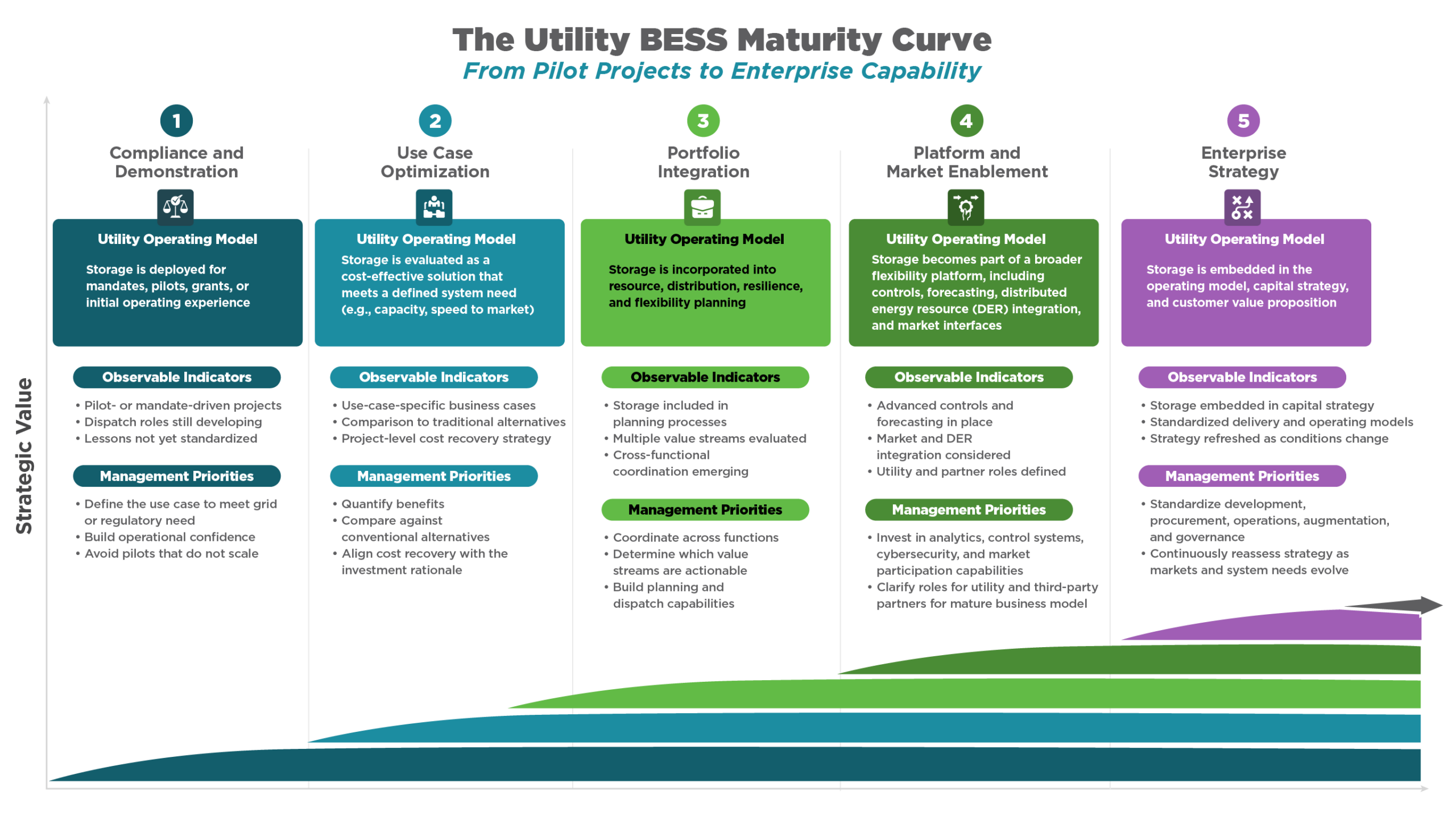
ScottMadden sees a consistent progression in how utilities mature their approach to new grid capabilities. Storage follows a similar pattern but with broader implications because it cuts across generation, transmission, distribution, markets, customer programs, and enterprise investment planning. The following maturity curve indicates the five-stage progression from pilot projects to embedded enterprise capabilities.
Where Utilities Tend to Stall
The maturity curve is not simply a sequence of deployment activity. Each transition requires a different set of capabilities, decision rights, systems, and business processes. Utilities often stall when the capabilities that supported one stage are not sufficient for the next.
Stage 1 → 2: Pilot to Business Case
The first transition is moving from storage as a learning opportunity to storage as a repeatable, disciplined investment option. Early pilots, mandates, grants, and non-wires alternatives can provide valuable operating experience, but experience alone does not establish where storage is the right solution or how it should be developed and operated at scale. Utilities can stall when lessons from early projects are not translated into repeatable use-case definitions, siting criteria, procurement specifications, dispatch expectations, cost-benefit methods, and regulatory narratives.
Poor early performance can also create additional barriers when project-specific design, vendor, safety, or operational issues reinforce broader organizational skepticism about storage. More mature utilities distinguish these execution challenges from the underlying value of the technology, incorporate lessons into subsequent deployments, and build the planning and operational capabilities needed to evaluate storage consistently against alternatives. The practical question is whether the utility can move from “we have experience with batteries” to “we know where storage is the right solution, how it should be evaluated against alternatives, and what capabilities are needed to operate it effectively.”
Stage 2 → 3: Project to Portfolio
The second transition is often one of the hardest because it requires storage to move beyond project-level justification. A utility may be able to demonstrate that a specific BESS project is cost-effective for capacity, renewable firming, distribution deferral, speed to market, or resilience but still struggle to incorporate storage consistently across resource planning, grid planning, resilience strategy, and flexibility needs. This is where business case discipline must evolve into portfolio discipline. The capability gap is not simply analytical; it is organizational. Planning groups, operations, regulatory, finance, procurement, and customer teams need a shared view of which value streams are real, which are measurable, which are operationally actionable, and which should be prioritized when objectives compete.
Stage 3 → 4: Modeled Value to Operational Value
The third transition is where many value-stacking strategies are tested. Multiple value streams may be visible in planning models, but they are only captured if the utility has the data, controls, forecasting, cybersecurity, dispatch protocols, market interfaces, and decision rights to operate storage dynamically. This is also where the role of third-party partners becomes more important. Developers, integrators, software providers, market optimization partners, and asset managers can help utilities access capabilities more quickly, but the utility still needs clarity on accountability, risk allocation, performance expectations, and how operating decisions will be made. The central challenge is moving from identifying storage value to reliably capturing it under real system, market, and operating conditions.
Stage 4 → 5: Platform to Enterprise
The final transition is embedding storage into the broader utility business model. At this stage, the question is no longer whether storage can provide flexibility but how that flexibility should shape capital planning, customer strategy, regulatory engagement, procurement models, operating standards, and long-term enterprise risk management. Utilities can stall when advanced storage capabilities remain concentrated in specific projects, functions, or platforms rather than becoming part of the way the organization plans and operates. The more mature model requires standardized development, procurement, operations, life cycle management, governance, and partner strategies, while still preserving the flexibility to adjust as technologies, market rules, customer expectations, and system needs evolve. In this stage, storage maturity is measured less by the size of the portfolio and more by the utility’s ability to translate flexibility into strategic value.
Implications for Utilities
Utilities do not need to reach the highest stage, and not every utility will move at the same pace. Market structure, regulatory environment, load growth, resource mix, and ownership model all matter. However, utilities that scale storage without maturing the surrounding business model risk underutilized assets, fragmented accountability, and missed opportunities for system-wide optimization.
- Anchor storage investments in clear system objectives and customer outcomes. Each project should connect to a defined need, such as reliability, affordability, resilience, flexibility, renewable integration, or capital deferral.
- Use fit-for-purpose cost justification frameworks. Compliance-driven, reliability-driven, and net-benefit investments require different regulatory narratives and evidence.
- Establish cross-functional governance early. Storage touches generation, transmission, distribution, IT, regulatory, finance, customer, procurement, and operations. Fragmented ownership and unclear governance erode value.
- Invest in data and control capabilities as enabling infrastructure. Forecasting, analytics, fleet management, cybersecurity, and real-time operational integration are increasingly central to storage value.
- Continuously reassess the strategy. Technology costs, market rules, interconnection dynamics, capacity accreditation, customer expectations, and system needs will continue to change.
How ScottMadden Can Help Utilities
Not every utility needs to reach the most advanced stage of storage maturity. The right level of maturity depends on the utility’s current and planned storage portfolio, market structure, regulatory environment, ownership model, and system needs. ScottMadden helps utility leaders determine the level of storage maturity required to support their portfolio, identify the highest-priority capability gaps, and build a practical road map tied to investment plans, system needs, regulatory context, and business objectives.
That assessment and road map can address several focus areas:
- Portfolio and investment strategy: Use cases, planning integration, capital allocation, and alignment with system needs
- Operating model and governance: Accountability, decision rights, dispatch ownership, organizational roles, and partner strategy
- Commercial and regulatory strategy: Procurement, contracting, benefit measurement, cost recovery, and regulatory support
- Technology, markets, and flexibility: Controls, forecasting, cybersecurity, DER/VPP integration, market participation, and optimization capabilities
The goal is not to produce a maturity score for its own sake. It is to help utilities right-size the capabilities, processes, systems, governance, and partnerships needed to turn battery storage deployment into durable enterprise value.
Engaging with ScottMadden
We support utilities across the full storage life cycle, from early use case evaluation and cost-benefit analysis to procurement strategy, governance design, regulatory support, operating model development, and portfolio integration. As storage becomes increasingly central to reliability, resilience, renewable integration, and flexibility, ScottMadden can help utility leaders move beyond project-by-project deployment and build the business models and operational capabilities required to capture long-term value.