



This article explores how AI is transforming HR service delivery and what HR leaders can do to prepare. Using ServiceNow and Workday as examples, it highlights emerging capabilities that enable smarter automation, improved employee experience, and new operating models for HR. The key question addressed here isn’t which vendor to choose, but how to apply these lessons to your organization’s AI roadmap.
From Virtual Assistants to Autonomous AI
The first wave of enterprise AI was conversational: virtual agents that let employees ask questions and complete simple requests via chat. Today, those experiences have evolved into autonomous agents that can take action. For example, AI can submit a time-off request after verifying eligibility, apply policy checks to routine expense claims, or route approvals across systems—while operating within guardrails and escalating to humans for exceptions or final sign-off.
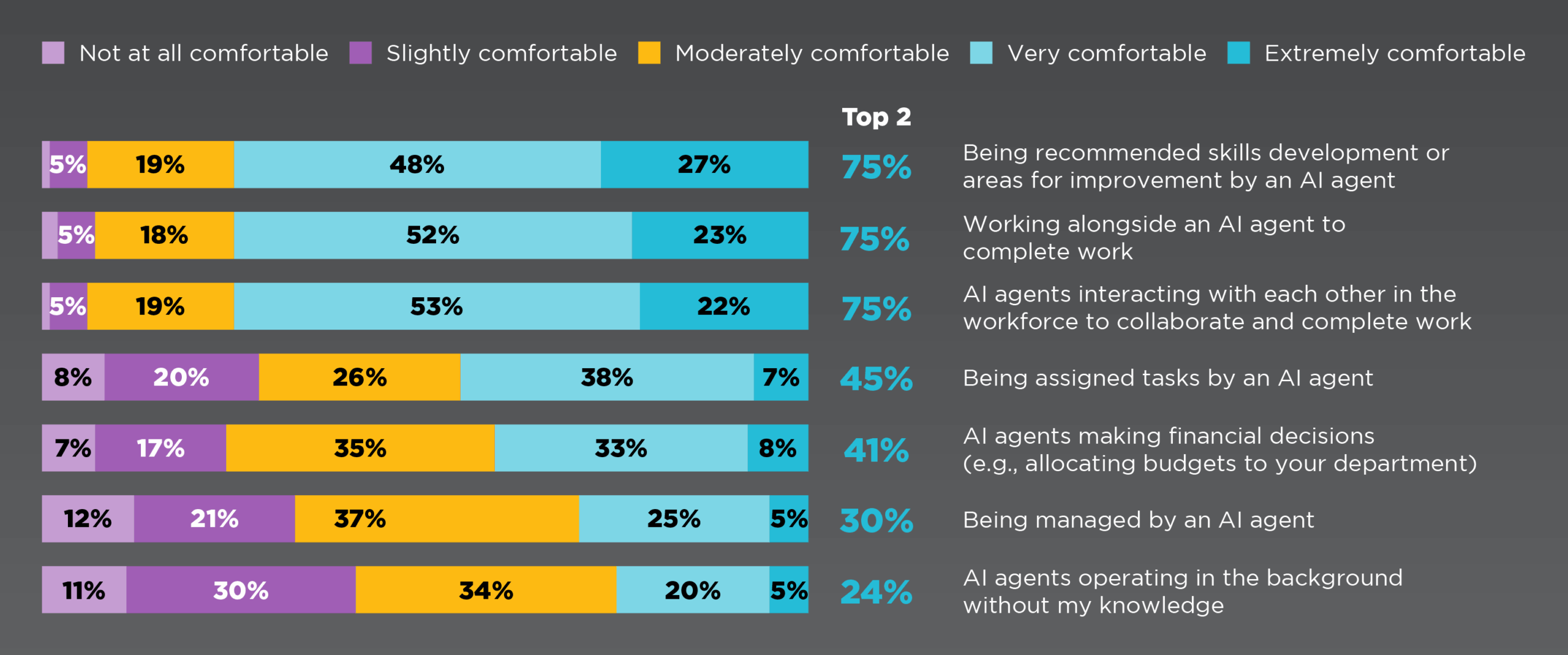
As this shift accelerates, employee comfort with different AI behaviors is a critical adoption signal and a reality check for organizations considering how much to delegate to agents. This comfort level helps determine where pilots can move quickly versus where executive-backed change programs, transparency, and stronger governance are needed.
To illustrate this point, data from Workday’s 2024 report AI Agents Are Here, But Don’t Call Them Boss (see Figure 1) show how employees feel about interacting with AI in the workplace. The survey measures comfort levels across several scenarios, from collaborative AI assistance and skills recommendations to more sensitive uses like financial decision-making or background automation.
Figure 1: Comfort Level with AI Agent Scenarios
What This Means for HR Services
AI continues to enhance HR service delivery by expanding what existing platforms can do. ServiceNow and Workday illustrate two ways AI capabilities can improve the experience for employees, managers, and HR teams. Rather than representing competing strategies, these examples show how organizations can combine automation and insight to strengthen HR operations.
Both ServiceNow’s autonomous HR support and Workday’s manager enablement demonstrate how AI can scale service delivery, reduce administrative burden, and enable more proactive HR support. Organizations can choose to adopt one or integrate aspects of both, depending on workforce needs and system maturity. In either case, the outcome is a more intelligent, responsive HR service model.
How ServiceNow Enables Autonomous HR Service Delivery
- Scale repeatable services: AI automates everyday transactions and surfaces cross-business opportunities.
- Position the orchestration layer: AI coordinates agents and automates workflows to reduce handoffs.
- Deflect routine HR cases to AI: AI handles FAQs and simple transactions, lowering Tier 1 volumes and automating triage/routing.
- Reserve human attention for complex cases: AI flags exceptions and escalates issues that need nuance or judgment.
- Integrate systems and workflows: AI-powered routing, self-service portals, and automation update records and shorten cycle times.
How Workday Streamlines HR Service Delivery
- Reduce managers’ administrative burdens: AI automates routine approvals and pre-populates forms.
- Accelerate hiring and internal mobility: AI filters applicants, drafts requisitions, and analyzes profiles to recommend best-fit roles and internal moves.
- Enhance HR case management: The new case agent automates administrative tasks to reduce resolution times, increase operational efficiency, and improve the employee experience.
- Streamline performance reviews: The performance agent analyzes performance data across applications to recommend actions and simplify review processes.
- Support frontline operations: The frontline agent cuts the time spent on staffing changes by up to 90%, enabling HR to focus on higher-value support.
While each platform focuses on distinct strengths, both illustrate how AI can reduce routine workload, improve employee experience, and strengthen HR service delivery across the organization.
Rethinking the Tiered Service Delivery Model
As AI moves into triage, routing, and drafting, HR leaders must adapt the tiered service model so roles, escalation rules, and governance remain clear. AI is being embedded across:
- Tier 0: Self-service and automated answers
- Tier 1: Routine inquiries, data input, and case handling
- Tier 2: Specialist or escalated work
AI now performs tasks once handled only by people—triage, routing, drafting, and decision support. To maintain accountability, organizations need clear escalation rules, governance, and checkpoints so HR professionals remain responsible for policy exceptions, empathy, and final approvals.
Example: In ServiceNow, AI can deflect a routine HR case, such as a benefits eligibility inquiry, by providing an automated answer, escalating only when the case requires policy interpretation or complex human judgment.
What AI-Ready Organizations Demonstrate
In HR service delivery, Workday’s illuminate agents highlight why these foundations matter: without accurate, connected data, AI cannot effectively automate case resolution, support performance reviews, or streamline frontline staffing changes.
AI-ready organizations demonstrate traits such as:
- AI oversight and governance: Defining guardrails, roles, and escalation paths as agents scale enterprise-wide
- Aligned change management across HR and IT: Coordinating stakeholders, measuring readiness, and communicating adoption goals
- A shift from transactional to strategic HR roles: Enabling teams to focus on workforce planning, strategy, and problem-solving
- Talent and skills readiness: Realigning HR skills and capabilities to effectively manage and govern AI-driven processes
The Bottom Line
The question isn’t which vendor or solution is best, but how to apply complementary AI capabilities from market leaders to your own HR service delivery model. ServiceNow’s autonomous agents and Workday’s illuminate agents both demonstrate measurable impact, helping HR deflect routine cases, accelerate resolution, and simplify staffing and performance processes. Even organizations that don’t use these specific platforms can achieve similar results through their HCM, HRIS, or CMS systems by applying these same principles.
Three Initiatives HR Leaders Should Pursue
- Map AI opportunities across Tier 0–2 processes: Identify where automation can reduce workload and build a roadmap for your organization.
- Assess employee and manager comfort with AI behaviors: Use surveys and pilots to guide adoption speed.
- Build AI governance and data readiness: Ensure safe, scalable implementation across platforms.
ScottMadden helps organizations assess AI readiness, realign HR skills and talent, integrate these platforms, and redesign HR shared services for the future of work.
Johnny Heidt also contributed to this article.